
The Magna Carta
-
Magna Carta established enduring principles that limit government power and require rulers to act according to law. Although created in 1215, its ideas continue to shape modern legal systems, influencing constitutional government, democratic accountability, and the expectation that power must be exercised lawfully and fairly.
-
Magna Carta contributed foundational ideas to human rights, including due process, lawful judgment, and protection from arbitrary imprisonment. While initially applying to a narrow elite, these principles expanded over time and now underpin modern human rights frameworks in domestic law and international agreements.
-
Magna Carta promoted the principle that no one is above the law, including the monarch. It helped inspire systems of checks and balances by limiting executive power, strengthening courts, and supporting institutional restraints that prevent the concentration and abuse of political authority.
-
The Kable case demonstrates how equality before the law developed in early Australia. The case confirmed that all individuals, regardless of background or status, were entitled to the same legal protections, reinforcing a key principle inherited from Magna Carta within Australian law.
-
One page Fact Sheet summarising key concepts about the Magna Carta. Can be used as part of Informed Civics Competition. The Magna Carta introduced the concept of equality before the law, independent judiciary, checks and balances on power and judgement before your peers.
-
Magna Carta promoted the principle that no one is above the law, including the monarch. It helped inspire systems of checks and balances by limiting executive power, strengthening courts, and supporting institutional restraints that prevent the concentration and abuse of political authority.
Magna Carta and Equality before the Law
Overview
A key principle of the Australian legal system is Equality before the Law, where every person is entitled to the equal protection that the law provides.
The Origins of Australia’s legal system and the basis for equality before the Law
In 1788 when the English established the penal colony of New South Wales, it was governed in accordance with English Law. As written in the Commentaries on the Laws of England by Sir William Blackstone; ‘those who were sent to settled colonies carried English law with them as a birthright...’ The laws of England were considered a birthright and inheritance as they provided a protection of rights and freedoms for citizens.
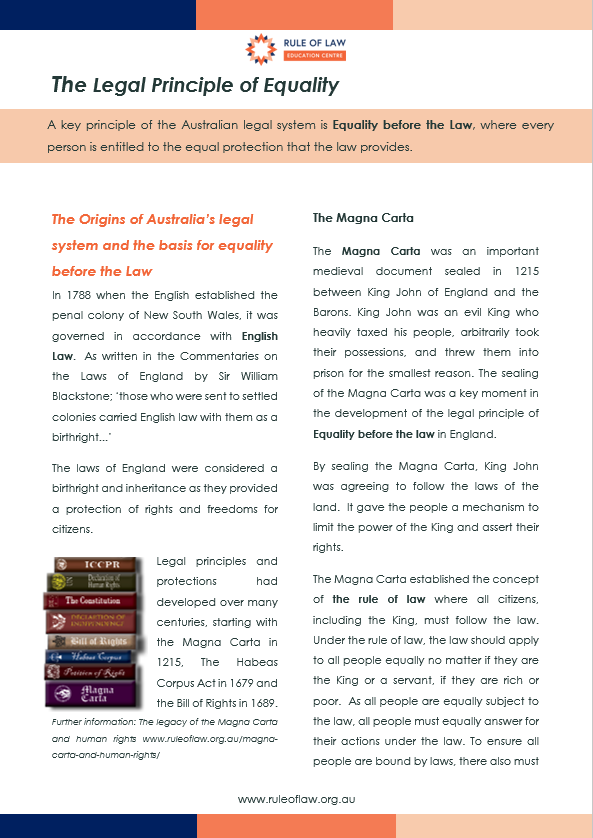
Legal principles and protections had developed over many centuries, starting with the Magna Carta in 1215, The Habeas Corpus Act in 1679 and the Bill of Rights in 1689.
The Magna Carta
The Magna Carta was an important medieval document sealed in 1215 between King John of England and the Barons. King John was an evil King who heavily taxed his people, arbitrarily took their possessions, and threw them into prison for the smallest reason. The sealing of the Magna Carta was a key moment in the development of the legal principle of Equality before the law in England.
By sealing the Magna Carta, King John was agreeing to follow the laws of the land. It gave the people a mechanism to limit the power of the King and assert their rights.
The Magna Carta established the concept of the rule of law where all citizens, including the King, must follow the law. Under the rule of law, the law should apply to all people equally no matter if they are the King or a servant, if they are rich or poor. As all people are equally subject to the law, all people must equally answer for their actions under the law. To ensure all people are bound by laws, there also must be equal access to the protections provided by the law through a fair trial and an independent and impartial judiciary.
The Magna Carta included provisions that ensured equality before the law such as:
No-one is above the law. King John agreed to follow the law of the land
Clause 1: JOHN, by the grace of God King of England, Lord of Ireland, Duke of Normandy and Aquitaine, and Count of Anjou, to his archbishops, bishops, abbots, earls, barons, justices, foresters, sheriffs, stewards, servants, and to all his officials and loyal subjects, Greetings.
Punishment could only be in accordance with the law of the land though due process and not the whims of the King
Clause 39: No free man shall be seized or imprisoned, or stripped of his rights or possessions, or outlawed or exiled, or deprived of his standing in any way, nor will we proceed with force against him, or send others to do so, except by the lawful judgment of his equals or by the law of the land
The Law is applied equally and fairly
Clause 40: To no one will we sell, to no one will we refuse or delay, right or justice.
A Qualified and Independent Judiciary, without improper influence or corruption
Clause 45: We will appoint as justices, constables, sheriffs, or bailiffs only such as know the law of the realm and mean to observe it well.
Clause 17: Common pleas shall not follow our court, but shall be held in some fixed place.
Equality before the Law and the principles from the Magna Carta that no-one is above the law and that laws must be applied equally and fairly, became key legal principles of the English justice system.
Australian Constitution
On 1 January 1901, the Commonwealth of Australia Constitution Act (1901) came into effect.
The Australian Constitution builds upon the common law and English legal principles but does not expressly require equality before the law. Instead, the rule of law forms an underlying assumption in the Constitution.
The Constitution supports the rule of law by ensuring all peoples, including those in power, are governed and bound by the laws of Australia.
Secondly, the Constitution provides for the separation of powers with an independent Judiciary to ensure the law is applied equally and fairly, including by those who make the laws (Parliament) and those who administer the laws (Executive).
International Human Rights
The UN Declaration of Human Rights, together with the International Covenant on Civil and Political Rights, expressly provide for all persons to be equal before the law.
International Covenant on Civil and Political Rights (ICCPR) Article 26 states: ‘All persons are equal before the law and are entitled without any discrimination to the equal protection of the law.’
Although Australia has signed and ratified the ICCPR, only some articles have been enshrined in statutes such as the Racial Discrimination Act 1992 (Cth) and Anti-Discrimination Act 1977 (NSW).
Related Resources
-
One page Fact Sheet summarising key concepts about the Magna Carta. Can be used as part of Informed Civics Competition. The Magna Carta introduced the concept of equality before the law, independent judiciary, checks and balances on power and judgement before your peers.
-
This classroom activity looks at legacies and how they shape society. It includes short questions on a video about the Magna Carta in Australia and then extends students to consider where the rights from Magna Carta can be seen in modern Human Rights documents today.
Explore Related Topics
-
What is the Rule of Law?
Explore resources explaining the rule of law, showing how a collection of principles works to limit government power and protect rights through clear rules, accountability and fairness.
-
Checks and Balances on Power
Explore resources on checks and balances, explaining how oversight limits power and ensures decisions remain lawful and accountable through independent scrutiny and transparent review processes.
-
Democracy
Explore resources on democracy, highlighting how accountability and representative institutions ensure power is exercised fairly and transparently through open processes, civic engagement and responsible governance.