
Law and Technology
-
This explainer outlines how technology creates new rule‑of‑law challenges, showing that expanding surveillance, data retention and social‑media‑driven harms place pressure on privacy, accountability and fair legal processes. It highlights concerns about broad metadata powers, unlawful access, cybercrime, and the difficulty of keeping legislation up to date, while also noting that technology can improve efficiency and access to justice when used transparently and responsibly.
-
This explainer outlines how media can support or undermine the justice system, showing that it can promote scrutiny, transparency and law reform, but can also create bias, fuel “trial by media,” and jeopardise fair trials through prejudicial coverage and profit‑driven reporting.
-
This explainer shows how Australian law lets certain agencies access two years of stored telecommunications metadata, why it’s useful for investigations, and why it raises rule‑of‑law and privacy concerns. It also highlights problems with self‑authorisation, risks to journalists’ sources, and ongoing debates about whether current safeguards are sufficient.
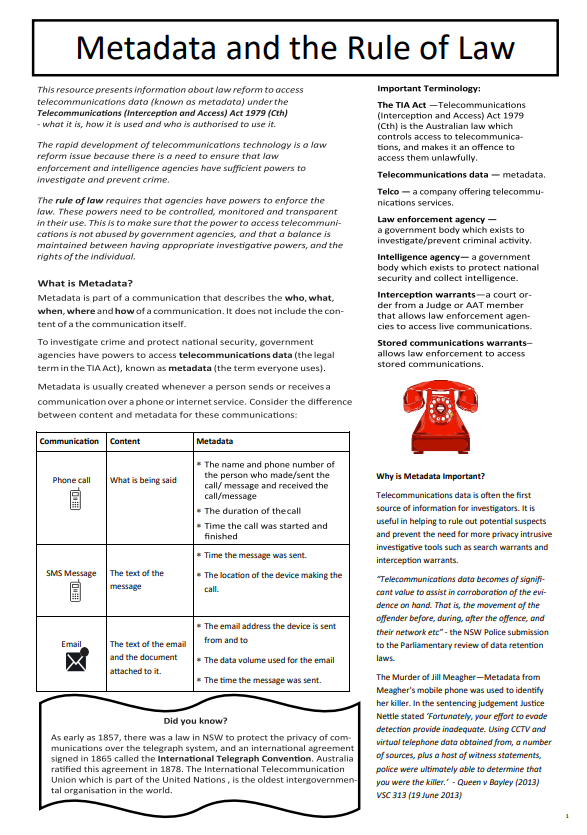
Metadata and the Rule of Law
This resource presents information about law reform to access telecommunications data (known as metadata) under the Telecommunications (Interception and Access) Act 1979 (Cth) – what it is, how it is used and who is authorised to use it.
The rapid development of telecommunications technology is a law reform issue because there is a need to ensure that law enforcement and intelligence agencies have sufficient powers to investigate and prevent crime.
The rule of law requires that agencies have powers to enforce the law. These powers need to be controlled, monitored and transparent in their use. This is to make sure that the power to access telecommunications is not abused by government agencies, and that a balance is maintained between having appropriate investigative powers, and the rights of the individual.
What is Metadata?
Metadata is part of a communication that describes the who, what, when, where and how of a communication. It does not include the content of the communication itself.
To investigate crime and protect national security, government agencies have powers to access telecommunications data (the legal term in the TIA Act), known as metadata (the term everyone uses).
Metadata is usually created whenever a person sends or receives a communication over a phone or internet service. Consider the difference between content and metadata for these communications:
Phone call
Content: What is being said
Metadata:
The name and phone number of the person who made/sent the call/message and received the call/message
The duration of the call
Time the call was started and finished
SMS Message
Content: The text of the message
Metadata:
Time the message was sent
The location of the device making the call
Content: The text of the email and the document attached to it
Metadata:
The email address the device is sent from and to
The data volume used for the email
The time the message was sent
Did you know?
As early as 1857, there was a law in NSW to protect the privacy of communications over the telegraph system, and an international agreement signed in 1865 called the International Telegraph Convention. Australia ratified this agreement in 1878. The International Telecommunication Union, which is part of the United Nations, is the oldest intergovernmental organisation in the world.
Important terminology
The TIA Act – Telecommunications (Interception and Access) Act 1979 (Cth) is the Australian law which controls access to telecommunications, and makes it an offence to access them unlawfully.
Telecommunications data – metadata.
Telco – a company offering telecommunications services.
Law enforcement agency – a government body which exists to investigate/prevent criminal activity.
Intelligence agency – a government body which exists to protect national security and collect intelligence.
Interception warrants – a court order from a Judge or AAT member that allows law enforcement agencies to access live communications.
Stored communications warrants – allows law enforcement to access stored communications.
Why is Metadata Important?
Telecommunications data is often the first source of information for investigators. It is useful in helping to rule out potential suspects and prevent the need for more privacy‑intrusive investigative tools such as search warrants and interception warrants.
“Telecommunications data becomes of significant value to assist in corroboration of the evidence on hand. That is, the movement of the offender before, during, after the offence, and their network etc.” — NSW Police submission to the Parliamentary review of data retention laws.
Case Study: The Murder of Jill Meagher
Metadata from Meagher’s mobile phone was used to identify her killer. In the sentencing judgement Justice Nettle stated:
“Fortunately, your effort to evade detection proved inadequate. Using CCTV and virtual telephone data obtained from a number of sources, plus a host of witness statements, police were ultimately able to determine that you were the killer.” — Queen v Bayley (2013) VSC 313 (19 June 2013)
Telecommunications Companies (“telcos”)
A telco is a company which offers telecommunications services such as mobile and fixed line phones, wired and wireless internet, or any other service that uses the telephone or internet networks to send messages. They are regulated by the Telecommunications Act 1997 (Cth).
Telcos and Metadata
The rapid development of smartphone technology and small handheld devices that can access the internet has changed the way telcos charge customers for services.
In the past, telcos primarily charged users for calls and SMS messages based on the length of the call and how many messages were sent. Metadata was recorded about all calls and messages and presented to the customer as a bill for service.
Since 2013 many telcos have started to offer unlimited calls, SMS, or data, meaning keeping metadata is not as important for telecos.
Intelligence and law enforcement agencies like the Australian Crime Commission and ASIO found accessing metadata was problematic because the data kept by each telco was different, as well as the different lengths of time that data was kept by each company.
Government Agencies
Since 1979, the number of agencies that can access telecommunications has expanded. Interception and stored communications warrants to access the content of communications can be applied for in the investigation of serious offences (see s5D TIA Act) - only law enforcement agencies have access to there warrants.
Access to metadata, however, has been much more widespread can can be used by many different government agencies in a broader range of investigations such as intelligence agencies, like ASIO, which collects intelligence in order to protect Australia’s national security.
Delegated Legislation
Delegated legislation is a law made by the Executive. It can only be made when an Act authorises it.
When the Data Retention Bill was first presented to the Parliament in 2015, what data was required to be kept by telcos was to be determined through delegated legislation as a regulation to the TIA Act. This meant responsibility for creating and changing what would make up the dataset would be delegated to the Attorney General or the Minister responsible for the TIA Act. While there is oversight of the regulations that are made in Parliament—many felt that the dataset was too important to be delegated and that any changes to it should be brought before the Parliament to be debated. The Government agreed to this and the dataset (which is the information and documents telcos must keep) can be found in section 187AA of the TIA Act. Any future changes to the dataset would need to be presented as a Bill, and passed by the Parliament.
Legislative Reform: Mandatory Data Retention Regime
In 2015, in response to law enforcement and intelligence agencies, mandatory retention of metadata was introduced. Telcos are required under the legislation to keep 2 years worth of metadata from all their services. The information must be stored securely and encrypted. The Act allows for approved law enforcement agencies to access metadata without a warrant, except for specific case of metadata relating to journalists.
The announcement of this legislation was met with significant criticism and concern regarding who would be able to access the metadata and the lack of protections for journalist and their sources. Many journalist and opponents of the Act argued that metadata can reveal just as much information about a person, the people they know and their habits as the content of the communication. The Attorney-General Department rejected this assessment as myth, however the ABC journalists, Will Ockendon interactive website of his metadata disputes the Attorney-generals position.
Review of the mandatory data regime
In 2019 the Parliamentary Joint Committee on Intelligence and Security (PJCIS) commenced a review of the mandatory data retention regime to assess its effectiveness. This review has been completed and the final report will be published by the end 2020.
Telephonic Communications (Interception) Act 1960 (Cth)
The Attorney General authorised the Australian Security Intelligence Organisation (ASIO) to intercept telephone conversations in the interest of the security of the Commonwealth.
The Telecommunications (Interception) Act 1979 (Cth)
This Act allowed interception of communications passing over all telecommunication. Interception were allowed at this point in narcotics investigations.
Amendments to the TIA Act
1987—State police forces and other ‘eligible authorities’ able to apply for interception warrants for investigating serious offences (S5D TIA Act)
2006—Stored Communications warrants introduced.
2007—Agencies given powers to self-authorise access to telecommunications data.
Telecommunications (Interception & Access) Amendment (Data Retention) Act 2015 (Cth)
Introduced of the “data retention bill”.
Telecommunications and Other Legislation Amendment (Assistance and Access) Act 2018
Who can access metadata?
Access to telecommunications data is regulated by Chapter 4 of the TIA Act, which permits ‘enforcement agencies’ to authorise telecommunications carriers to disclose telecommunications data where that information is reasonably necessary for the enforcement of the criminal law, a law imposing a pecuniary penalty, or the protection of the public revenue and to locate a missing person. Agencies approved to access metadata under the TIA Act self-authorise access to data. This involves a senior member of an agency giving permission to access metadata held by a telco. Some of the law enforcement agencies that can access data under section 110A of the TIA Act are:
Australian Federal Police
Australian Criminal Intelligence Commission
Australian Competition and Consumer COmmission
Department of Home Affaris
A police force of a state
Australian Commission for Law Enforcement Integrity
Australian Securities and Investments Commission
Australia Commission Against Corruption
The issues of Self Authorisation
It has been argued that there should be an independent person, separate from the law enforcement agency requesting the metadata, who approves access. It has been suggested judges could approve metadata request, or an independent body could be set up to make decisions about access to metadata. It has been argued that because of the sheer number of metadata requests made by law enforcement, that this however, would not be practical.
How often is metadata accessed?
In the 2018-2019 Annual Report for the Telecommunications (Interception and Access) Act 1979, 20 enforcement agencies made 291,353 authorisations for disclosure of historical telecommunications data.
Non authorised agencies accessing Metadata
The Data Retention Bill 2015 removed access to metadata for all agencies except intelligence, law enforcement agencies, The Immigration and Broader Protection Department, the ACCC and ASIC.
However the Attorney General has discretion to grant access to agencies that are not considered approved agencies under the Act.
In making a decision about whether any agency should get access to metadata, the Attorney-General must consider:
If access to metadata would be reasonably likely to assist in the investigation of serious contraventions of the law.
If the agency complies with Australian Privacy Principles.
Whether giving the agency the access to metadata is within the public interest
Agencies that have requested metadata include local councils (who request access to data to manage minor traffic offences, unlawful removal of trees, illegal rubbish dumping, and billposters), the RSPCA, the Environment Protection Authority, and state coroners.
Issues with Data Retention
Data retention creates tension with the concept of the rule of law. The rule of law requires that the law should be enforced. If the law enforcement do not have appropriate powers to investigate crime and enforce the law, can justice be done? On the other hand, the rule of law demands constant scrutiny of how government uses its power—to ensure it is fair, transparent and according to the law.
The fact that an enormous amount of data is kept for two years about any Australian who uses a telecommunications services, and access is self-authorised by government agencies, raises the concern that government might have access to all people’s data, not just those who are suspected of involvement in a crime.
It also raises issues about an individual’s right to privacy and civil liberties. The International Covenant on Civil and Political Rights (ICCPR) provides for the protection for individuals from arbitrary or unlawful interference with their privacy, family home or correspondence. Any assessment of the legitimacy of the mandatory data retention regime in relation to recognised international human rights, such as the right to privacy, must consider whether the laws are reasonably necessary and proportionate to achieving a legitimate purpose.
The TIA Act and the data retention regime have a legitimate purpose and contain many safeguards for people’s privacy, and a degree of transparency through reporting requirements. However this does not mean that further changes or expansion of powers to access metadata should not be questioned and the current system should be reviewed to ensure that government agencies are not reaching beyond the powers they have in the legislation.
In public hearings in February 2020 at The Parliamentary Joint Committee on Intelligence and Security (PJCIS) review of the metadata retention laws, the Commonwealth Ombudsman confirmed that law enforcement agencies are receiving URLs as part of the mandatory data retention regime, despite this practice being explicitly banned under the legislation. This example is of significant concern and was one of the major issues opponents of data retention had with the scheme.
Journalist and Data Retention
Freedom of press is an essential aspect of a society which has the rule of law. Without independent journalists to investigate issues in the public interest, many important political, legal and social issues would not be known to the public. Having independent journalism is essential to the rule of law as it helps to hold government and other law enforcement agencies accountable.
Key concern: Protection of Journalists sources
Many journalist have voiced concern that Australian metadata laws have a freezing effect on anyone who wish to give information to a journalist. The potential for enforcement agencies to discover journalist sources through metadata raises some controversial legal and ethical issues. Journalist adhere to a professional code of ethics that means they will not reveal their sources. Clause 3 of MEAA’s Journalist Code of Ethics requires confidences to be respected in all circumstance. However if law enforcement can access anyone’s metadata then they may be able to identify journalist sources. This is significant because some sources may be providing journalists with information about government behaviour and alleged corruption. The legal issue in this situation is that many such disclosures of government information is illegal, and law enforcement would have good reason to identify a leak.
“Our major fear is that the new regime will crush investigative journalism in Australia and deal a serious blow to freedom of speech and press freedom. A healthy democratic society requires robust free speech and a free and vigour press to hold governments accountable. To fulfil this critical role, the press need to be able to engage with confidential sources’. Professor David Weisbord, Chair of the Australian Press Council, Media release, 11 March 2015.
Safeguards for Journalists in the TIA Act
The Data Retention Act established the Journalist Information Warrant (JIW) scheme. This requires enforcement agencies to obtain a warrant prior to authorising the disclosure of telecommunications data to identify a journalists' source. A warrant will be granted where the Minister believes the interest in issuing the warrant outweighs the public interest in protecting the confidentiality of the source. In 2017-19 TIA Act Annual Report two JIW were issued with 58 metadata request made.
This scheme has been criticised especially in light of revelations in 2017 that the Australian Federal Police had accessed a journalist's metadata without a warrant. An audit by the Commonwealth Ombudsman found that Australian Federal Police did not destroy all copies of phone records it obtained unlawfully, without a warrant, for the purpose of identifying the journalist’s source.
Related Resources
-
This case note outlines the High Court’s decision in Comcare v Banerji, where a public servant challenged her dismissal after anonymously posting critical political comments on Twitter. The Court confirmed that the implied freedom of political communication is not a personal right but a limit on legislative power, and held that the APS Code of Conduct did not impose an unjustified burden on that freedom. The decision highlights how the rule of law balances public sector duties, political communication and constitutional limits on government power.
-
This poster forms part of the Informed Playing Card Project, showing how Australian values such as the fair go, freedom and respect for others guide civic behaviour and support a cohesive, democratic society.
-
This activity helps students identify Australia’s core civic values—such as equality, respect, freedom and responsibility—and apply them to everyday scenarios. Students discuss how these values guide behaviour, support democratic participation and connect to the rule of law.
Explore Related Topics
-
Checks and Balances on Power
Explore resources on checks and balances, explaining how oversight limits power and ensures decisions remain lawful and accountable, supporting transparency, restraint, & responsible government action.
-
Open and Free Criticism
Explore resources on open and free criticism of law & government, showing how scrutiny of institutions strengthens accountability and supports a rule‑of‑law culture.
-
Human Rights
Explore resources on human rights, outlining key protections, and how rights are balanced against government power in Australia through constitutional principles, legislative safeguards and rule‑of‑law accountability.