
Establishment of the NSW Supreme Court and Press Freedom
-
This case method resource explores Chief Justice Francis Forbes’ decision on allowing a free press in early NSW. It includes summaries, primary sources, and discussions examining tensions with Governor Darling. It highlights how an independent judiciary and free press act as checks on power, reinforcing rule of law and protecting rights in society.
-
These discussion questions guide students to evaluate early NSW governance, Governor Darling’s leadership, and the challenges of managing a penal colony. They explore reforms, the rule of law, and separation of powers, while examining tensions between Darling and Forbes, press freedom, and how checks and balances protect rights and limit government power.
-
This activity sheet is to be used in conjunction with the Checks and Balances storybook to assist students understand the story and events that led to the establishment of the NSW Supreme Court and the fight for press freedom in the early colony
-
Timeline Worksheet. Using the details from the Checks and Balances Book or their own research, students can complete this timeline of events.
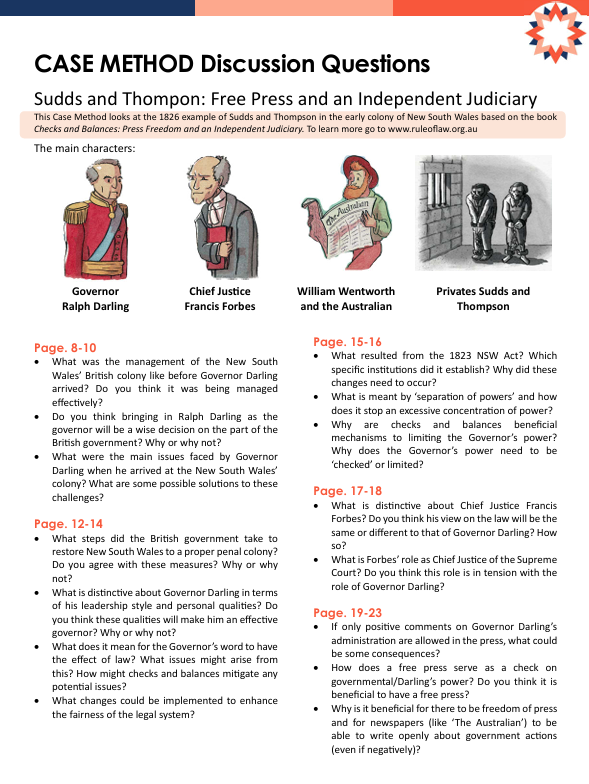
Case Based Method Questions: Establishment of the NSW Supreme Court and Press Freedom
Overview
This Case Method looks at the 1826 example of Sudds and Thompson in the early colony of New South Wales based on the book Checks and Balances: Press Freedom and an Independent Judiciary.
“If you were Chief Justice Forbes in the early colony of NSW that was filled with convicts, would you allow a free press?”
The below questions relate the the storybook, but can also be completed by watching the summary video.
Page. 8-10
What was the management of the New South Wales’ British colony like before Governor Darling arrived? Do you think it was being managed effectively?
Do you think bringing in Ralph Darling as the governor will be a wise decision on the part of the British government? Why or why not?
What were the main issues faced by Governor Darling when he arrived at the New South Wales’ colony? What are some possible solutions to these challenges?
Page. 12-14
What steps did the British government take to restore New South Wales to a proper penal colony? Do you agree with these measures? Why or why not?
What is distinctive about Governor Darling in terms of his leadership style and personal qualities? Do you think these qualities will make him an effective governor? Why or why not?
What does it mean for the Governor’s word to have the effect of law? What issues might arise from this? How might checks and balances mitigate any potential issues?
What changes could be implemented to enhance the fairness of the legal system?
Page. 15-16
What resulted from the 1823 NSW Act? Which specific institutions did it establish? Why did these changes need to occur?
What is meant by ‘separation of powers’ and how does it stop an excessive concentration of power?
Why are checks and balances beneficial mechanisms to limiting the Governor’s power? Why does the Governor’s power need to be ‘checked’ or limited?
Page. 17-18
What is distinctive about Chief Justice Francis Forbes? Do you think his view on the law will be the same or different to that of Governor Darling? How so?
What is Forbes’ role as Chief Justice of the Supreme Court? Do you think this role is in tension with the role of Governor Darling?
Page. 19-23
If only positive comments on Governor Darling’s administration are allowed in the press, what could be some consequences?
How does a free press serve as a check on governmental/Darling’s power? Do you think it is beneficial to have a free press?
Why is it beneficial for there to be freedom of press and for newspapers (like ‘The Australian’) to be able to write openly about government actions (even if negatively)?
Was it full freedom of press? Were there any limitations on the press’ freedom (from Darling or others)?
Page. 22-24
Is an annual license that requires each newspaper to apply to the Governor to be published fair? Would you support such a law? Why or why not?
Do you think this restriction on the freedom of press is justified in a colony of convicts? Why or why not?
Page. 25-28
What does the case of Joseph Sudds and Patrick Thompson (and their desire to become convicts) reveal about the perception of convict transportation back in England? Has Darling been effective at setting up the colony as a place of statutory terror?
Was Governor Darling’s treatment of Sudds and Thompson reasonable? If no, what would you do differently?
Do you agree with how Australian newspapers portrayed Governor Darling during this incident? Do you think it is good for the press to hold the Governor accountable?
Page. 29-34
Do you support Governor Darling’s attempts to control what newspapers can write? Why or why not? Is this a restriction on the freedom of the press?
How do you think Chief Justice Francis Forbes should react to the bills that Governor Darling proposed?
Do you think the freedom of the press is important? Why or why not?
Should the freedom of the press be restricted? Why or why not? What decision do you think the British government should make?
Is the colony really in danger, or are other reasons motivating Darling to submit the Bills?
Should Governor Darling break the law, or make laws that are ‘repugnant’ to other laws if he is worried about the safety of the colony? Why is it important that he, as the Governor, follows the law?
If Governor Darling breaks the law, who should hold him to account? What characteristics are needed so that there is justice?
Could there be justice if Governor Darling could direct Chief Justice Francis Forbes on how to make his decisions?
Who do you think is right – Governor Darling or Francis Forbes? Do you think the Bill should pass?
Page. 35-37
Did Francis Forbes correctly execute his duty as Chief Justice of the Supreme Court? Was Governor Darling a lawful governor? Why or why not?
In Francis Forbes’ letters he saw his role as ‘bowing to no power. ’ Why did he see this as important? What authority did Francis Forbes believe he had to follow?
Who was the most powerful person in the colony? Who had the least power?
Why can there be conflict where two bodies such as the judiciary and government are independent of each other? What or who is this conflict ultimately protecting?
As Governor Darling was held to account for (trying) to overreach his powers, how would that impact him and other later Governor’s in exercising their duties? Who would this protect?
If Governor Darling had been successful in passing his Bill for a newspaper licence, what would that mean for newspapers who report about other times the Governor oversteps his powers?
What does this case tell us about the importance of having a separation of powers in modern-day Australia?
Are checks and balances, an independent judiciary and freedom of the press important? If so, why? What are the benefits and potential shortcomings of this system?
How do checks and balances on those in power help to protect our individual rights and freedoms in Australia?
Related Resources
-
Francis Forbes (1784–1841) was the first Chief Justice of NSW, playing a key role in shaping the colony’s legal system. He upheld the rule of law, checked the Governor’s power, and supported press freedom. Known for independence and integrity, Forbes helped protect citizens’ rights and advance democratic principles in early Australia.
-
The following case about the establishment of the Supreme Court in New South Wales highlights the
importance of having checks and balances in place (such as an independent judiciary and free press) to restrain the power of the Governor and to ensure that the rule of law is universally upheld. In
doing so, this case illustrates how a separation of powers continues to protect our individual rights
and freedoms, even today. -
This case method resource explores Chief Justice Francis Forbes’ decision on allowing a free press in early NSW. It includes summaries, primary sources, and discussions examining tensions with Governor Darling. It highlights how an independent judiciary and free press act as checks on power, reinforcing rule of law and protecting rights in society.
-
These discussion questions guide students to evaluate early NSW governance, Governor Darling’s leadership, and the challenges of managing a penal colony. They explore reforms, the rule of law, and separation of powers, while examining tensions between Darling and Forbes, press freedom, and how checks and balances protect rights and limit government power.
Explore Related Topics
-
Independent and Impartial Judiciary
Explore resources on an open, independent and impartial judiciary and its role in delivering fair justice.
-
Freedom of Speech
Explore resources on freedom of speech in Australia, outlining how it supports democratic debate, accountability, the protection of individual rights, and a rule-of-law culture.
-
First Civil Case in NSW: The Lost Parcel
On the First Fleet, a lost parcel sparked Australia’s first civil lawsuit. In Cable v Sinclair (1788), convicts Henry and Susannah Kable successfully sued a powerful ship’s captain.