
Establishment of the NSW Supreme Court and Press Freedom
-
The book, ‘Checks and Balances’ tells the true story about the establishment of the Supreme Court in New South Wales. It looks at the clash between Chief Justice Forbes and Governor Darling and highlights the importance of having checks and balances in place (such as an independent judiciary and free press) to restrain the power of the Governor and to ensure that the rule of law is universally upheld. I
-
Francis Forbes (1784–1841) was the first Chief Justice of NSW, playing a key role in shaping the colony’s legal system. He upheld the rule of law, checked the Governor’s power, and supported press freedom. Known for independence and integrity, Forbes helped protect citizens’ rights and advance democratic principles in early Australia.
-
Ralph Darling (1772–1858) was a British military officer and Governor of NSW (1825–1831). He introduced administrative and financial reforms but ruled with strict, military-style authority. Though credited with improving governance, critics viewed him as authoritarian and dismissive of legal rights. He was later investigated, exonerated, and knighted before his death.
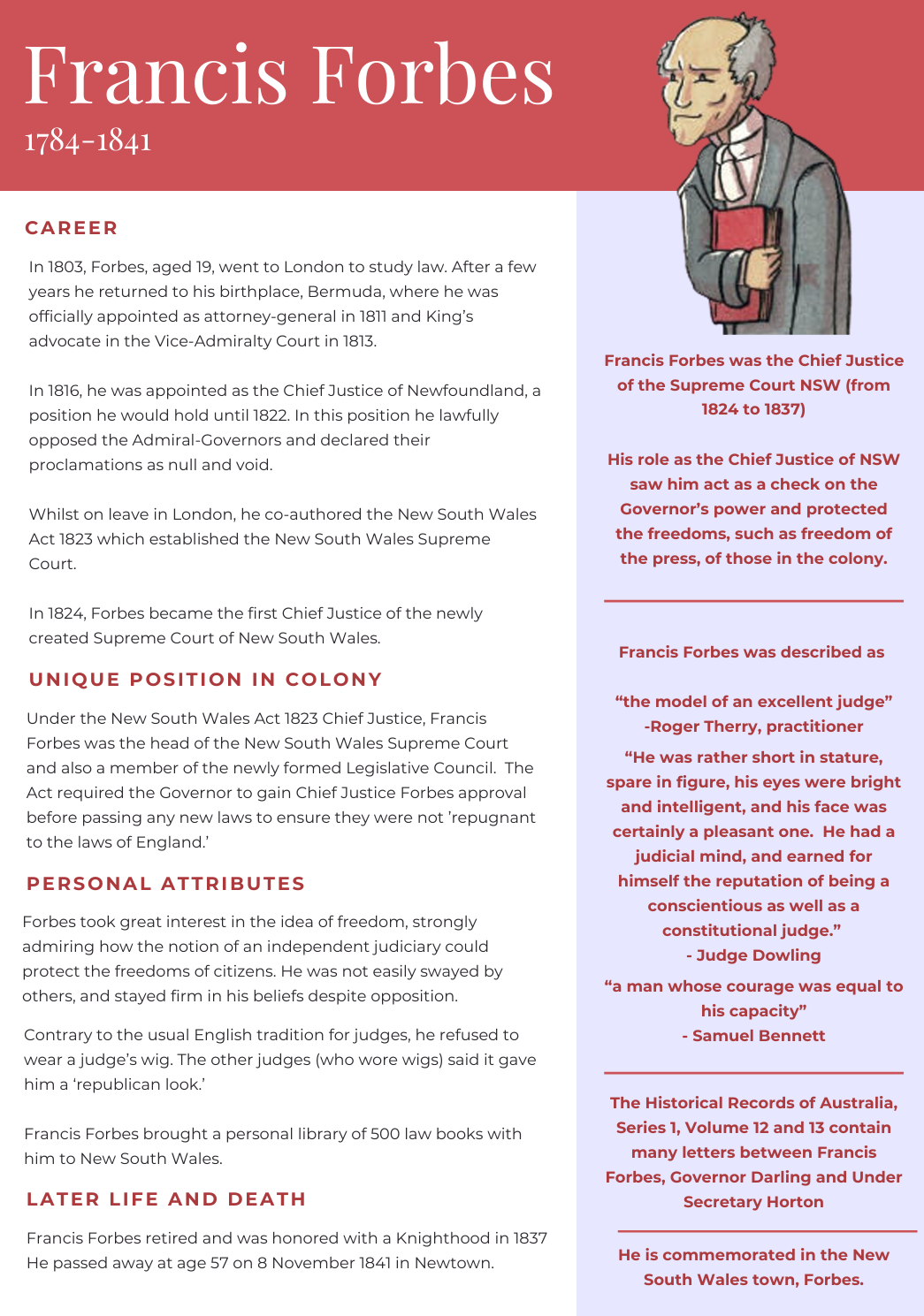
Chief Justice Forbes Character Card
1784-1841
Francis Forbes was the Chief Justice of the Supreme Court NSW (from 1824 to 1837) His role as the Chief Justice of NSW saw him act as a check on the Governor’s power and protected the freedoms, such as freedom of the press, of those in the colony.
Career
In 1803, Forbes, aged 19, went to London to study law. After a few years he returned to his birthplace, Bermuda, where he was officially appointed as attorney-general in 1811 and King’s advocate in the Vice-Admiralty Court in 1813.
In 1816, he was appointed as the Chief Justice of Newfoundland, a position he would hold until 1822. In this position he lawfully opposed the Admiral-Governors and declared their proclamations as null and void.
Whilst on leave in London, he co-authored the New South Wales Act 1823 which established the New South Wales Supreme Court.
In 1824, Forbes became the first Chief Justice of the newly created Supreme Court of New South Wales.
Unique Position in the Colony
Under the New South Wales Act 1823 Chief Justice, Francis Forbes was the head of the New South Wales Supreme Court and also a member of the newly formed Legislative Council. The Act required the Governor to gain Chief Justice Forbes approval before passing any new laws to ensure they were not ’repugnant to the laws of England.’
Personal Attributes
Forbes took great interest in the idea of freedom, strongly admiring how the notion of an independent judiciary could protect the freedoms of citizens. He was not easily swayed by others, and stayed firm in his beliefs despite opposition. Contrary to the usual English tradition for judges, he refused to wear a judge’s wig. The other judges (who wore wigs) said it gave him a ‘republican look.’ Francis Forbes brought a personal library of 500 law books with him to New South Wales.
Later Life and Death
Francis Forbes retired and was honored with a Knighthood in 1837 He passed away at age 57 on 8 November 1841 in Newtown.
Other Facts
Francis Forbes was described as:
“the model of an excellent judge”
-Roger Therry, practitioner
“He was rather short in stature, spare in figure, his eyes were bright and intelligent, and his face was certainly a pleasant one. He had a judicial mind, and earned for himself the reputation of being a conscientious as well as a constitutional judge.”
- Judge Dowling
“a man whose courage was equal to his capacity”
- Samuel Bennett
The Historical Records of Australia, Series 1, Volume 12 and 13 contain many letters between Francis Forbes, Governor Darling and Under Secretary Horton.
He is commemorated in the New South Wales town, Forbes
Related Resources
-
Ralph Darling (1772–1858) was a British military officer and Governor of NSW (1825–1831). He introduced administrative and financial reforms but ruled with strict, military-style authority. Though credited with improving governance, critics viewed him as authoritarian and dismissive of legal rights. He was later investigated, exonerated, and knighted before his death.
-
The following case about the establishment of the Supreme Court in New South Wales highlights the importance of having checks and balances in place (such as an independent judiciary and free press) to restrain the power of the Governor and to ensure that the rule of law is universally upheld. In doing so, this case illustrates how a separation of powers continues to protect our individual rights and freedoms, even today.
-
This case method resource explores Chief Justice Francis Forbes’ decision on allowing a free press in early NSW. It includes summaries, primary sources, and discussions examining tensions with Governor Darling. It highlights how an independent judiciary and free press act as checks on power, reinforcing rule of law and protecting rights in society.
-
These discussion questions guide students to evaluate early NSW governance, Governor Darling’s leadership, and the challenges of managing a penal colony. They explore reforms, the rule of law, and separation of powers, while examining tensions between Darling and Forbes, press freedom, and how checks and balances protect rights and limit government power.
Explore Related Topics
-
Independent and Impartial Judiciary
Explore resources on an open, independent and impartial judiciary and its role in delivering fair justice.
-
Freedom of Speech
Explore resources on freedom of speech in Australia, outlining how it supports democratic debate, accountability, the protection of individual rights, and a rule-of-law culture.
-
First Civil Case in NSW: The Lost Parcel
On the First Fleet, a lost parcel sparked Australia’s first civil lawsuit. In Cable v Sinclair (1788), convicts Henry and Susannah Kable successfully sued a powerful ship’s captain.