
Establishment of the NSW Supreme Court and Press Freedom
-
The following case about the establishment of the Supreme Court in New South Wales highlights the importance of having checks and balances in place (such as an independent judiciary and free press) to restrain the power of the Governor and to ensure that the rule of law is universally upheld. In doing so, this case illustrates how a separation of powers continues to protect our individual rights and freedoms, even today.
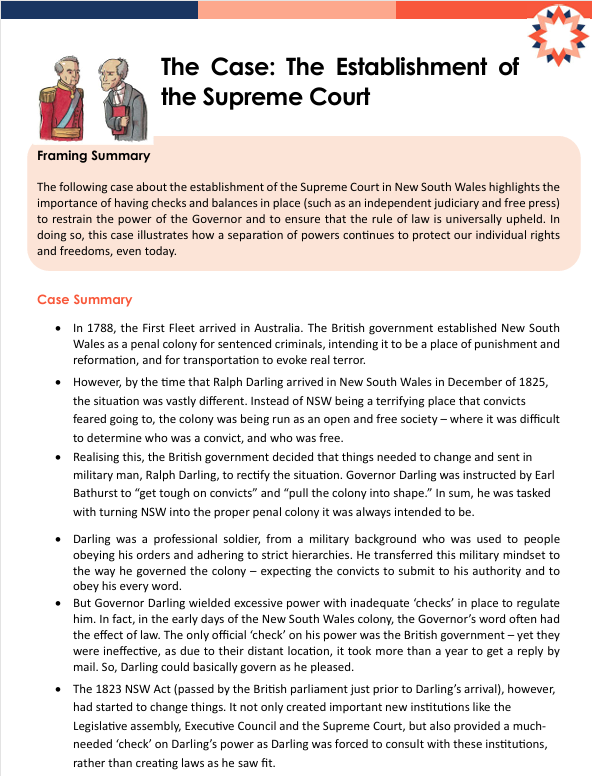
The Case: The Establishment of the Supreme Court
Framing Summary
The following case about the establishment of the Supreme Court in New South Wales highlights the importance of having checks and balances in place (such as an independent judiciary and free press) to restrain the power of the Governor and to ensure that the rule of law is universally upheld. In doing so, this case illustrates how a separation of powers continues to protect our individual rights and freedoms, even today.
Case Summary
In 1788, the First Fleet arrived in Australia. The British government established New South Wales as a penal colony for sentenced criminals, intending it to be a place of punishment and reformation, and for transportation to evoke real terror.
However, by the time that Ralph Darling arrived in New South Wales in December of 1825, the situation was vastly different. Instead of NSW being a terrifying place that convicts feared going to, the colony was being run as an open and free society – where it was difficult to determine who was a convict, and who was free.
Realising this, the British government decided that things needed to change and sent in military man, Ralph Darling, to rectify the situation. Governor Darling was instructed by Earl Bathurst to “get tough on convicts” and “pull the colony into shape.” In sum, he was tasked with turning NSW into the proper penal colony it was always intended to be.
Darling was a professional soldier, from a military background who was used to people obeying his orders and adhering to strict hierarchies. He transferred this military mindset to the way he governed the colony – expecting the convicts to submit to his authority and to obey his every word.
But Governor Darling wielded excessive power with inadequate ‘checks’ in place to regulate him. In fact, in the early days of the New South Wales colony, the Governor’s word often had the effect of law. The only official ‘check’ on his power was the British government – yet they were ineffective, as due to their distant location, it took more than a year to get a reply by mail. So, Darling could basically govern as he pleased.
The 1823 NSW Act (passed by the British parliament just prior to Darling’s arrival), however, had started to change things. It not only created important new institutions like the Legislative assembly, Executive Council and the Supreme Court, but also provided a much-needed ‘check’ on Darling’s power as Darling was forced to consult with these institutions, rather than creating laws as he saw fit.
At the head of this newly established Supreme Court was Francis Forbes – the first Chief Justice of the Supreme Court of NSW. Forbes had an extensive knowledge of the law and was determined to uphold the 1823 NSW Act, even when he encountered pressures from Governor Darling to disregard the law. As Chief Justice, his role was to keep the Governor’s power in ‘check’ and to protect the freedoms of those in the NSW colony. He acts independently of Governor Darling and must resist infringements on these freedoms, and overall, must remain impartial.
In 1826, two soldiers – Joseph Sudds and Patrick Thompson – decide that life would be more enjoyable if they get discharged from the army and become convicts. So, the pair steal some fabrics from a Sydney shopkeeper, intending to be caught.
Their desire to become convicts enraged Governor Darling, as it exposed that he was failing to convert the colony into a place of salutary terror.
So, Governor Darling decides to make an example of the pair – and steps in to worsen the sentence, commuting it to a flogging and assigning them to seven years of hard labour in the chain gain. Darling however was unaware that Sudds was already seriously ill, and he dies of fever a few days later in hospital.
Darling’s treatment of Sudds and Thompson horrifies the Australian newspapers who wage a public campaign against Governor Darling – labelling him a tyrant and criticising him for inflicting such cruel and vicious punishments. Governor Darling is not used to his authority being questioned or in ‘check’ and strongly dislikes when newspapers like ‘The Australian’ criticise him. So, Darling wants to restrain the press’ freedom in publishing negative comments.
As such, Darling wants to introduce a press licensing law that would force people to apply directly to the Governor. This would allow him to control the newspapers and to cancel licenses if defamatory material about him or his administration was published.
But Forbes does not agree with Darling’s perspective that an annual license should be introduced and argues that the freedom of the press is a constitutional privilege which cannot be denied.
Nonetheless, in April 1827, Governor Darling submits two draft bills to the Executive council. The first aimed to regulate newspaper publishers and to restrict their ability to publish negative content about him by implementing a licensing system. The second bill sought to impose a newspaper stamp duty.
Forbes argues against Darling’s attempt to impose the license system, claiming that:
The measure is repugnant to the law.
The colony is not in immediate danger – despite the claims of Darling that it is
The annual license would destroy the freedom of the press and place it at the discretion of the government.
Outcome
A year later, the Crown Law Officers in London examine the case and affirm that Forbes correctly executed his duty by refusing to certify the bill to regulate newspapers.
Even despite pressures from Governor Darling to the contrary, Forbes had stood firm to protect the rights of those in the colony.
Forbes’ ability to remain judicially independent and impartial, even amidst pressures from Governor Darling, laid the foundation for the separation of powers in Australia.
This enduring legacy underscores the necessity of checks and balances (including an independent judiciary and free press) in Australian governance, which remains relevant today.
Related Resources
-
Francis Forbes (1784–1841) was the first Chief Justice of NSW, playing a key role in shaping the colony’s legal system. He upheld the rule of law, checked the Governor’s power, and supported press freedom. Known for independence and integrity, Forbes helped protect citizens’ rights and advance democratic principles in early Australia.
-
This case method resource explores Chief Justice Francis Forbes’ decision on allowing a free press in early NSW. It includes summaries, primary sources, and discussions examining tensions with Governor Darling. It highlights how an independent judiciary and free press act as checks on power, reinforcing rule of law and protecting rights in society.
-
These discussion questions guide students to evaluate early NSW governance, Governor Darling’s leadership, and the challenges of managing a penal colony. They explore reforms, the rule of law, and separation of powers, while examining tensions between Darling and Forbes, press freedom, and how checks and balances protect rights and limit government power.
Explore Related Topics
-
Independent and Impartial Judiciary
Explore resources on an open, independent and impartial judiciary and its role in delivering fair justice.
-
Freedom of Speech
Explore resources on freedom of speech in Australia, outlining how it supports democratic debate, accountability, the protection of individual rights, and a rule-of-law culture.
-
First Civil Case in NSW: The Lost Parcel
On the First Fleet, a lost parcel sparked Australia’s first civil lawsuit. In Cable v Sinclair (1788), convicts Henry and Susannah Kable successfully sued a powerful ship’s captain.