
Establishment of the NSW Supreme Court and Press Freedom
-
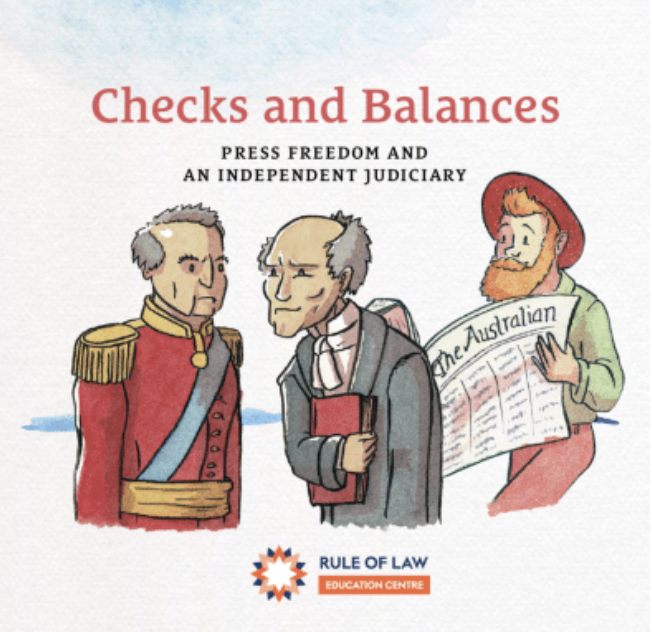
The book ‘Checks and Balances’ tells the true story about the establishment of the Supreme Court in New South Wales. It looks at the clash between Chief Justice Forbes and Governor Darling and highlights the importance of having checks and balances in place (such as an independent judiciary and free press) to restrain the power of the Governor and to ensure that the rule of law is universally upheld.
-
Francis Forbes (1784–1841) was the first Chief Justice of NSW, playing a key role in shaping the colony’s legal system. He upheld the rule of law, checked the Governor’s power, and supported press freedom. Known for independence and integrity, Forbes helped protect citizens’ rights and advance democratic principles in early Australia.
-
Ralph Darling (1772–1858) was a British military officer and Governor of NSW (1825–1831). He introduced administrative and financial reforms but ruled with strict, military-style authority. Though credited with improving governance, critics viewed him as authoritarian and dismissive of legal rights. He was later investigated, exonerated, and knighted before his death.
The Establishment of the NSW Supreme Court
The Story of Chief Justice Forbes and his battle for the Free Press: Story Book
‘Checks and Balances’ tells the story of the explosive tension between Governor Ralph Darling, who has been sent to the colony to rebuild it as a place of terror for convicts and Chief Justice Forbes, whose duty it was to administer justice through the courts and ensure that the rule of law was upheld by all… even the Governor!
With such great power being vested in two men with such opposing objectives, who will win out – the unyielding military man, Ralph Darling or the morally upright, Chief Justice Forbes?
This book illuminates the importance of having checks and balances in place (such as an independent judiciary and free press) to restrain the tyrannical ambitions of the Governor and to ensure that the rule of law is universally upheld.
Related Resources
-
The following case about the establishment of the Supreme Court in New South Wales highlights the importance of having checks and balances in place (such as an independent judiciary and free press) to restrain the power of the Governor and to ensure that the rule of law is universally upheld. In doing so, this case illustrates how a separation of powers continues to protect our individual rights and freedoms, even today.
-
This case method resource explores Chief Justice Francis Forbes’ decision on allowing a free press in early NSW. It includes summaries, primary sources, and discussions examining tensions with Governor Darling. It highlights how an independent judiciary and free press act as checks on power, reinforcing rule of law and protecting rights in society.
-
These discussion questions guide students to evaluate early NSW governance, Governor Darling’s leadership, and the challenges of managing a penal colony. They explore reforms, the rule of law, and separation of powers, while examining tensions between Darling and Forbes, press freedom, and how checks and balances protect rights and limit government power.
Explore Related Topics
-
Independent and Impartial Judiciary
Explore resources on an open, independent and impartial judiciary and its role in delivering fair justice.
-
Freedom of Speech
Explore resources on freedom of speech in Australia, outlining how it supports democratic debate, accountability, the protection of individual rights, and a rule-of-law culture.
-
First Civil Case in NSW: The Lost Parcel
On the First Fleet, a lost parcel sparked Australia’s first civil lawsuit. In Cable v Sinclair (1788), convicts Henry and Susannah Kable successfully sued a powerful ship’s captain.