
Establishment of the NSW Supreme Court and Press Freedom
-
The book, ‘Checks and Balances’ tells the true story about the establishment of the Supreme Court in New South Wales. It looks at the clash between Chief Justice Forbes and Governor Darling and highlights the importance of having checks and balances in place (such as an independent judiciary and free press) to restrain the power of the Governor and to ensure that the rule of law is universally upheld. I
-
Francis Forbes (1784–1841) was the first Chief Justice of NSW, playing a key role in shaping the colony’s legal system. He upheld the rule of law, checked the Governor’s power, and supported press freedom. Known for independence and integrity, Forbes helped protect citizens’ rights and advance democratic principles in early Australia.
-
Ralph Darling (1772–1858) was a British military officer and Governor of NSW (1825–1831). He introduced administrative and financial reforms but ruled with strict, military-style authority. Though credited with improving governance, critics viewed him as authoritarian and dismissive of legal rights. He was later investigated, exonerated, and knighted before his death.
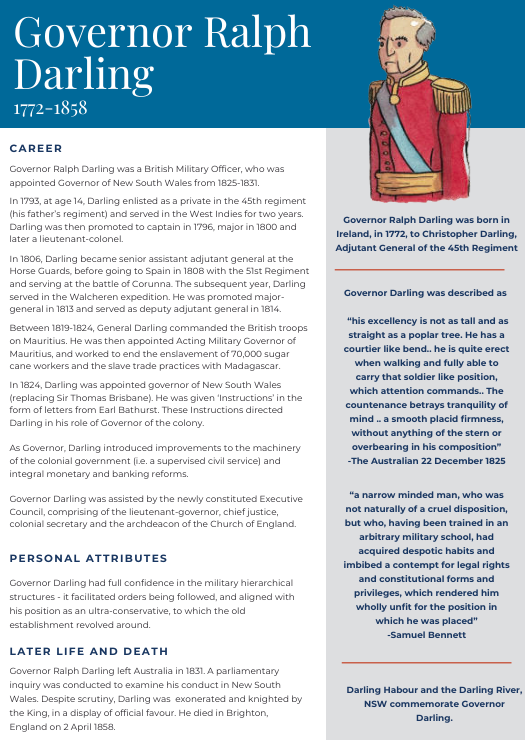
Governor Ralph Darling Character Card
1772 - 1858
Governor Ralph Darling was born in Ireland, in 1772, to Christopher Darling, Adjutant General of the 45th Regiment
Career
Governor Ralph Darling was a British Military Officer, who was appointed Governor of New South Wales from 1825-1831. In 1793, at age 14, Darling enlisted as a private in the 45th regiment (his father’s regiment) and served in the West Indies for two years. Darling was then promoted to captain in 1796, major in 1800 and later a lieutenant-colonel.
In 1806, Darling became senior assistant adjutant general at the Horse Guards, before going to Spain in 1808 with the 51st Regiment and serving at the battle of Corunna. The subsequent year, Darling served in the Walcheren expedition. He was promoted major general in 1813 and served as deputy adjutant general in 1814.
Between 1819-1824, General Darling commanded the British troops on Mauritius. He was then appointed Acting Military Governor of Mauritius, and worked to end the enslavement of 70,000 sugar cane workers and the slave trade practices with Madagascar.
In 1824, Darling was appointed governor of New South Wales (replacing Sir Thomas Brisbane). He was given ‘Instructions’ in the form of letters from Earl Bathurst. These Instructions directed Darling in his role of Governor of the colony.
As Governor, Darling introduced improvements to the machinery of the colonial government (i.e. a supervised civil service) and integral monetary and banking reforms.
Governor Darling was assisted by the newly constituted Executive Council, comprising of the lieutenant-governor, chief justice, colonial secretary and the archdeacon of the Church of England.
Personal Attributes
Governor Darling had full confidence in the military hierarchical structures - it facilitated orders being followed, and aligned with his position as an ultra-conservative, to which the old establishment revolved around.
Later Life and Death
Governor Ralph Darling left Australia in 1831. A parliamentary inquiry was conducted to examine his conduct in New South Wales. Despite scrutiny, Darling was exonerated and knighted by the King, in a display of official favour. He died in Brighton, England on 2 April 1858
Other Facts
Governor Darling was described as
“his excellency is not as tall and as straight as a poplar tree. He has a courtier like bend.. he is quite erect when walking and fully able to carry that soldier like position, which attention commands.. The countenance betrays tranquility of mind .. a smooth placid firmness, without anything of the stern or overbearing in his composition”
-The Australian 22 December 1825
“a narrow minded man, who was not naturally of a cruel disposition, but who, having been trained in an arbitrary military school, had acquired despotic habits and imbibed a contempt for legal rights and constitutional forms and privileges, which rendered him wholly unfit for the position in which he was placed”
-Samuel Bennett
Darling Habour and the Darling River, NSW commemorate Governor Darling
Related Resources
-
Francis Forbes (1784–1841) was the first Chief Justice of NSW, playing a key role in shaping the colony’s legal system. He upheld the rule of law, checked the Governor’s power, and supported press freedom. Known for independence and integrity, Forbes helped protect citizens’ rights and advance democratic principles in early Australia.
-
The following case about the establishment of the Supreme Court in New South Wales highlights the importance of having checks and balances in place (such as an independent judiciary and free press) to restrain the power of the Governor and to ensure that the rule of law is universally upheld. In doing so, this case illustrates how a separation of powers continues to protect our individual rights and freedoms, even today.
-
This case method resource explores Chief Justice Francis Forbes’ decision on allowing a free press in early NSW. It includes summaries, primary sources, and discussions examining tensions with Governor Darling. It highlights how an independent judiciary and free press act as checks on power, reinforcing rule of law and protecting rights in society.
-
These discussion questions guide students to evaluate early NSW governance, Governor Darling’s leadership, and the challenges of managing a penal colony. They explore reforms, the rule of law, and separation of powers, while examining tensions between Darling and Forbes, press freedom, and how checks and balances protect rights and limit government power.
Explore Related Topics
-
Independent and Impartial Judiciary
Explore resources on an open, independent and impartial judiciary and its role in delivering fair justice.
-
Freedom of Speech
Explore resources on freedom of speech in Australia, outlining how it supports democratic debate, accountability, the protection of individual rights, and a rule-of-law culture.
-
First Civil Case in NSW: The Lost Parcel
On the First Fleet, a lost parcel sparked Australia’s first civil lawsuit. In Cable v Sinclair (1788), convicts Henry and Susannah Kable successfully sued a powerful ship’s captain.