
Access to Justice
-
This activity helps students apply the three principles of justice—access, equality and fairness—to real‑world scenarios. Students identify which principle is involved, analyse how it is upheld or limited, and discuss why each principle is essential for a fair legal system. The task builds understanding of how justice operates in practice and how these principles support the rule of law in Australia.
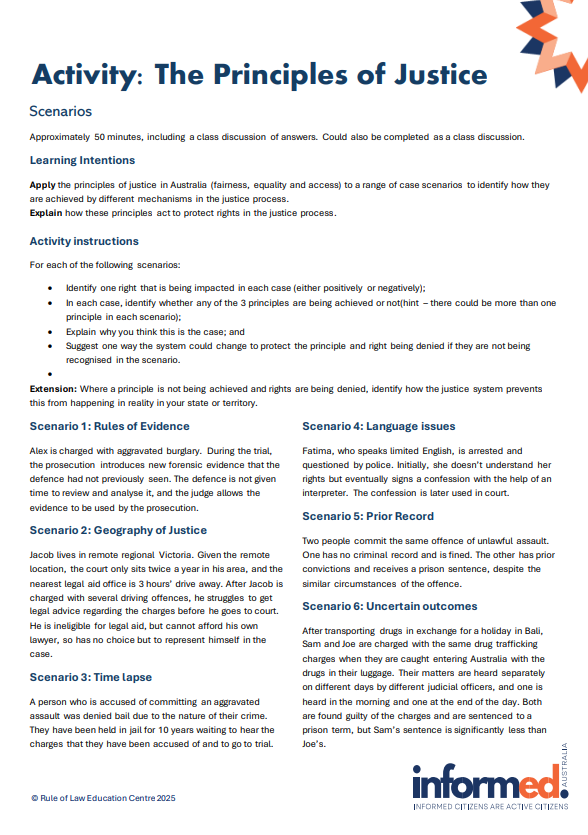
Principles of Justice Scenario Worksheet
Scenarios
Approximately 50 minutes, including a class discussion of answers. Could also be completed as a class discussion.
Learning Intentions
Apply the principles of justice in Australia (fairness, equality and access) to a range of case scenarios to identify how they are achieved by different mechanisms in the justice process.
Explain how these principles act to protect rights in the justice process.
Activity instructions
For each of the following scenarios:
Identify one right that is being impacted in each case (either positively or negatively);
In each case, identify whether any of the 3 principles are being achieved or not(hint – there could be more than one principle in each scenario);
Explain why you think this is the case; and
Suggest one way the system could change to protect the principle and right being denied if they are not being recognised in the scenario.
Extension: Where a principle is not being achieved and rights are being denied, identify how the justice system prevents this from happening in reality in your state or territory.
Scenario 1: Rules of Evidence
Alex is charged with aggravated burglary. During the trial, the prosecution introduces new forensic evidence that the defence had not previously seen. The defence is not given time to review and analyse it, and the judge allows the evidence to be used by the prosecution.
Scenario 2: Geography of Justice
Jacob lives in remote regional Victoria. Given the remote location, the court only sits twice a year in his area, and the nearest legal aid office is 3 hours’ drive away. After Jacob is charged with several driving offences, he struggles to get legal advice regarding the charges before he goes to court. He is ineligible for legal aid, but cannot afford his own lawyer, so has no choice but to represent himself in the case.
Scenario 3: Time lapse
A person who is accused of committing an aggravated assault was denied bail due to the nature of their crime. They have been held in jail for 10 years waiting to hear the charges that they have been accused of and to go to trial.
Scenario 4: Language issues
Fatima, who speaks limited English, is arrested and questioned by police. Initially, she doesn’t understand her rights but eventually signs a confession with the help of an interpreter. The confession is later used in court.
Scenario 5: Prior Record
Two people commit the same offence of unlawful assault. One has no criminal record and is fined. The other has prior convictions and receives a prison sentence, despite the similar circumstances of the offence.
Scenario 6: Uncertain outcomes
After transporting drugs in exchange for a holiday in Bali, Sam and Joe are charged with the same drug trafficking charges when they are caught entering Australia with the drugs in their luggage. Their matters are heard separately on different days by different judicial officers, and one is heard in the morning and one at the end of the day. Both are found guilty of the charges and are sentenced to a prison term, but Sam’s sentence is significantly less than Joe’s.
Scenario 7: Disability and the Legal Process
Emily, who has an intellectual disability, is charged with shoplifting. She struggles to understand the court process and pleads guilty without fully understanding her rights or the consequences.
Scenario 8: Young Offenders
A 14-year-old is charged with reckless conduct endangering life. When it is heard in a specialist court that deals only with matters involving children, he is allowed a specialist lawyer and a support person.
Scenario 9: Embarrassing
A wife takes her husband to court stealing her jewellery and giving it to his new girlfriend. The husband does not want the case heard in a public hearing as he does not want his parents to find out. The judge refuses to have a private hearing.
Scenario 10: Sentencing submissions
A member of Parliament is sentenced for property damage after a heated debate in the Lower House. During the sentencing, submissions about his personal background and community support are heard by the court.
Scenario 11: Lost luggage
Susannah goes on a cruise with her husband and son, with a large number of valuable items in her luggage. Her possessions are lost on the cruise ship while in being loaded or unloaded from the boat. She is able to take action in court and give evidence about her lost baggage to receive compensation.
Scenario 12: Police power
Due to an economic downturn, there has been a significant increase in homelessness and crime. Police have been experiencing bribes to remove homeless people from certain neighbourhoods, and some homeless people have been seriously injured as a result.
Scenario 13: Law making
A new law is introduced that creates a new government agency, the Happy Smiles Commission, to promote wellness and positivity in the community. Officers can issue on the spot fines for any offense that they feel does not promote 'happiness'.
Related Resources
-
This explainer outlines the three interconnected principles of justice—access, equality and fairness—and shows how they ensure people are treated with respect under the law. It explains that justice requires clear and predictable laws, equal treatment in legal processes, and genuine opportunities for individuals to understand and exercise their rights. The factsheet highlights how these principles uphold the rule of law by promoting transparency, accountability and a fair legal system for all Australians.
-
This case note explains the High Court’s landmark decision in Dietrich v The Queen, which established that an accused facing a serious criminal charge should not be tried without legal representation unless exceptional circumstances exist. It highlights the case’s significance for the right to a fair trial, access to justice, and judicial discretion in staying proceedings to ensure fairness.
Explore Related Topics
-
Law is Known and Accessible
Explore resources on accessible law, highlighting why clear, public, and open rules are essential for fairness and democratic participation, strengthening transparency, and public trust.
-
Open and Transparent Laws
Explore resources on transparent lawmaking, highlighting how accessible, participatory processes strengthen accountability and support openness, public trust, and community engagement.
-
Fair and Prompt Trials
Explore resources on fair and prompt trials, showing how timely hearings and procedural fairness protect justice through transparent and efficient processes and accountable decision‑making.