
Access to Justice
-
This resource outlines the core elements of access to justice in Australia, explaining why a fair, impartial, and adequately resourced legal system is essential to the rule of law. It highlights barriers such as legal complexity, limited Legal Aid funding, and the rise of self‑represented litigants, while pointing to mechanisms like pro bono work and government policy initiatives that help maintain fairness in the justice system.
-
This explainer outlines the three interconnected principles of justice—access, equality and fairness—and shows how they ensure people are treated with respect under the law. It explains that justice requires clear and predictable laws, equal treatment in legal processes, and genuine opportunities for individuals to understand and exercise their rights. The factsheet highlights how these principles uphold the rule of law by promoting transparency, accountability and a fair legal system for all Australians.
Principles of Justice
The inter-related principles of access, equality and fairness
The Australian legal system has its origins in British law and is shaped by JudeoChristian heritage and values. It is built on foundational principles aimed at ensuring justice for all. This commitment to justice is echoed in the Magna Carta, which famously declared: "To no one will we sell, to no one will we deny or delay, right or justice."
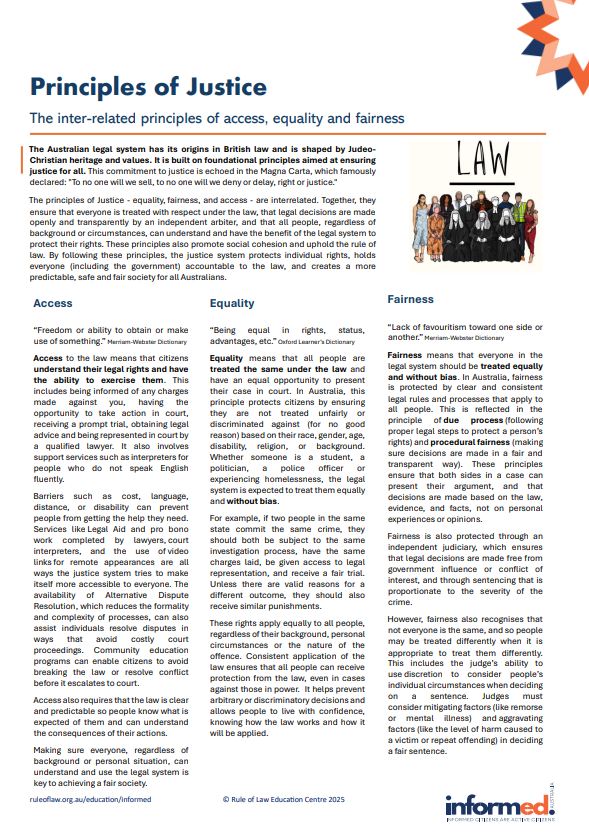
The principles of Justice - equality, fairness, and access - are interrelated. Together, they ensure that everyone is treated with respect under the law, that legal decisions are made openly and transparently by an independent arbiter, and that all people, regardless of background or circumstances, can understand and have the benefit of the legal system to protect their rights. These principles also promote social cohesion and uphold the rule of law. By following these principles, the justice system protects individual rights, holds everyone (including the government) accountable to the law, and creates a more predictable, safe and fair society for all Australians.
Access
“Freedom or ability to obtain or make use of something.” Merriam-Webster Dictionary
Access to the law means that citizens understand their legal rights and have the ability to exercise them. This includes being informed of any charges made against you, having the opportunity to take action in court, receiving a prompt trial, obtaining legal advice and being represented in court by a qualified lawyer. It also involves support services such as interpreters for people who do not speak English fluently.
Barriers such as cost, language, distance, or disability can prevent people from getting the help they need. Services like Legal Aid and pro bono work completed by lawyers, court interpreters, and the use of video links for remote appearances are all ways the justice system tries to make itself more accessible to everyone. The availability of Alternative Dispute Resolution, which reduces the formality and complexity of processes, can also assist individuals resolve disputes in ways that avoid costly court proceedings. Community education programs can enable citizens to avoid breaking the law or resolve conflict before it escalates to court.
Access also requires that the law is clear and predictable so people know what is expected of them and can understand the consequences of their actions.
Making sure everyone, regardless of background or personal situation, can understand and use the legal system is key to achieving a fair society.
Equality
“Being equal in rights, status, advantages, etc.” Oxford Learner’s Dictionary
Equality means that all people are treated the same under the law and have an equal opportunity to present their case in court. In Australia, this principle protects citizens by ensuring they are not treated unfairly or discriminated against (for no good reason) based on their race, gender, age, disability, religion, or background. Whether someone is a student, a politician, a police officer or experiencing homelessness, the legal system is expected to treat them equally and without bias.
For example, if two people in the same state commit the same crime, they should both be subject to the same investigation process, have the same charges laid, be given access to legal representation, and receive a fair trial. Unless there are valid reasons for a different outcome, they should also receive similar punishments.
These rights apply equally to all people, regardless of their background, personal circumstances or the nature of the offence. Consistent application of the law ensures that all people can receive protection from the law, even in cases against those in power. It helps prevent arbitrary or discriminatory decisions and allows people to live with confidence, knowing how the law works and how it will be applied.
Fairness
“Lack of favouritism toward one side or another.” Merriam-Webster Dictionary
Fairness means that everyone in the legal system should be treated equally and without bias. In Australia, fairness is protected by clear and consistent legal rules and processes that apply to all people. This is reflected in the principle of due process (following proper legal steps to protect a person’s rights) and procedural fairness (making sure decisions are made in a fair and transparent way). These principles ensure that both sides in a case can present their argument, and that decisions are made based on the law, evidence, and facts, not on personal experiences or opinions.
Fairness is also protected through an independent judiciary, which ensures that legal decisions are made free from government influence or conflict of interest, and through sentencing that is proportionate to the severity of the crime.
However, fairness also recognises that not everyone is the same, and so people may be treated differently when it is appropriate to treat them differently. This includes the judge’s ability to use discretion to consider people’s individual circumstances when deciding on a sentence. Judges must consider mitigating factors (like remorse or mental illness) and aggravating factors (like the level of harm caused to a victim or repeat offending) in deciding a fair sentence.
Related Resources
-
This poster forms part of the Informed Playing Card Project, showing how fairness, equality and access to justice help ensure everyone can have their rights protected.
-
This activity helps students apply the three principles of justice—access, equality and fairness—to real‑world scenarios. Students identify which principle is involved, analyse how it is upheld or limited, and discuss why each principle is essential for a fair legal system. The task builds understanding of how justice operates in practice and how these principles support the rule of law in Australia.
-
This case note explains the High Court’s landmark decision in Dietrich v The Queen, which established that an accused facing a serious criminal charge should not be tried without legal representation unless exceptional circumstances exist. It highlights the case’s significance for the right to a fair trial, access to justice, and judicial discretion in staying proceedings to ensure fairness.
Explore Related Topics
-
Law is Known and Accessible
Explore resources on accessible law, highlighting why clear, public, and open rules are essential for fairness and democratic participation, strengthening transparency, and public trust.
-
Open and Transparent Laws
Explore resources on transparent lawmaking, highlighting how accessible, participatory processes strengthen accountability and support openness, public trust, and community engagement.
-
Fair and Prompt Trials
Explore resources on fair and prompt trials, showing how timely hearings and procedural fairness protect justice through transparent and efficient processes and accountable decision‑making.