
Laws
-
This activity helps students evaluate whether a law is clear, consistent, enforceable and fair by applying a simple checklist. It supports understanding of what makes laws effective and how these features uphold the rule of law.
-
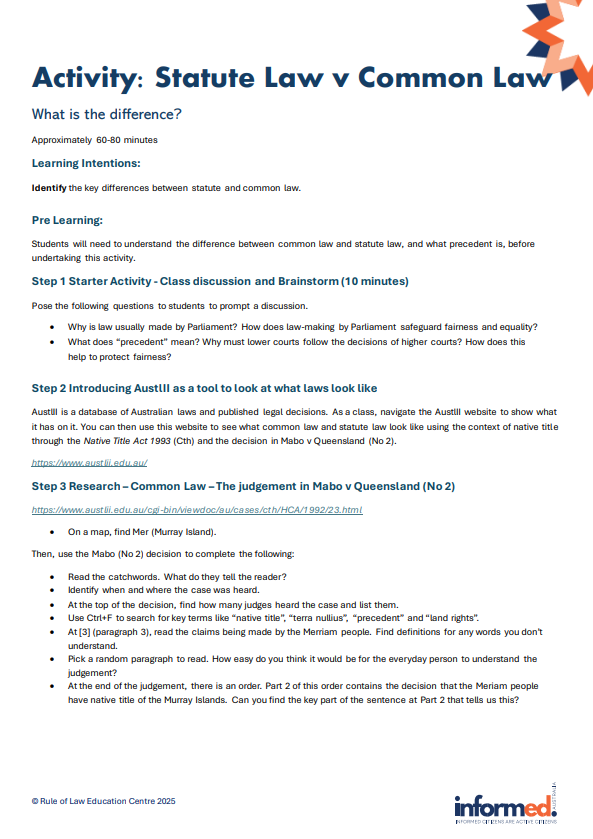
This activity helps students understand the difference between statute law made by Parliament and common law developed by judges. It guides learners through identifying each type of law, exploring how courts interpret legislation and showing how both sources work together to create a coherent legal system.
-
Reflection Activity designed as part of the Informed Civics Competition where students draw on the blank card what they have learned about the concept of Laws, Law making and effective laws and different types of laws including criminal, civil, statute and common law.
Statute vs Common Law
Related Resources
-
This explainer outlines how statute law, common law and delegated legislation are created, changed and applied in Australia, outlining the parliamentary stages of law‑making, the development of common law through judicial decisions and precedent, and the role of executive bodies in making delegated legislation under enabling Acts. It connects directly to syllabus concepts such as the origin and development of common law, features of the doctrine of precedent, steps in the legislative process, parliamentary supremacy, and reasons for changes in the law, including social values, technology and community safety. By showing how each source of law operates within Australia’s democratic framework and the rule of law, the resource helps students understand how legal authority is exercised fairly, transparently and accountably.
-
This factsheet outlines the key characteristics of effective laws in Australia’s representative democracy, explaining how laws must protect the rule of law, uphold human rights, and regulate behaviour in ways that are clear, known, accepted, consistent and fair. It highlights syllabus concepts such as accessibility, enforceability, stability, prospectivity, and the need for laws to be amendable as community values change. By showing how effective laws prevent arbitrary power and support equality before the law, the factsheet helps students understand why legal certainty and accountability are essential in Australia’s legal system.
-
This factsheet provides a clear overview of how laws in Australia are created, applied and enforced, explaining the purpose of laws, the role of statute law, common law and legal precedent, and the importance of the rule of law in a democratic society. It outlines key syllabus concepts including effective law‑making, bicameral and unicameral parliaments, the doctrine of precedent, and major types of law such as criminal, civil, administrative and constitutional. Designed as a concise one‑page resource, it helps students understand how legal institutions operate across different jurisdictions and why fairness, accountability and legal certainty are essential in Australia’s legal system.
Explore Related Topics
-
Law is Known and Accessible
Explore resources on accessible law, highlighting why clear, and public rules are essential for fairness and social participation by enabling informed decision‑ making & transparent governance.
-
Democracy
Explore resources on democracy, highlighting how accountability and representative institutions ensure power is exercised fairly and transparently through open processes, civic engagement and responsible governance.
-
Open and Transparent Laws
Explore resources on transparent lawmaking, highlighting how accessible processes strengthen accountability and uphold democratic principles through responsible decision‑making.