
Establishment of the NSW Supreme Court and Press Freedom
-
This retelling of The Rule of Law Education Centre book Checks and Balances is about the establishment of the NSW Supreme Court. This story highlights the important role that checks and balances such as an independent judiciary and free press had in the new colony. It tells the story of the tension between Governor Ralph Darling, who had been sent to the colony to rebuild it as a place of ‘terror’ for the convicts who had been sentenced there, and Chief Justice Forbes, whose duty it was to administer justice through the courts and ensure that the rule of law was upheld by all… even the Governor! With such great power being vested in two men with such opposing objectives, what could go wrong? The team at the Rule of Law Education Centre have created resources (all have printable PDF’s), to help teachers use this historical event to engage students in understanding civic concepts.
-
Read the texts from a wide variety of source documents including an Extract from Australian Discovery & Colonisation (Volume II – 1800 to 1831) by Samuel Bennett, 1865, Extract from Sir Francis Forbes: The First Chief Justice of the Supreme Court of New South Wales by C. H. Currey, 1968 and the Australian newspaper in 1824 to understand the perspectives and decisions.
Case Based Method Source Documents
Establishment NSW Supreme Court and Press Freedom
“If you were Chief Justice Forbes in the early colony of NSW that was filled with convicts, would you allow a free press?”
The below primary source documents provide students with an insight into the information available to decision-makers at the time and are read prior to class. For more details about the Case Method, including other supplementary resources, click here.
Summary of Case Based Method
Firstly, access a case the summary of the case here. This case can form the basis of class discussion, for example, for three lessons.
Students are provided with below source documents / ‘Case Exhibits’ in advance. Students complete the reading before class and come prepared to discuss the case in depth during class.
Class time is then used as discussion – where students have an opportunity to think critically, problem-solve and constructively build upon or disagree with their classmate’s comments. In the first lesson on a new case, teachers set the scene for the class by orientating students to the historical context, key issues and personalities. This is done in the present tense, for example, “Imagine: You are Chief Justice Forbes…” and the story is to gradually unfold. Students then locate evidence by referring to the source document (known as an ‘Exhibit’) they read prior to class. This will contain pertinent information, quotes and statistics etc. Exhibits reflects the information available to decision-makers at the time, allowing students to consider what they would have done if they were key figures from the past – like Governor Darling.
Throughout, the teacher prompts discussion with questions, for example, “What was the management of the New South Wales’ British colony like before Governor Darling arrived? Do you think it was being managed effectively?”
As the class discusses, the teacher notes student input up on the board – e.g. potential solutions to the issues Governor Darling faced when he arrived at the New South Wales’ colony. Importantly, each case builds to a particular decision point – for example, “Should we have a separation of powers in Australia?” – without revealing what decision was actually made. This allows students to think critically and refine their opinions as the story unfolds.
At the very end, the teacher reveals the outcome – what actually occurred and why.
How to do Source Analysis
Origin:
What is the source? What kind of source is it?
Who created it? Who is the author?
When was it created?
When and where was it published?
Is it a primary or secondary source?
Audience
Who is the intended audience?
Was it meant for publication?
Purpose
Why does the document exist? Why did the author create this piece of work?
What was their motive/agenda?
What potential bias might exist?
Reliability
Is the source complete/incomplete?
In what way is it limited (does it lack detail or point of view)?
Is it biased? Is it propaganda?
Do other sources support or contradict it or not?
For what is the source reliable? For what is it unreliable?
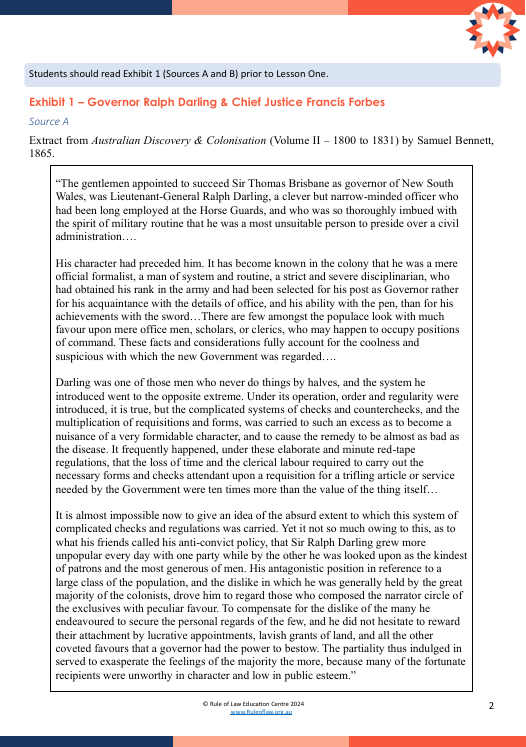
Exhibit 1 – Governor Ralph Darling & Chief Justice Francis Forbes
Source A
Extract from Australian Discovery & Colonisation (Volume II – 1800 to 1831) by Samuel Bennett, 1865.
“The gentlemen appointed to succeed Sir Thomas Brisbane as governor of New South Wales, was Lieutenant-General Ralph Darling, a clever but narrow-minded officer who had been long employed at the Horse Guards, and who was so thoroughly imbued with the spirit of military routine that he was a most unsuitable person to preside over a civil administration….
His character had preceded him. It has become known in the colony that he was a mere official formalist, a man of system and routine, a strict and severe disciplinarian, who had obtained his rank in the army and had been selected for his post as Governor rather for his acquaintance with the details of office, and his ability with the pen, than for his achievements with the sword…There are few amongst the populace look with much favour upon mere office men, scholars, or clerics, who may happen to occupy positions of command. These facts and considerations fully account for the coolness and suspicious with which the new Government was regarded….
Darling was one of those men who never do things by halves, and the system he introduced went to the opposite extreme. Under its operation, order and regularity were introduced, it is true, but the complicated systems of checks and counterchecks, and the multiplication of requisitions and forms, was carried to such an excess as to become a nuisance of a very formidable character, and to cause the remedy to be almost as bad as the disease. It frequently happened, under these elaborate and minute red-tape regulations, that the loss of time and the clerical labour required to carry out the necessary forms and checks attendant upon a requisition for a trifling article or service needed by the Government were ten times more than the value of the thing itself…
It is almost impossible now to give an idea of the absurd extent to which this system of complicated checks and regulations was carried. Yet it not so much owing to this, as to what his friends called his anti-convict policy, that Sir Ralph Darling grew more unpopular every day with one party while by the other he was looked upon as the kindest of patrons and the most generous of men. His antagonistic position in reference to a large class of the population, and the dislike in which he was generally held by the great majority of the colonists, drove him to regard those who composed the narrator circle of the exclusives with peculiar favour. To compensate for the dislike of the many he endeavoured to secure the personal regards of the few, and he did not hesitate to reward their attachment by lucrative appointments, lavish grants of land, and all the other coveted favours that a governor had the power to bestow. The partiality thus indulged in served to exasperate the feelings of the majority the more, because many of the fortunate recipients were unworthy in character and low in public esteem.”
Source Analysis Questions
Account for the perspective of Source A.
What are the values and limitations of Source A for a historian studying the administration and policies of Governor Darling in New South Wales?
Outline the reasons for Governor Darling’s unpopularity.
How useful is Source A for understanding public opinion on Governor Darling’s governance style?
To what extent was Governor Darling an effective governor of New South Wales? Integrate evidence from Source A in your answer.
Source B
Extract from Sir Francis Forbes: The First Chief Justice of the Supreme Court of New South Wales by C. H. Currey, 1968.
“When at length, after Bigge’s Report on the Judicial Establishments of the Colony, it was realised how imperatively the Colony needed a constitution and a judicial establishment, it was to Francis Forbes that the task was committed of guiding the still largely primitive society of New South Wales towards the principles of the Rule of Law which had for so long been treated with scant regard if not trampled underfoot. And, oddly enough, he was to do this whilst occupying a dual role as a member of the Legislative Council as well as being Chief Justice of the Supreme Court, an office which carried the additional responsibility of certifying to the validity of Colonial laws.
In the hands of a man of less integrity, courage and legal ability, these multiple powers could have become instruments of oppression and caprice, but with the guiding principles of the common law always in full view and a clear appreciation of the relation of Crown and citizen and of the proper function of the courts, [Chief Justice] Forbes was able to infuse a measure of constitutionalism and legality into the government and daily administration of the affairs of the Colony. This task was accomplished…[even] in the face of substantial opposition by influential segments of colonial society and often with little or no sympathy from a wider public, but it was pursued with objective zeal, courage and humanity.”
Source Analysis Questions
Account for the different perspectives of Governor Ralph Darling and Chief Justice Forbes shown in Sources A and B.
What are the values and limitations of the perspective provided in Source B?
What does Source B reveal about the roles and responsibilities of a Chief Justice?
What are the values and limitations of Source A for a historian studying Francis Forbes’ contributions to establishing constitutionalism and legality in New South Wales?
To what extent were Francis Forbes’ personal qualities well-suited to his role as Chief Justice? Was Forbes effective at upholding the principles of common law? Integrate evidence from Source B in your answer.
Students should read Exhibit 2 (Sources C and D) prior to Lesson Two.
Exhibit 2 – Freedom of the Press
Source C
Extract from the opening editorial of The Australian (Sydney, NSW: 1824 – 1848), Thursday 14 October 1824, page 2. Accessible at: http://nla.gov.au/nla.news-article37074013
“In a Colony whose energies are thus expanding, little doubt can be entertained of the utility and efficacy of an Independent Newspaper. The aggrandisement and the increasing wealth of a people introduce a complexity in their affairs; conflicting opinions and conflicting interests arise, individual influence is apt to luxuriate and flourish where there exists no corrective to check its exuberance or prevent its growth. A free Press is the most legitimate, and at the same time, the most powerful weapon that can be employed to annihilate such influence, frustrate the designs of tyranny, and restrain the arm of oppression. Without its active and liberal co-operation the biased views of a party frequently preponderate, while the true interests of the public languish and are over-looked. In offering THE AUSTRALIAN to our Readers we pretend to no uncommon merit, we affect no singularity, we anticipate no triumphs. Aiming at something more than rendering it a mere miscellany of news or compilation of events, we are solicitous that it should become the medium of extensive and general communication among all the members of the Colony, thereby concentrating public opinion and giving a tone and a direction to public feeling. Whatever questions may arise involving the interests of the whole or any portion of the Colonists, whatever state measures may be promulgated they will each receive from us an attention and deliberation commensurate with their importance, at the same time that we afford every facility to an interchange of opinions among those who choose to become our Correspondents, as well as Readers. In the many topics that may come within the scope of our comments, we do not limit ourselves to any precise line of politics. Independent yet consistent --- free yet not licentious --- equally un-moved by favour and by fear --- we shall pursue our labours without either a sycophantic approval of or a systematic opposition to acts of authority merely because they emanate from government.
… We are also endeavouring to organise a system by which we shall be enabled to give an account of all domestic occurrences of immediate interest…We must endeavour to amuse readers of all classes, and all tastes, and while we attend to objects of the first magnitude and importance, we shall be careful not to overlook those of minor consequence. Aware of the necessity that exists for the exercise of every diligence to avoid giving circulation to erroneous reports, we shall on no occasion insert any article of news that is not fully authenticated. And though we reserve to ourselves the utmost latitude in the expression of our opinions, we shall studiously abstain from individual attacks and personal invective, which can only be indulged in for the purpose of gratifying a malignant mind, or a rancorous spirit of revenge. It is the errors of a system — the vices of office that we condemn. It is measures not men that we assail; and our respect for the one will not restrain our animadversions on the other. A legal responsibility, we know, will attach to us for every thing we may publish in the AUSTRALIAN — but we consider ourselves responsible in point of principles for such opinions only as appear in the leading articles, and our consistency cannot be impeached for admitting into our columns the letters of Correspondents, though they may militate with our own avowed sentiments. Indeed it would be in direct contravention of the spirit of a free Journal to exclude the writings of all whose views of a question happened not to coincide with our own. A Newspaper carried on in undeviating conformity to these rules, must naturally meet with universal approbation, and eventually give rise to most important results to the Colony.”
Source Analysis Questions
What are the values and limitations of the perspective presented in Source C?
Account for the perspective of Source C.
What is the purpose (and agenda) of Source C?
Explain the goals and objectives of The Australian newspaper in shaping public opinion and discourse in the colony. Integrate evidence from Source C to support your response.
Who is the the intended audience of Source C?
Evaluate the usefulness of Source C to a historian studying the necessity and impact of a free press in the colony.
To what extent is the freedom of the press significant? Support your response using evidence from Source C and other relevant sources.
Source D
Extract from Sir Francis Forbes: The First Chief Justice of the Supreme Court of New South Wales by C. H. Currey, 1968.
“Two Bills, one to regulate newspapers and the other to impose stamp duties…were transmitted by His Excellency to the Chief Justice on 11th April with a cover note stating that he proposed to bring them under the consideration of the Legislative Council.
… Since Darling had already inferred that Forbes would not certify a measure instituting the licensing of newspapers, the assumption in his note does not permit of a ready explanation. “His Excellency seems to have thought,” observed Forbes, “that it was of course for me to certify the proposed law and for the legislature to adopt.”
“To the adoption of so much of the Statute Law of England, as facilitates the proof of publication in cases of libel and inflicts additional penalties on conviction of blasphemous and seditious publication,” he replied on 12th April, “there can be no objection; and I shall be ready to certify such parts of the Bill immediately.” So much of the Bill, however, as related to a license for newspapers resumable at the pleasure of the Executive Council, he declined to certify….His reasons for so suggesting were, first, that he was anxious to avoid being obliged to declare that a measure, “recommended by so high an Authority as the Secretary of State”, was repugnant to law, and, second, he was “equally solicitous to learn what might be the opinion of His Majesty’s Law Officers upon a question much too large and momentous to place upon the undivided responsibility of so humble a functionary in the administration of the laws of an empire as himself. Assuming that his suggestion had been adopted, he now invited His Excellency to consider whether it would not be wise to refrain from pressing, the, to him, uncertifiable part of the Arthur Bill until the further pleasure of His Majesty’s Government was known.
Darling, however, was adamant.
Had not the papers preserved in their mischievous endeavours to bring the Government in hatred and contempt, and in fact succeeded in exciting a strong spirit of discontent among the prisoners [he replied to Forbes, on 14th April], I should not have thought it necessary to agitate the question at the present moment….Considering, as I do on the most mature reflection, that the safety of the Colony is endangered from the present licentiousness of the press…it would be inconsistent with my duty to wait the result of the reference…The order…is imperative on me; and, concurring as I do in the expediency of the measure which it directs, I cannot longer abstain from using my best endeavours to carry it into effect. It is my duty…It therefore only remains for me again to transmit to you the enclosed Bills…
Thereupon the Chief Justice promptly returned the two Bills. To the one that was to regulate the newspapers, he denied his certificate in respect of its first six clauses, since they regulated the matter of the license. The other, which dealt with the imposition of stamp duties, he certified in the form in which it was presented to him. In that form, the amount of the duty was not stated; his certificate, therefore, went only to the principle of the Bill. When the amount of the stamp duty was determined the Bill would, in his opinion, again have to be certified by him.
This correspondence between the Governor and the Judge divided them sharply. Forbes thought the General was mistaken about the discontent amongst the convicts. “Prisoners, I am assured by the Superintendent,” he wrote, “are as quiet and well-disposed as they have been for years past; and neither within the range of my experience in the criminal court, nor in the executive council, has it appeared that any sensation has been caused by the papers among the prisoners of the Crown.”
… “The course” in question had been determined by Darling himself, and had been consistently followed by him, for the reasons he gave, until, infuriated by his newspaper critics, he decided to have an instrument made that would put them under his thumb.”
Source Analysis Questions
Outline the reasons provided by Chief Justice Forbes for his refusal to certify certain clauses of the newspaper regulation bill.
Assess the value and limitations of Source D for understanding Governor Darling’s motives regarding the regulation of newspapers.
Assess the value of Sources D for a historian examining Governor Darling and Chief Justice Forbes' perspectives on freedom of the press.
To what extent does Chief Justice Forbes’ response to Governor Darling’s proposals demonstrate his commitment to upholding legal principles and preserving the independence of the judiciary in the colony?
Students should read Exhibit 3 (Sources E and F) prior to Lesson Three.
Exhibit 3 – Sudds and Thompson
Source E
The Australian (Sydney, NSW: 1824 – 1848), Tuesday 27 January, 1829, page 2. Accessible at: http://nla.gov.au/nla.news-article36864189
“We consider the enquiry of the Council as unconstitutional… We do not conceive that the report says anything, but we hate all deviations from what is legal and constitutional. — Justice, however, is above Governors and Judges: let each man make his own defence; we are no man's apologist, and we say, in God's name, let justice be done. To proceed—a charge is made against the Governor for doing an act from which death ensued. To defend himself, his Excellency convenes the Council to enquire into, and give their opinion, not of the legality of the act, nor of its expediency, but merely of the circumstances of Sudds' death. The Council consisted of the Governor (the defendant) Colonel Stewart, the Chief Justice, Mr. McLeay, (the Archdeacon was absent) and Colonel Dumaresq, the defendant's brother-in-law, sat as clerk to take down the evidence. The witnesses called were, Martin Wilson, un-der gaoler, John Toole, first turnkey, John Thomp-son, medical attendant, Mr. McIntyre, Assistant Surgeon on the Civil Staff, Dr. Bowman, Principal Surgeon, Captain Dumaresq, defendant's brother-in-law, and Mr. McLeay, his staunch supporter. It will be seen that there was not a person present who was not an officer of Government, and not a witness examined, that was not liable to be displaced from his situation. Far be it from us to say or to insinuate that the proceedings were not conducted with as much propriety as if the whole world had been present—yet we do say that it would have been far more delicate and satisfactory to have examined witnesses, who must have been above the influence of intimidation or of favour, and beyond the reach of suspicion ;—thus the Sheriff, Dr. Mitchell, and persons present on the parade, should have been called, and an open inquiry would have removed that suspicion which almost always attaches to mystery. But least of all should the Governor have been present, or his brother-in-law have recorded the proceedings. Let it not be tortured into a libellous imputation, when we say that there was an indelicacy about this, which ought by all means to have been avoided…We have shown that the Enquiry before the Council was UNCONSTITUTIONAL—that it does not save the Governor from responsibility—that it was an indelicate procedure— that the defendant sat as President, and his brother-in-law recorded the proceedings—and that the result does not appear to have been unanimous—but that at all events it was a result which comes to nothing, or at least only to this: that Sudds had unusual chains on, and did die within six days of his increased punishment. We cannot dismiss this subject however, with-out asking why was not a CORONER'S INQUEST summoned upon the body of ill-fated Sudds? This would have been a constitutional and a satisfactory tribunal to have investigated the causes of his death. Had he died in gaol, this must have been done—why was it not done, when he was removed from thence but the day before? Sudds' death was known by the Government on the very day it occurred. We have never heard, we have never been able to conceive any good reason to justify a deviation from the constitutional enquiry before a coroner and jury.
… They [the House of Commons] will decide whether will is to be substituted for law—and whether or not an iron collar be a fitting decoration for the neck of an Englishman— of even an English culprit. They must determine whether he, who is sent here to govern according to law, and who daily administers punishment for the neglect or infraction of the laws, have authority himself to step without the pale of them. It is for the Legislature to determine if high functions are to shield the bearer from accountability; and if that person be a fit delegate to administer justice, and govern according to law, who by his own example could encourage a disregard and ignorance of its plainest principle? To the House of Commons we leave the case, fully expecting justice; and though we shall ever show that becoming respect which is due to the individual who holds his Majesty's Commission to govern this Colony, we can never believe and affirm that the author and ostensible executor of Sudds' punishment, and which terminated in his death, is a fit person to rule over a British Colony.”
Source Analysis Questions
Assess the value of Source E for understanding public perceptions and reactions to the punishment and treatment of soldiers Sudds and Thompson.
Outline the reasons given as to why the enquiry of the Council was unconstitutional.
Describe the perspective of Source E.
Assess the value of Source E for understanding the role of the press in shaping public opinion and discourse regarding the treatment of soldiers Sudds and Thompson.
How does Source E contribute to our understanding of the criticisms directed at Governor Darling's conduct during the Sudds-Thompson case?
How significant was the enquiry into Sudds’ death to the broader issue of governance and accountability in the New South Wales’ colony? Integrate evidence from Source E in your response.
To what extent was the treatment of Sudds and Thompson constitutional under Darling’s administration? In your response, integrate evidence from Source E.
Source F
Extract from Australian Discovery & Colonisation (Volume II – 1800 to 1831) by Samuel Bennett, 1865.
“[In another instance] the opposition press was loud in its denunciation of the Governor and his advisers, while the official journal, the Sydney Gazette, by its indiscreet advocacy and sycophantish twaddle helped to render them ridiculous.
… a case had occurred, known as that of Sudds and Thompson – which, although exceedingly grave in some of its aspects, was made to assume, under the influence of party prejudice and personal rancour, so much of a political character that the real significance of the facts themselves was, to a great extent, overlooked or absorbed in other considerations. Sudds and Thompson were soldiers of the 57th regiment, who, thinking the lot of convicts preferable to their own, committed a felony, by stealing a piece of cloth from a shop in George-street, for the express purpose of getting themselves convicted, hoping thus to escape from the irksomeness of military service. It is asserted that the wealth and luxury in which many persons who had been convicts were living, was too strong a temptation to these men, who believed that after being convicted and suffering a short sentence they should emerge into a condition where advantages would be within their reach which would enable them to acquire the means of similar enjoyment. The motive which led to the commission of the crime was disclosed on their trial, and it was asserted that other soldiers had committed offences for the same purposes, and that there was wide-spread discontent among the military at the inferior position, as regards liberty and comfort, which they enjoyed in comparison with ticket-of-leave men and emancipatists.
… But Governor Darling, fearing the consequences…determined to take the men out of the custody of the civil power and punish them in a manner which he thought calculated to deter others from committing offences of a similar kind… the two men were taken from the custody of the jailor, brought to Barrack-square in Sydney, and in the presence of the assembled military it was announced that their sentence had been changed to seven years hard labour in irons on the roads.
… The death of the unfortunate soldier, [Sudds] however, was a result which neither Darling nor his advisers desired or anticipated. It was the consequence of a lamentable error of judgement on the part of a narrow-minded man, who was not naturally of a cruel disposition, but who, having been trained in an arbitrary military school, had acquired despotic habits and imbibed a contempt for legal rights and constitutional forms and privileges, which rendered him wholly unfit for the position in which he was placed.
… The official journal, the Sydney Gazette, with its usual subservience and stupidity, not only defended Darling’s illegal and absurd acts, and eulogised his character, but indulged in coarse vituperation and unprovoked abuse of all who were believed to entertain opposite opinions. The independent journals, the Australian and the Monitor, were by this means goaded into violent attacks upon the Governor and his personal friends, and the case of Sudds and Thompson afforded abundant materials to light up the fires of class animosity for years. A sense of the gravity of the offence of which the Governor had undoubtedly been guilty, was thus obscured by party prejudice until it was almost lost in the violence of unreasonable clamour.”
Source Analysis Questions
Assess the values and limitations of the perspective provided in Source F.
Account for the perspective presented in Source F, particularly focusing on the portrayal of Governor Darling’s decision-making and leadership style.
How useful would Source F be to a historian investigating the press’ role in shaping public perception of Governor Darling?
Analyse the differing viewpoints presented in Source F regarding Governor Darling’s treatment of Sudds and Thompson. Account for the different reactions of the Sydney Gazette and opposition press.
Assess the value of Sources E and F for understanding public perceptions and reactions to the punishment and treatment of soldiers Sudds and Thompson.
To what extent is freedom of the press important? In your response, integrate evidence from Sources E and F.
Related Resources
-
Francis Forbes (1784–1841) was the first Chief Justice of NSW, playing a key role in shaping the colony’s legal system. He upheld the rule of law, checked the Governor’s power, and supported press freedom. Known for independence and integrity, Forbes helped protect citizens’ rights and advance democratic principles in early Australia.
-
The following case about the establishment of the Supreme Court in New South Wales highlights the
importance of having checks and balances in place (such as an independent judiciary and free press) to restrain the power of the Governor and to ensure that the rule of law is universally upheld. In
doing so, this case illustrates how a separation of powers continues to protect our individual rights
and freedoms, even today. -
These discussion questions guide students to evaluate early NSW governance, Governor Darling’s leadership, and the challenges of managing a penal colony. They explore reforms, the rule of law, and separation of powers, while examining tensions between Darling and Forbes, press freedom, and how checks and balances protect rights and limit government power.
-
Timeline Worksheet. Using the details from the Checks and Balances Book or their own research, students can complete this timeline of events.
Explore Related Topics
-
Independent and Impartial Judiciary
Explore resources on an open, independent and impartial judiciary and its role in delivering fair justice.
-
Freedom of Speech
Explore resources on freedom of speech in Australia, outlining how it supports democratic debate, accountability, the protection of individual rights, and a rule-of-law culture.
-
First Civil Case in NSW: The Lost Parcel
On the First Fleet, a lost parcel sparked Australia’s first civil lawsuit. In Cable v Sinclair (1788), convicts Henry and Susannah Kable successfully sued a powerful ship’s captain.