
Roles of the Executive Government
-
The Executive Government is a branch within the Separation of Powers that has the power to enforce the laws and put them into action. It contains the Governor General, Prime Minister and members of the Legislature that are appointed as ministers of Government and the Staff of the Government departments that include the police and army.
-
The Attorney-General Of Australia is our nation's First Law Officer. The primary responsibility of this role is to protect the rule of law and the integrity of the Courts. In practice, the Attorney-General delegates many administrative functions Of their role to others.
-
The Police are part of the executive with their roles and responsibilities outlined in legislation
-
Governors of New South Wales.
This explainer outlines how the first five Governors of New South Wales—Arthur Phillip, John Hunter, Philip Gidley‑King, William Bligh, and Lachlan Macquarie—worked to build a functioning colony from a population of transported convicts. It highlights their efforts to apply fairness, justice, and emerging ideas about individual rights while managing a settlement that began as a prison. It also provides context on Britain’s overcrowded prisons, the shift to transporting convicts to Australia, and the role of the Charter of Justice in shaping early governance.
What is the role of the Attorney General?
The Attorney-General of Australia is our nation's First Law Officer. The primary responsibility of this role is to protect the rule of law and the integrity of the Courts.
In practice, the Attorney-General delegates many administrative functions of their role to others.
The Attorney-General is a Member Of Parliament, appointed by the Governor-General under the Constitution, on the advice of the Prime Minister. By convention, the Attorney-General is a lawyer and has the role of principal legal adviser to the Commonwealth government.
The primary responsibility of the Attorney General is to protect, preserve and promote the rule of law.
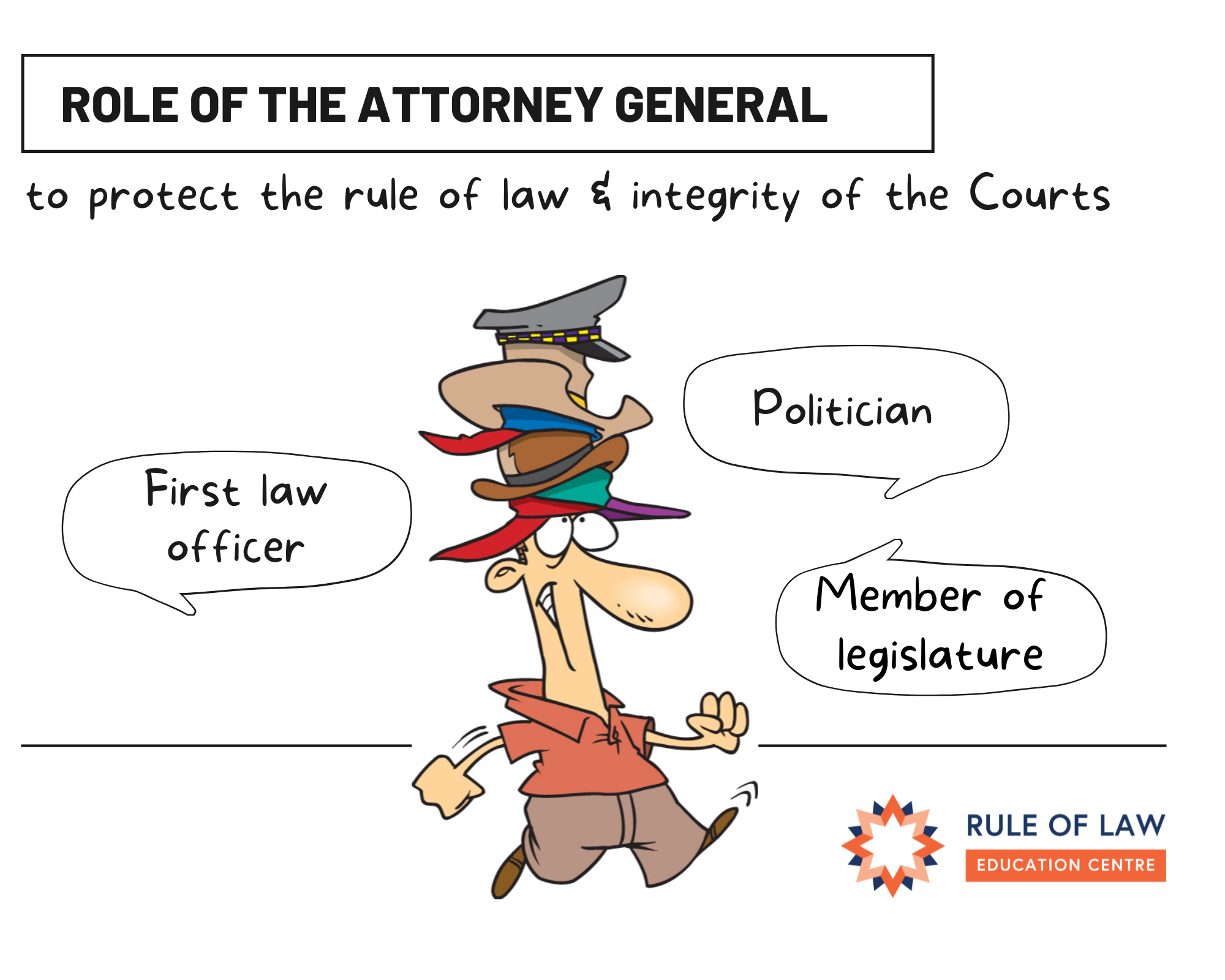
This means the Attorney-General must ensure the law is applied equally and fairly to everyone and that checks and balances are maintained between the three arms Of government — the legislature, the executive and judiciary.
An inherent part of the First Law Officer's responsibilities is also to ensure that each of these arms of government are accountable to the public.
As stated on the Attorney-General's website:
We uphold the rule of law through our daily work to ensure:
laws are clear, predictable and accessible
laws are publicly made and the community is able to participate in the law- making process
laws are publicly adjudicated in courts that are independent from the executive arm Of government
dispute settlement is fair and efficient where parties cannot resolve disputes themselves.
We support the Australian Government in being accountable for actions, making rational decisions and protecting human rights.
In essence, the Attorney-General is to be the promoter, protector and "head publicist" for the rule of law.
It is the Attorney-General's role to make sure there is public confidence in the rule of law and that those in power, whether they are the parliament, Executive, Judiciary, Media or Community leaders, adhere to the rule of law.
What would the Job Description for the Attorney-General look like?
In protecting the rule of law, the Attorney-General must ensure the law is allowed to take its course. This means the Attorney-General must uphold established legal traditions and processes such as the presumption of innocence and fair and prompt trials.
For criminal matters, the Attorney-General must ensure they are appropriately dealt with first by a police investigation and then by the judicial system. Parallel systems of justice and trial by media are contrary to the rule of law and erode public confidence in the integrity of the legal system to provide justice.
As First Law Officer, the Attorney-General is also responsible for the administration of justice. The duties include oversight of the Attorney General's Department, the federal government department which advises the Commonwealth government on issues such as constitutional and international law matters, industrial relations, workplace health and safety, institutional integrity, fraud and anti-corruption, the family law system and people's rights.
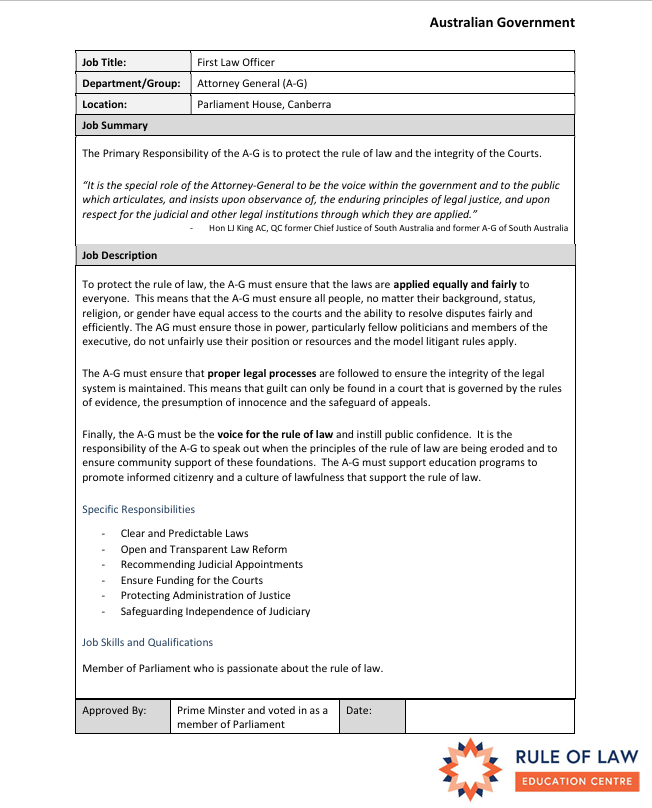
First Law Officer: The delegation of the administration of justice.
In protecting the rule of law, the Attorney-General must ensure the law is allowed to take its course. This means the Attorney-General must uphold established legal traditions and processes such as the presumption of innocence and fair and prompt trials.
For criminal matters, the Attorney-General must ensure they are appropriately dealt with first by a police investigation and then by the judicial system. Parallel systems of justice and trial by media are contrary to the rule of law and erode public confidence in the integrity of the legal system to provide justice.
As First Law Officer, the Attorney-General is also responsible for the administration of justice. The duties include oversight of the Attorney General's Department, the federal government department which advises the Commonwealth government on issues such as constitutional and international law matters, industrial relations, workplace health and safety, institutional integrity, fraud and anti-corruption, the family law system and people's rights.
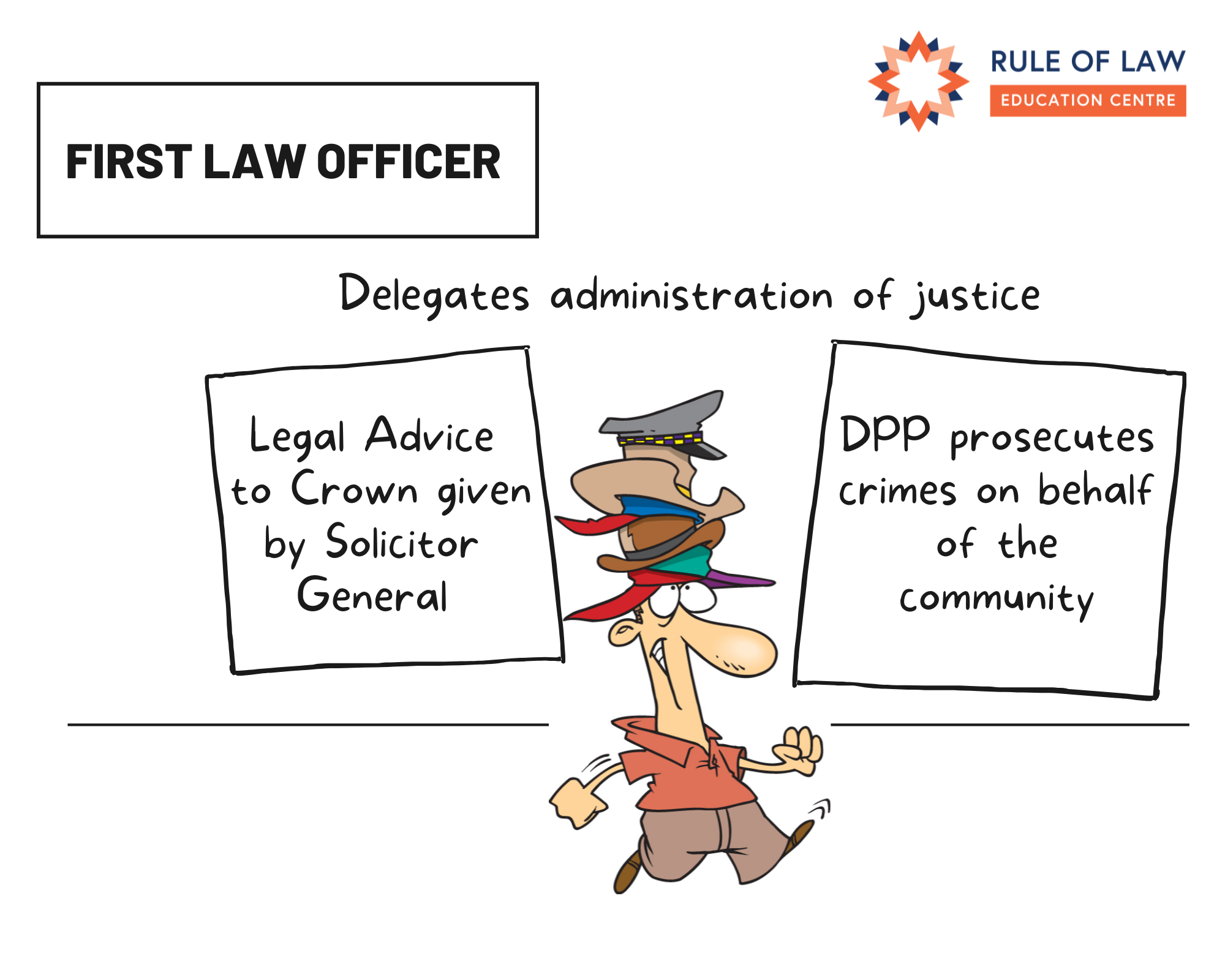
Under the Law Officers Act 1964 (Cth) some powers of the Attorney-General are delegated to other Law Officers. For example, the Solicitor- General acts as second Law Officer and provides legal advice to the Commonwealth and the Australian Government Solicitor. The Director of public prosecutions (DPP) is also a delegation under Director of public prosecutions Act 1983 to initiate and conduct public prosecutions.
At its most basic level, the rule of law is a simple concept. It requires that we have laws that are known, adhered to and enforced. The Australian Constitution creates a system of checks and balances on the use of power and divides the institutions of government into three arms. Each arm of government works within defined areas of responsibility and keeps a check on the actions of other.
The Attorney-General is appointed as the official "protector of the rule of law."
It is the responsibility of the Attorney-General to speak out when the principles of the rule of law are being eroded and to ensure community support of these foundations. The Attorney-General must promote an informed citizenry and a culture of lawfulness that supports the rule of law.
However, it is not solely the responsibility of the person elected as Attorney- General to promote and protect the rule of law. It is up to the Attorney- General to ensure that every Australian- whether they be the PM, a MP, lawyer, teacher, business leader or regular average Aussie, know and value the rule of law and are actively involved in ensuring the law is applied equally and fairly.
Explore Related Topics
-
Law is Known and Accessible
Explore resources on accessible law, highlighting why clear, and public rules are essential for fairness and social participation by enabling informed decision‑ making & transparent governance.
-
Democracy
Explore resources on democracy, highlighting how accountability and representative institutions ensure power is exercised fairly and transparently through open processes, civic engagement and responsible governance.
-
Open and Transparent Laws
Explore resources on transparent lawmaking, highlighting how accessible processes strengthen accountability and uphold democratic principles through responsible decision‑making.