
What is the Rule of Law?
-
The Rule of Law Wheel is a visual tool to explain the key principles that underpin a society governed by the rule of law. It breaks down complex legal ideas into four clear layers and helps students and the public understand how these elements work together to protect rights, limit power, and uphold justice.
-
This video outlines the underlying elements of the rule of law as fairness, rationality, predictability, consistency, and impartiality, that are essential because they ensure that laws are applied justly and protect individual rights in a democratic society.
-
Judge Culver of the District Court of NSW outlines the essential features of the rule of law and then illustrates what a society looks like without the rule of law in action.
Her Honour outlines a fictional case of an overseas tourist being given a package by a stranger. She looks at differing treatment by the police and courts depending on whether the country has the rule of law and how that impacts the accused’s access to justice.
-
When any of the elements of the Rule of Law are weakened— whether through corruption, erosion of judicial independence, suppression of dissent, or exclusion of certain groups from the democratic process—the foundations of democracy begin to crumble. This erosion can destabilise democratic institutions, paving the way for authoritarianism, lawlessness, or dictatorial rule. This not only undermines public trust in government but also threatens the rights and freedoms that democracy is meant to protect.
-
This poster forms part of the Informed Playing Card Project, showing that with the Rule of Law, all people are under the law.
-
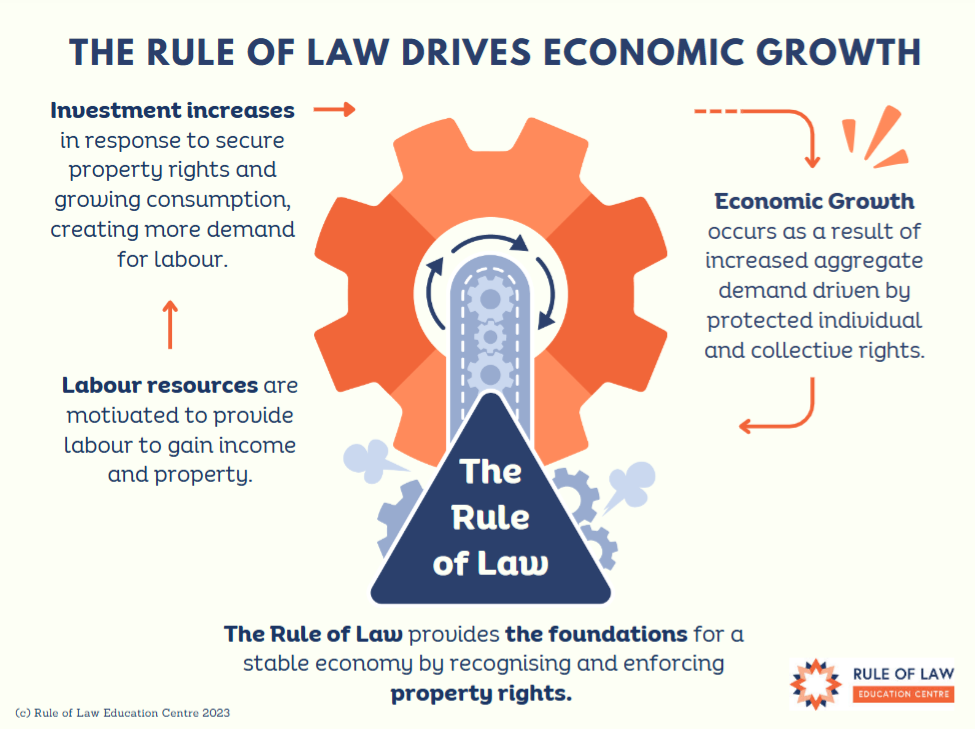
This poster shows how the rule of law provides the foundations for a stable economy by recognising and enforcing property rights with a motivated labour force, investment increase leading to economic growth
Playing Card: Rule of Law Drives Economic Growth
Related Resources
-
Explains the different ways scholars and institutions including AV Dicey, Lord Bingham, Professor Martin Krygier and the Rule of Law Education Centre define and interpret the rule of law, from minimalist approaches focused on procedural fairness to broader conceptions that include rights, accountability, and limits on power. Highlights how these varying perspectives shape public understanding, legal frameworks, and the practical application of rule‑of‑law principles in Australia.
-
The principles of the rule of law include equality before the law, clear and known laws, separation of powers, and an independent judiciary. The benefits are protection of rights, limits on arbitrary power, access to justice, accountability of government, and a stable, fair, and democratic society for all.
-
The 1951 Communist Party Case saw Australia’s High Court invalidate legislation banning the Communist Party, reaffirming that Parliament cannot declare its own constitutional authority. The decision powerfully reinforced judicial review, constitutional limits on executive action, and the rule of law during a period of intense Cold War fear.
Explore Related Topics
-
Equality Before the Law
Explore resources on equality before the law, including the Lost Parcel story, showing how legal rules apply fairly to all people, strengthening fairness in everyday situations.
-
Presumption of Innocence
Explore resources on the presumption of innocence, showing how the burden of proof protects the accused and safeguards fairness in criminal justice.
-
Independent and Impartial Judiciary
Explore resources on an independent and impartial judiciary, including the history of the Supreme Court & its role in delivering justice & strengthening trust in the judiciary.