
What is the Rule of Law?
-
This activity introduces students to the Rule of Law Index. Students then choose a country from the index and research the link between rule of law and the stability and success of a country.
-
A classroom‑ready guided video activity that teaches students the principles and benefits of the rule of law. Through short questions, matching tasks and real‑world reflections, learners explore how the rule of law protects rights, limits power, strengthens democracy and supports economic and social stability. Ideal for Legal Studies and Civics classrooms.
-
This activity assists students to apply concepts introduced in the Rule of Law Video. Included are Worksheets with fill in the blanks, a summary sheet and also flash cards with all the key rule of law values.
-
Reflection Activity designed as part of the Informed Civics Competition where students draw on the blank card what they have learned about the concept Rule of Law.
-
This activity resource guides students to analyse how rule of law principles operate in practice through the criminal case R v White, using structured tasks that test each spoke of the Rule of Law Wheel. It supports critical evaluation of equality before the law, judicial independence, accountability, human rights, and institutional checks and balances through case‑based discussion and extension questions.
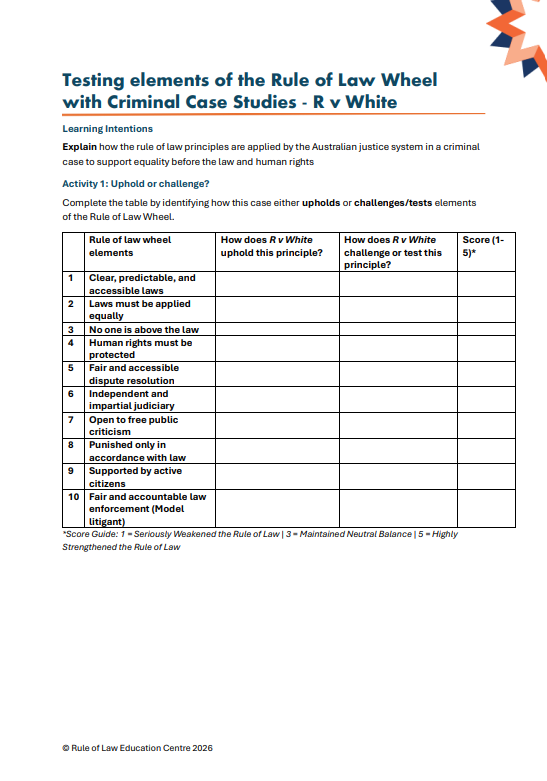
Testing elements of the Rule of Law Wheel with Criminal Case Studies - R v White
Learning Intentions
Explain how the rule of law principles are applied by the Australian justice system in a criminal case to support equality before the law and human rights
Activity 1:
Uphold or challenge? Complete the table by identifying how this case either upholds or challenges/tests elements of the Rule of Law Wheel.
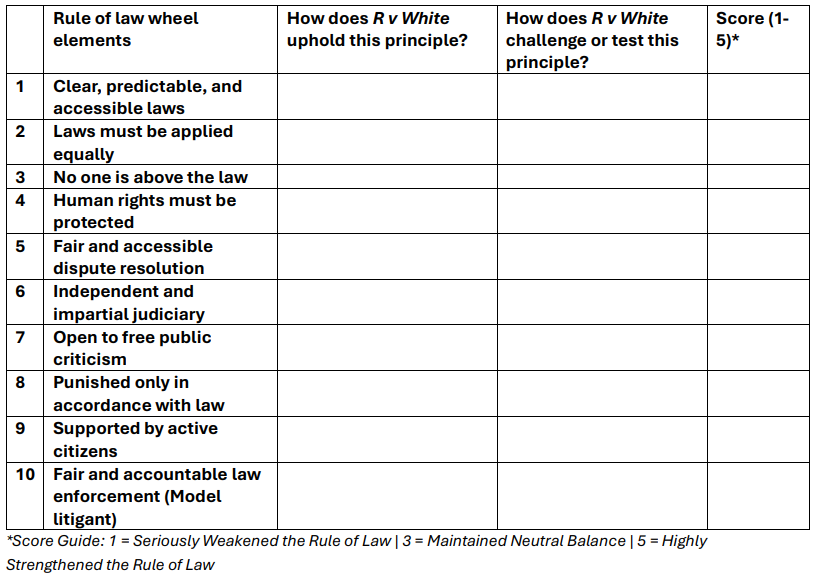
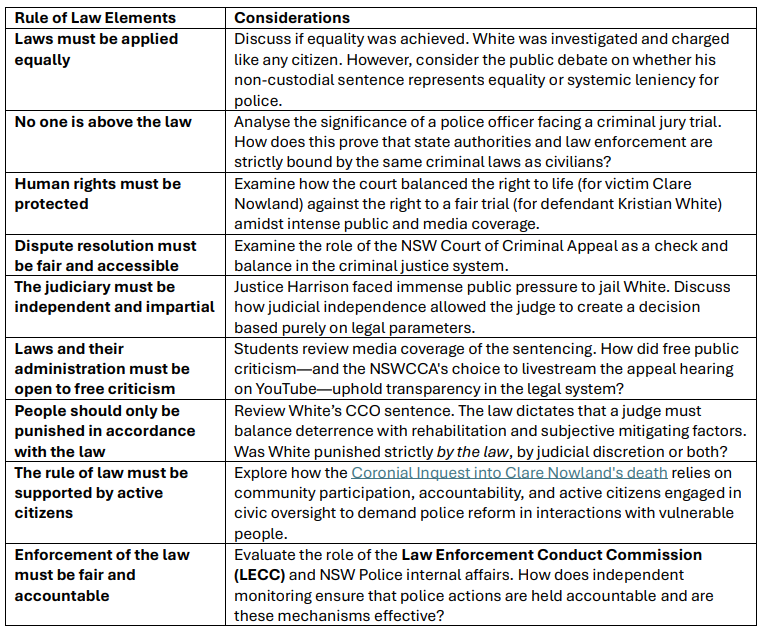
Activity 2: Rule of law considerations in R v White
Create a PPT that provides a response to the question, justifying your perspective with relevant elements of R v White.
Extension activities
Question 1 (4 Marks)
Explain how the case of R v White demonstrates the use of institutional "checks and balances" within the Australian legal system.
Question 2 (8 Marks)
Evaluate the extent to which the NSW criminal justice system achieved a balance between the rights of the victim, the rights of the offender, and the expectations of society in R v White. In your answer, refer directly to at least two spokes of the Rule of Law Wheel.
Related Resources
-
This page explains the rule of law as the foundation of democracy, where government and citizens are equally bound by clear, fair laws. It highlights equality before the law, independent courts, checks and balances, and a culture of lawfulness that protects rights and prevents abuse of power.
-
The Rule of Law Wheel is a visual tool to explain the key principles that underpin a society governed by the rule of law. It breaks down complex legal ideas into four clear layers and helps students and the public understand how these elements work together to protect rights, limit power, and uphold justice.
-
This activity resource guides students to analyse how rule of law principles operate in practice through the criminal case R v White, using structured tasks that test each spoke of the Rule of Law Wheel. It supports critical evaluation of equality before the law, judicial independence, accountability, human rights, and institutional checks and balances through case‑based discussion and extension questions.
Explore Related Topics
-
Equality Before the Law
Explore resources on equality before the law, including the Lost Parcel story, showing how legal rules apply fairly to all people, strengthening fairness in everyday situations.
-
Presumption of Innocence
Explore resources on the presumption of innocence, showing how the burden of proof protects the accused and safeguards fairness in criminal justice.
-
Independent and Impartial Judiciary
Explore resources on an independent and impartial judiciary, including the history of the Supreme Court & its role in delivering justice & strengthening trust in the judiciary.