
What is the Rule of Law?
-
Principles and Benefits of the Rule of Law explained for Australian students and teachers. In this video, the Rule of Law Education Centre explores the principles of the rule of law and explains how it benefits Australians economically, politically and socially. This educational video is designed to support secondary students and teachers studying Legal Studies, Civics and Citizenship, Commerce and Australian law.
-
The Rule of Law Wheel is a visual tool to explain the key principles that underpin a society governed by the rule of law. It breaks down complex legal ideas into four clear layers and helps students and the public understand how these elements work together to protect rights, limit power, and uphold justice.
-
This video outlines the underlying elements of the rule of law as fairness, rationality, predictability, consistency, and impartiality, that are essential because they ensure that laws are applied justly and protect individual rights in a democratic society.
-
Judge Culver of the District Court of NSW outlines the essential features of the rule of law and then illustrates what a society looks like without the rule of law in action.
Her Honour outlines a fictional case of an overseas tourist being given a package by a stranger. She looks at differing treatment by the police and courts depending on whether the country has the rule of law and how that impacts the accused’s access to justice.
-
When any of the elements of the Rule of Law are weakened— whether through corruption, erosion of judicial independence, suppression of dissent, or exclusion of certain groups from the democratic process—the foundations of democracy begin to crumble. This erosion can destabilise democratic institutions, paving the way for authoritarianism, lawlessness, or dictatorial rule. This not only undermines public trust in government but also threatens the rights and freedoms that democracy is meant to protect.
-
This poster forms part of the Informed Playing Card Project, showing that with the Rule of Law, all people are under the law.
-
This poster shows how the rule of law provides the foundations for a stable economy by recognising and enforcing property rights with a motivated labour force, investment increase leading to economic growth
-
This PowerPoint introduces teachers to the rule of law within the Year 11 Commerce and Legal Studies syllabuses, explaining the concept, its supporting principles, and why it matters in practice. It breaks down each principle using clear explanations, syllabus links, and a case‑based approach—showing how the Kristian White case illustrates the operation, fragility, and educational importance of the rule of law.
Poster: Rule of Law Wheel
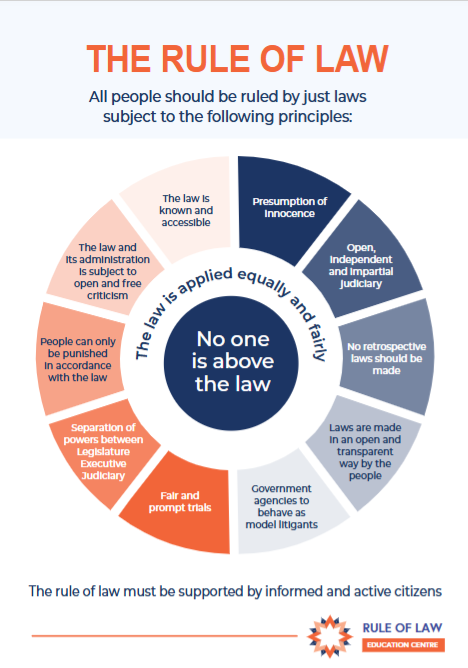
Overview
The Rule of Law Wheel is a visual tool to explain the key principles that underpin a society governed by the rule of law. It breaks down complex legal ideas into four clear layers and helps students and the public understand how these elements work together to protect rights, limit power, and uphold justice.
The Four Layers of the Rule of Law
The Core: People are ruled by just laws, and no one is above the law.
The government can only exercise its power within the boundaries set by the law. People have the freedom to do anything, as long as their actions do not break the law.
The Middle Ring: The law is applied equally and fairly.
For laws to be effective, they must be clear, certain, and predictable. This enables people to understand and follow them willingly. All people must follow the law and any dispute about the law must be resolved by the independent judiciary, who is free from political pressure and personal biases.
The Wheel Spokes: Checks and balances, such as legal principles, procedures and governing institutions, ensure the law is applied equally and fairly, so that no one is above the law.
These structures provide mechanisms to ensure Australians are governed by laws that their elected representatives make, and which reflect the rule of law. They also ensure that the law is administered justly and fairly.
The Support: Supported by a culture of lawfulness.
People, including those in power, follow the law because they believe it is fair, just and of benefit to the common good. Informed citizens play a crucial role by participating in decision making and holding leaders accountable.
Related Resources
-
This page explains the rule of law as the foundation of democracy, where government and citizens are equally bound by clear, fair laws. It highlights equality before the law, independent courts, checks and balances, and a culture of lawfulness that protects rights and prevents abuse of power.
-
This activity introduces students to the Rule of Law Index. Students then choose a country from the index and research the link between rule of law and the stability and success of a country.
-
The Rule of Law Wheel is a visual tool to explain the key principles that underpin a society governed by the rule of law. It breaks down complex legal ideas into four clear layers and helps students and the public understand how these elements work together to protect rights, limit power, and uphold justice.
Explore Related Topics
-
Equality Before the Law
Explore resources on equality before the law, including the Lost Parcel story, showing how legal rules apply fairly to all people, strengthening fairness in everyday situations.
-
Presumption of Innocence
Explore resources on the presumption of innocence, showing how the burden of proof protects the accused and safeguards fairness in criminal justice.
-
Independent and Impartial Judiciary
Explore resources on an independent and impartial judiciary, including the history of the Supreme Court & its role in delivering justice & strengthening trust in the judiciary.