
Australia: Making a Nation
-
This case note examines the War Precautions Act 1914, highlighting how the legislation granted broad executive powers, regulated public behaviour, and demonstrated the tension between national security and individual freedoms.
-
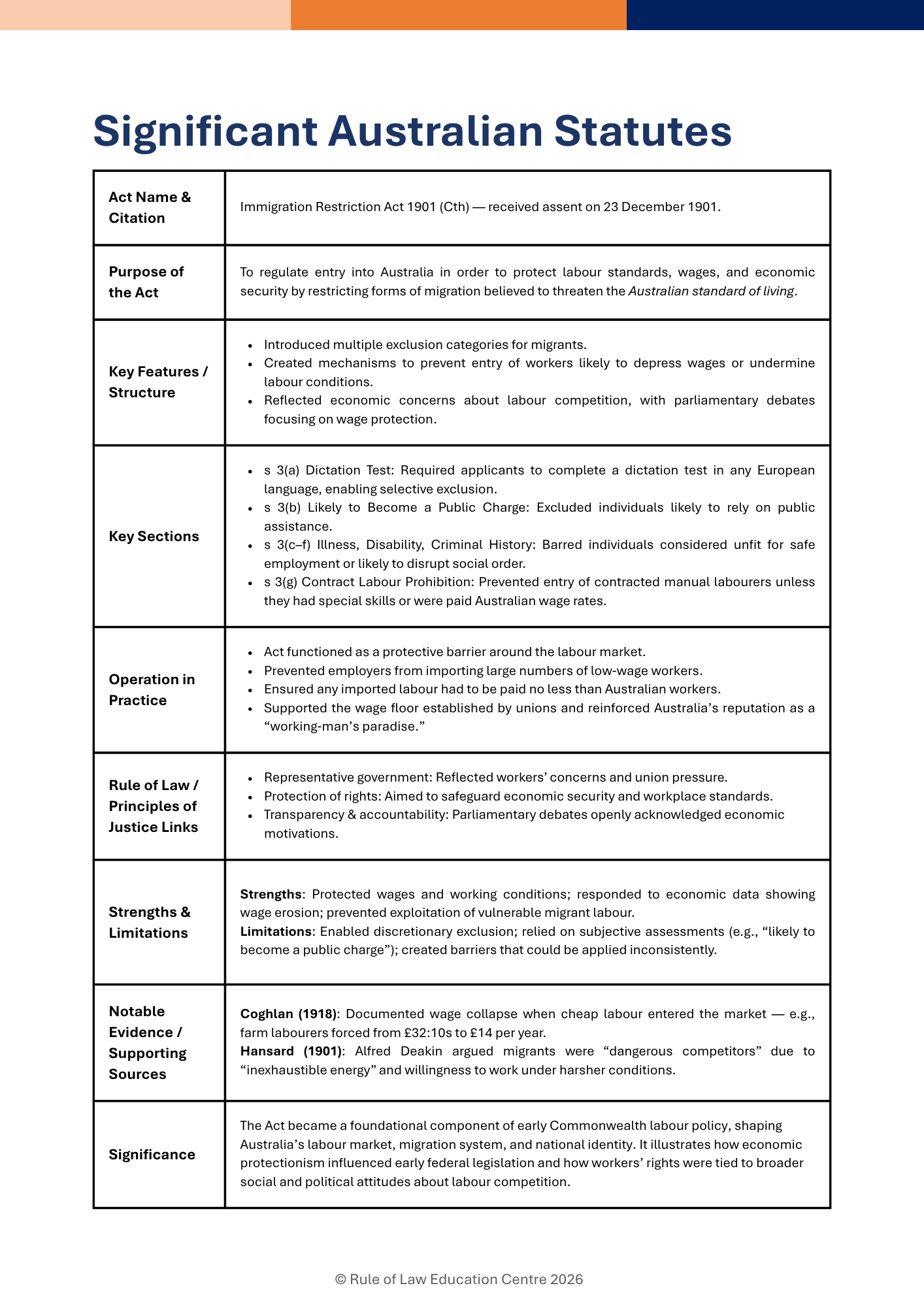
This case note examines the development of workers’ rights in Australia, focusing on trade unions’ advocacy for fair pay and safe conditions, and analysing how the Immigration Restriction Act 1901 affected labour markets and access to workplace protections.
-
A concise collection of case briefs summarising major Australian statutes that shaped democracy, workers’ rights, and constitutional development.
Case Briefs: Significant Australian Statutes
-
New South Wales Act 1823 (UK)

-
Australian Constitutions Act 1842 (UK)

-
Australian Constitutions Act 1850 (UK)

-
New South Wales Constitution Act 1855 (UK)

-
Trade Union Act 1881 (NSW)

-
Federal Council of Australasia Act 1885 (UK)

-
Commonwealth of Australia Constitution Act 1900

-
Immigration Restriction Act 1901 (Cth)
-
War Precautions Act 1914 (Cth)

Related Resources
-
An overview of the key features of the Australian Constitution, including its role as the highest source of law, its democratic structure, and its deliberate division and separation of powers. It explains federalism, the responsibilities of the Parliament, Executive and Judiciary, the High Court’s constitutional role, and the Constitution’s reliance on the rule of law and responsible government rather than a full Bill of Rights.
-
A summary of the key arguments for and against Federation in Australia, including support for unified defence, emerging nationalist ideas, immigration control, and economic disagreements. It also outlines major developments from the 1880s to 1901, from the Federal Council and Tenterfield Oration to the Conventions, referendums, and final passage of the Constitution.
Explore Related Topics
-
Federation of Australia
Explore resources on Federation in 1901, outlining how Australia became a nation, divided powers, and established the constitutional structures and institutions that govern today.
-
Democracy
Explore resources on democracy, highlighting how accountability and representative institutions ensure power is exercised fairly and transparently through open processes, civic engagement and responsible governance.
-
Human Rights
Explore resources on human rights and freedoms, outlining the key protections, legal frameworks, that support rights, and explore how rights and responsibilities are balanced against government power in Australia.