
Australia: Making a Nation
-
An overview of the major factors that shaped the development of democracy in Australia, including egalitarian legal ideals shown in cases like Kable v Sinclair, the introduction of checks and balances through institutions such as the Supreme Court and a free press, the influence of immigration and political activism including Chartism and the Eureka Stockade, and the constitutional debates that led the colonies to design their own representative systems of government.
-
A summary of the key arguments for and against Federation in Australia, including support for unified defence, emerging nationalist ideas, immigration control, and economic disagreements. It also outlines major developments from the 1880s to 1901, from the Federal Council and Tenterfield Oration to the Conventions, referendums, and final passage of the Constitution.
-
This explainer examines the War Precautions Act 1914, highlighting how the legislation granted broad executive powers, regulated public behaviour, and demonstrated the tension between national security and individual freedoms.
-
An overview of the key features of the Australian Constitution, including its role as the highest source of law, its democratic structure, and its deliberate division and separation of powers. It explains federalism, the responsibilities of the Parliament, Executive and Judiciary, the High Court’s constitutional role, and the Constitution’s reliance on the rule of law and responsible government rather than a full Bill of Rights.
-
This explainer examines the development of workers’ rights in Australia, focusing on trade unions’ advocacy for fair pay and safe conditions, and analysing how the Immigration Restriction Act 1901 affected labour markets and access to workplace protections.
-
An overview of the Commonwealth Franchise Act 1902 and its significance in expanding political rights for women in Australia. It explains how the Act granted most Australian women the right to vote and stand for federal Parliament, placing Australia among the earliest countries to adopt women’s suffrage. The explainer also outlines the Act’s limitations, and examines its broader impact on democratic participation and later reforms.
COMING SOON!
-
An overview of how governance structures in New South Wales have evolved from the early colonial period to the present, highlighting key changes such as the shift from autocratic rule to responsible government, the development of democratic institutions, and the introduction of checks and balances. It also identifies elements of continuity, including the ongoing influence of Westminster traditions, the role of the Governor, and the structure of Parliament within the NSW system of government.
The features of the Australian Constitution, including federalism, the division of powers and separation of powers
Australia’s Highest Law
The Australian Constitution is the nation's highest law. It establishes the framework of government and determines how power is distributed and exercised.
A central purpose of the Constitution is to prevent power from becoming concentrated in a single institution or level of government. To achieve this, the Constitution distributes power in two important ways:
Between different levels of government through federalism and the division of powers.
Between different branches of government through the separation of powers.
Together, these features support democracy, protect the rule of law, and help ensure that the government remains accountable to the Australian people.
Democracy
Although the word democracy does not appear in the Constitution, it establishes a system of representative government in which citizens elect members of Parliament to make laws on their behalf.
The Constitution was created through a process of negotiation, public debate, and popular approval. Unlike many constitutions that emerged from revolution or conflict, Australia's Constitution was accepted by the people of the colonies and can only be changed through a referendum.
COMMONWEALTH OF AUSTRALIA
CONSTITUTION ACT
9 July 1900
WHEREAS the people of New South Wales, Victoria, South Australia, Queensland, and Tasmania, humbly relying on the blessing of Almighty God, have agreed to unite in one indissoluble Federal Commonwealth under the Crown of the United Kingdom of Great Britain and Ireland, and under the Constitution hereby established...
Excerpt from the Commonwealth of Australia Constitution Act 1900 (UK) https://www.foundingdocs.gov.au/item-sdid-82.html
The Constitution therefore derives its authority from the people and provides the legal framework within which democratic government operates.
It is carefully structured into chapters that organise how this framework works in practice. Chapter I sets out the Parliament, Chapter II the Executive Government, and Chapter III the Judicature. Later chapters deal with areas such as the states, finance and trade, and the process for altering the Constitution.
THE CONSTITUTION
This Constitution is divided as follows:—
Chapter I. The Parliament:
Part I. General:
Part II. The Senate:
Part III. The House of Representatives:
Part IV. Both Houses of the Parliament:
Part V. Powers of the Parliament:
Chapter II. The Executive Government:
Chapter III. The Judicature:
Chapter IV. Finance and Trade:
Chapter V. The States:
Chapter VI. New States:
Chapter VII. Miscellaneous:
Chapter VIII. Alteration of the Constitution.
The Schedule.
Chapters of the Australia Constitution. https://www.austlii.edu.au/cgi-bin/viewdb/au/legis/cth/consol_act/coaca430/
Federalism and Division of Powers
Federalism is a system of government in which power is shared between a national government and smaller, regional governments.
When Australia federated in 1901, the six colonies became states within a new Commonwealth of Australia. Rather than creating a single central government, the Constitution preserved the autonomy of the states by dividing governmental responsibilities between the Commonwealth and the states.
This arrangement was described during the Constitutional Conventions by Sir Samuel Griffith, one of the drafters of the Constitution and the first Chief Justice of the Hight Court of Australia:
Australasian Federation Conference
Wednesday 4th March, 1891
Sir SAMUEL GRIFFITH: We must not lose sight of the essential condition that this is to be a federation of States and not a single government of Australia…
The separate States are to continue as autonomous bodies, surrendering only so much of their power as is necessary to the establishment of a general government to do for them collectively what they cannot do individually for themselves...
Excerpt from the Australasian Federation Conference 4 March 1891, https://parlinfo.aph.gov.au/parlInfo/search/display/display.w3p;query=Id%3A%22constitution%2Fconventions%2F1891-1015%22
Federalism allows matters of national importance to be managed by the Commonwealth while enabling state governments to address local and regional needs.
The division of powers is the mechanism through which federalism operates. The Constitution allocates law-making powers between the Commonwealth and the states.
Sections 51 and 52 of the Constitution give the Commonwealth Parliament power to make laws in specified areas, including defence, immigration, trade and commerce, external affairs, and taxation. These powers are exclusive to the Commonwealth.
Powers not specifically granted to the Commonwealth remain with the states. These are known as residual powers and include areas such as education, health, public transport, criminal law, and local infrastructure. Because state governments are closer to local communities, they are often better positioned to manage these services.
Occasionally Commonwealth and state laws overlap. Section 109 of the Constitution provides that where a valid Commonwealth law is inconsistent with a state law, the Commonwealth law prevails to the extent of the inconsistency. This ensures national consistency while maintaining the federal structure.
Separation of Powers
While federalism divides power between different levels of government, the separation of powers divides power between different branches of government.
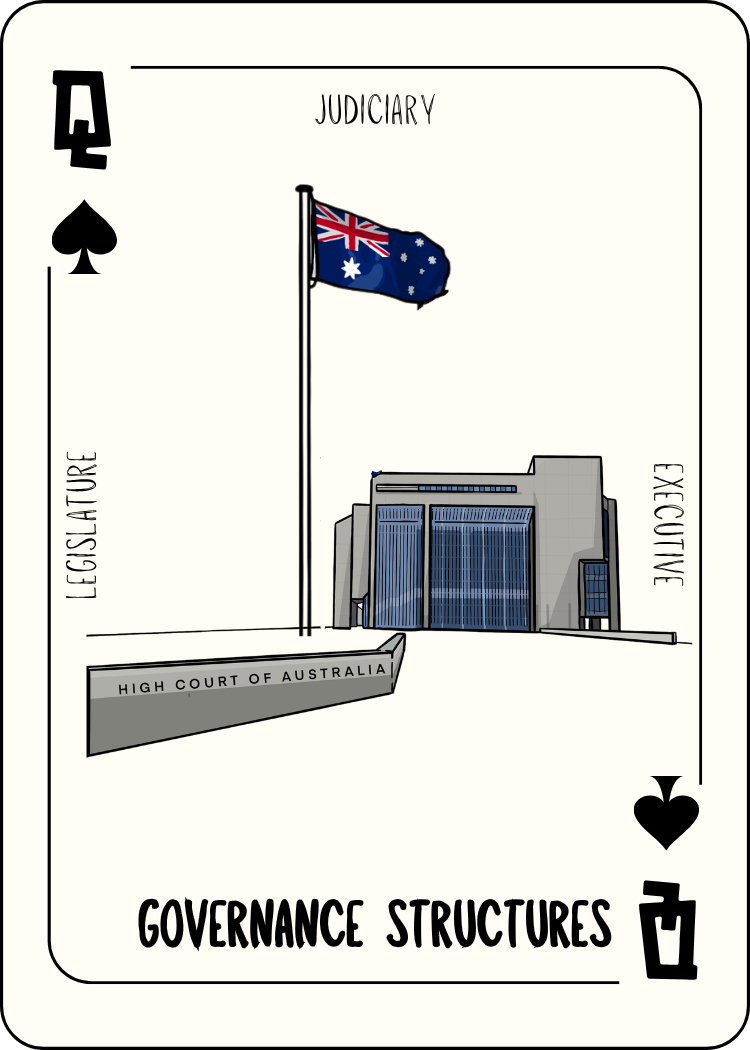
The Constitution separates governmental authority into three distinct powers:
Legislative power is the power to make and change the law. This power is exercised by the Commonwealth and state parliaments. The Commonwealth Parliament (and most state parliaments) are bicameral, meaning they have an Upper House (the Senate) and a Lower House (the House of Representatives). Having two levels of scrutiny helps to ensure that proposed laws are carefully examined before being enacted.
Executive power is the power to administer and enforce the law. This power is exercised by the Governor-General, the Prime Minister, ministers, and government departments and agencies (e.g., the police). The Executive is responsible for the day-to-day operation of government and for implementing laws passed by Parliament.
Judicial power is the power to interpret and apply the law. This power is exercised by the courts, particularly the High Court of Australia, which was established by the Constitution. The High Court performs two important functions: interpreting the Constitution and acting as Australia's final court of appeal.
Judicial Independence
An independent judiciary ensures that disputes are resolved according to law rather than political influence. The Constitution protects judicial independence by providing judges with security of tenure, and protection of their salaries. These safeguards help ensure that judges can make decisions impartially, even when those decisions are unpopular with governments or the public.
The Rule of Law
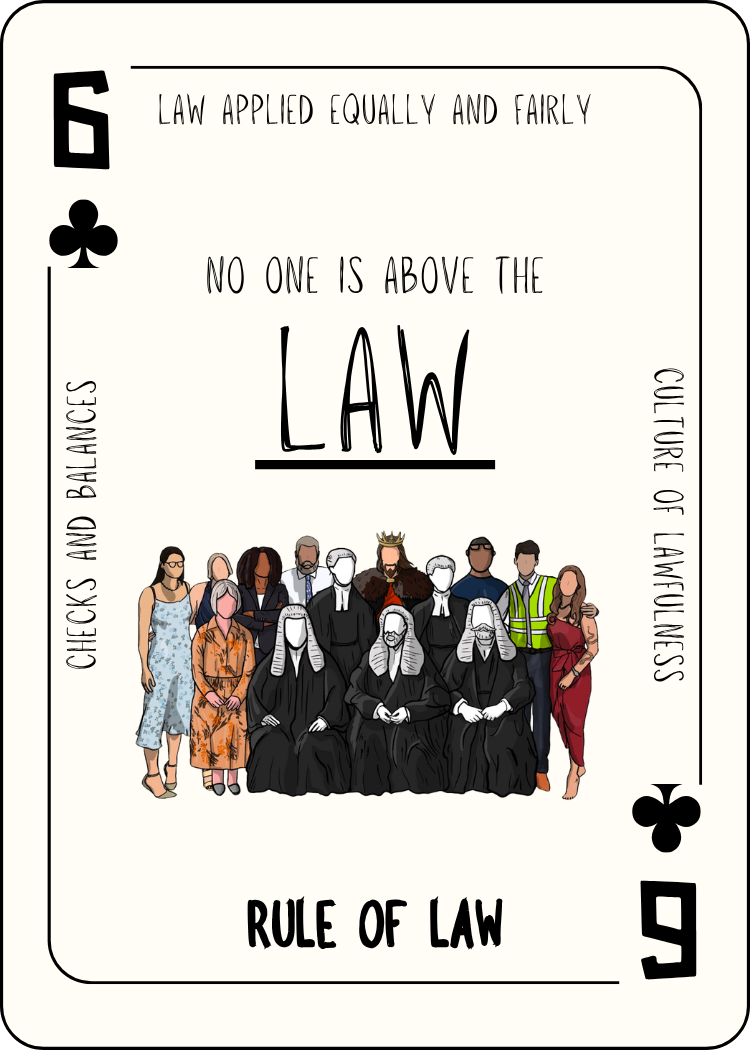
The Constitution is founded on the principle of the rule of law, which requires that all individuals and institutions are subject to the same law. This principle means that Parliament must act within constitutional limits, the Executive must exercise its powers lawfully, and the courts must apply the law impartially.
The rule of law is reinforced by both the division of powers (federalism) and the separation of powers. Because power is distributed among different institutions, governments are subject to legal checks and cannot exercise authority without limitation.
Rights, Freedoms and Responsible Government
The Australian Constitution contains relatively few express rights. This was a deliberate choice by the framers, who saw the Constitution’s main purpose as establishing a system of government that would protect rights through its structure, rather than by listing them in a single document.
They believed that rights are only meaningful when supported by strong institutions and a culture that values and defends them. In their view, rights written on paper offer limited protection unless the system of government encourages accountability, limits power and reflects the will of the people.
The framers expected rights and freedoms to be protected through several key features of the Constitution, including representative democracy, responsible government, the rule of law, the division of powers, and the separation of powers.
Under responsible government, ministers must maintain the confidence of Parliament. If a minister loses that confidence, they can be removed from office, creating a direct link between the actions of government and the expectations of the people.
Many attendees at the Constitutional Conventions argued that democratic institutions themselves would provide strong protection for individual freedoms. They believed that governments elected by the people would be unlikely to restrict fundamental liberties. As Mr Trenwith stated during the debates:
Australasian Federation Conference
Wednesday 2nd March, 1898
Mr. O’CONNOR.-There is no portion of the Bill which gives any right of citizenship, or points out what citizenship is.
Mr. TRENWITH (Victoria).-The honorable member who has just sat down has assumed a possible difficulty that I cannot conceive is likely to occur. He assumes that unless we define clearly what we mean by citizenship, the Federal Parliament may take such action as will infringe some liberties which we now possess, and which we ought to possess. When we remember that we have provided in the Constitution that both Houses of Parliament shall be elected on the broadest possible franchise, it seems to me to be utterly impossible to conceive that such a Parliament will proceed to infringe any of the liberties of the citizens.
Excerpt from the Australasian Federation Conference 2 March 1898. https://parlinfo.aph.gov.au/parlInfo/search/display/display.w3p;query=Id%3A%22constitution%2Fconventions%2F1898-1120%22
The Australian Constitution establishes a system of limited and accountable government. Through federalism and the division of powers, authority is shared between the Commonwealth and the states. Through the separation of powers, legislative, executive and judicial functions are allocated to different institutions.
Together, these features prevent excessive concentrations of power, uphold the rule of law, and support Australia's system of representative democracy. They remain fundamental to the operation of government and the protection of human rights in Australia today.

Related Resources
-
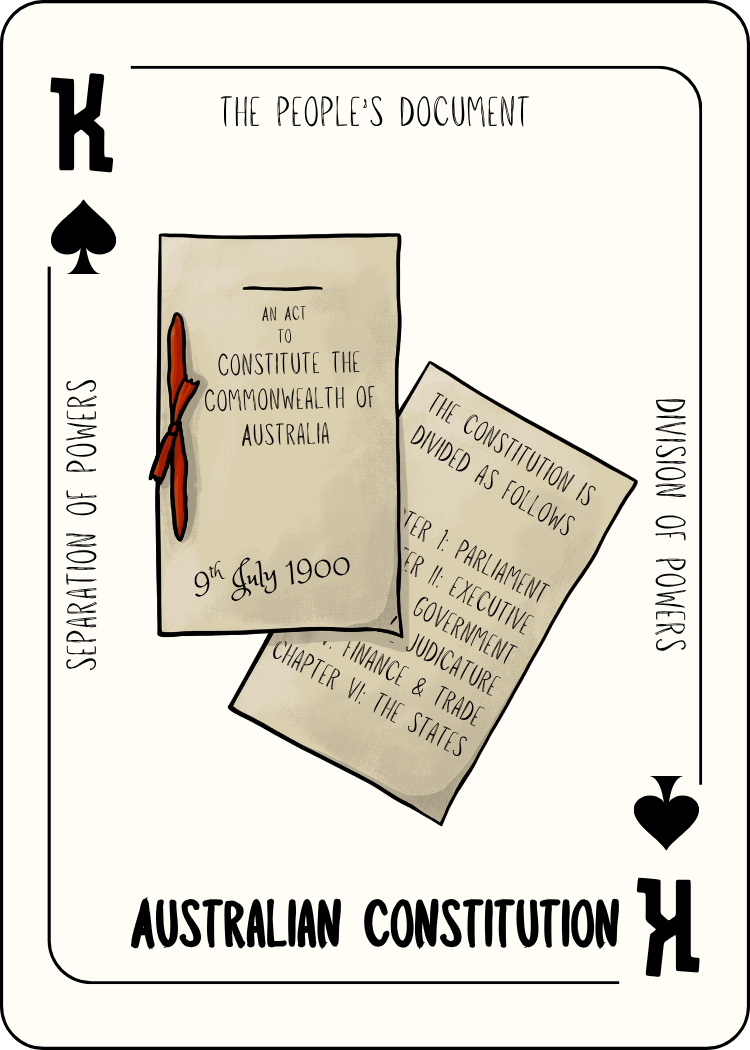
This resource provides structured questions that help students unpack the core principles and institutional arrangements embedded in the Australian Constitution. It encourages examination of how federalism and separated powers distribute authority and safeguard democratic governance.
-
An overview of how governance structures in New South Wales have evolved from the early colonial period to the present, highlighting key changes such as the shift from autocratic rule to responsible government, the development of democratic institutions, and the introduction of checks and balances. It also identifies elements of continuity, including the ongoing influence of Westminster traditions, the role of the Governor, and the structure of Parliament within the NSW system of government.
-
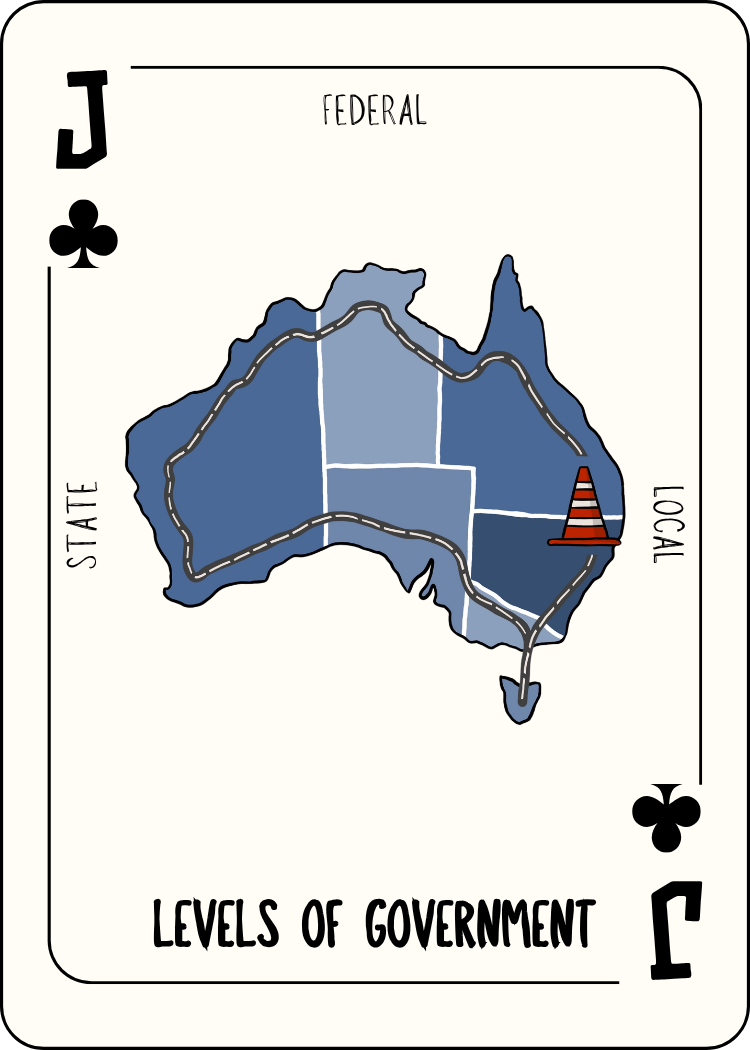
A summary of the key arguments for and against Federation in Australia, including support for unified defence, emerging nationalist ideas, immigration control, and economic disagreements. It also outlines major developments from the 1880s to 1901, from the Federal Council and Tenterfield Oration to the Conventions, referendums, and final passage of the Constitution.
Explore Related Topics
-
Federation of Australia
Explore resources on Federation in 1901, outlining how Australia became a nation, divided powers, and established the constitutional structures and institutions that govern today.
-
Democracy
Explore resources on democracy, highlighting how accountability and representative institutions ensure power is exercised fairly and transparently through open processes, civic engagement and responsible governance.
-
Human Rights
Explore resources on human rights and freedoms, outlining the key protections, legal frameworks, that support rights, and explore how rights and responsibilities are balanced against government power in Australia.