
Australia: Making a Nation
-
An overview of the major factors that shaped the development of democracy in Australia, including egalitarian legal ideals shown in cases like Kable v Sinclair, the introduction of checks and balances through institutions such as the Supreme Court and a free press, the influence of immigration and political activism including Chartism and the Eureka Stockade, and the constitutional debates that led the colonies to design their own representative systems of government.
-
A summary of the key arguments for and against Federation in Australia, including support for unified defence, emerging nationalist ideas, immigration control, and economic disagreements. It also outlines major developments from the 1880s to 1901, from the Federal Council and Tenterfield Oration to the Conventions, referendums, and final passage of the Constitution.
-
This explainer examines the War Precautions Act 1914, highlighting how the legislation granted broad executive powers, regulated public behaviour, and demonstrated the tension between national security and individual freedoms.
-
An overview of the key features of the Australian Constitution, including its role as the highest source of law, its democratic structure, and its deliberate division and separation of powers. It explains federalism, the responsibilities of the Parliament, Executive and Judiciary, the High Court’s constitutional role, and the Constitution’s reliance on the rule of law and responsible government rather than a full Bill of Rights.
-
This explainer examines the development of workers’ rights in Australia, focusing on trade unions’ advocacy for fair pay and safe conditions, and analysing how the Immigration Restriction Act 1901 affected labour markets and access to workplace protections.
-
An overview of the Commonwealth Franchise Act 1902 and its significance in expanding political rights for women in Australia. It explains how the Act granted most Australian women the right to vote and stand for federal Parliament, placing Australia among the earliest countries to adopt women’s suffrage. The explainer also outlines the Act’s limitations, and examines its broader impact on democratic participation and later reforms.
COMING SOON!
-
An overview of how governance structures in New South Wales have evolved from the early colonial period to the present, highlighting key changes such as the shift from autocratic rule to responsible government, the development of democratic institutions, and the introduction of checks and balances. It also identifies elements of continuity, including the ongoing influence of Westminster traditions, the role of the Governor, and the structure of Parliament within the NSW system of government.
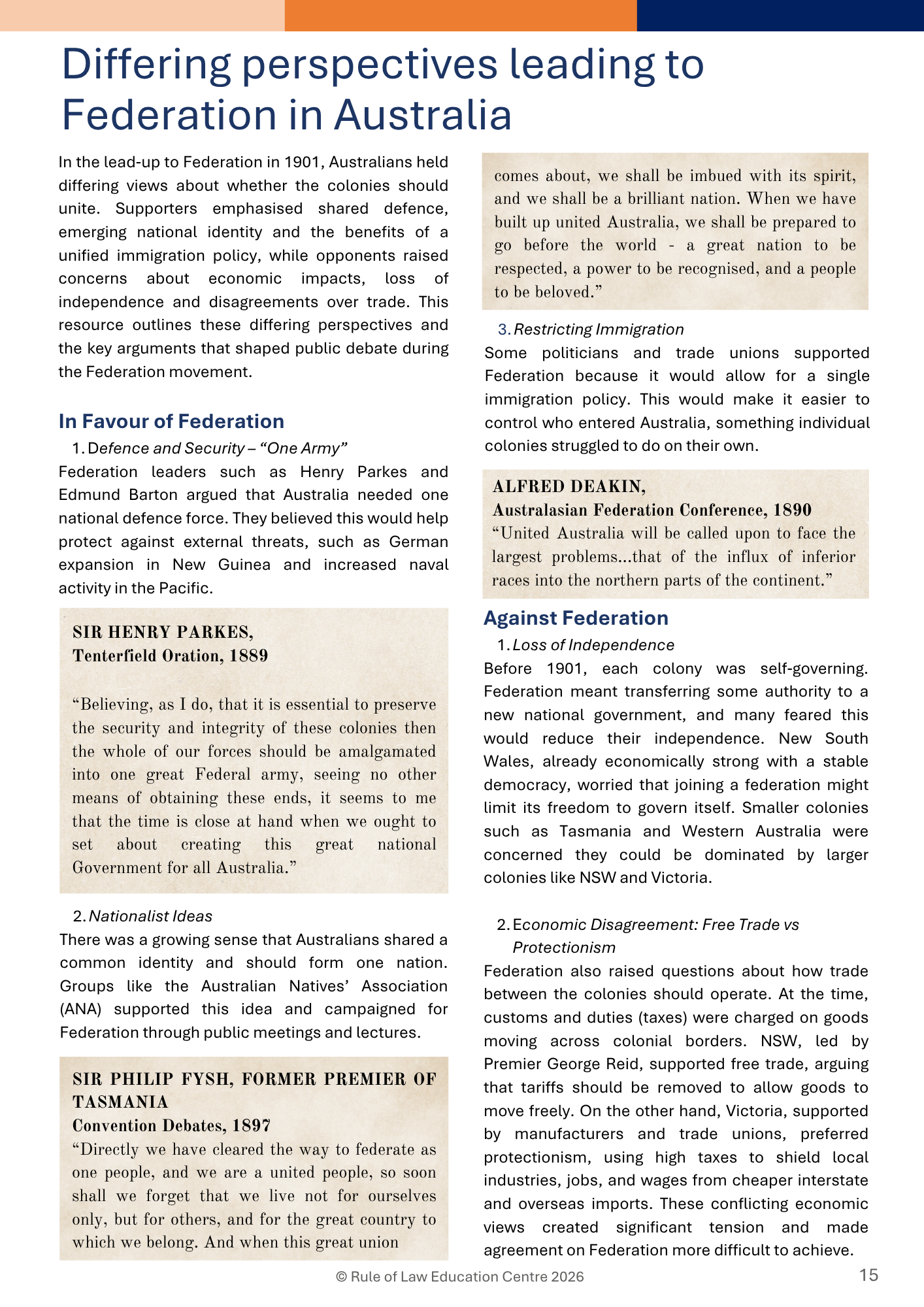
Differing perspectives leading to Federation in Australia
In the lead‑up to Federation in 1901, Australians held differing views about whether the colonies should unite. Supporters emphasised shared defence, emerging national identity and the benefits of a unified immigration policy, while opponents raised concerns about economic impacts, loss of independence and disagreements over trade. This resource outlines these differing perspectives and the key arguments that shaped public debate during the Federation movement.
In Favour of Federation
Defence and Security – “One Army”
Federation leaders such as Henry Parkes and Edmund Barton argued that Australia needed one national defence force. They believed this would help protect against external threats, such as German expansion in New Guinea and increased naval activity in the Pacific.
Sir Henry Parkes,
Tenterfield Oration, 1889
“Believing, as I do, that it is essential to preserve the security and integrity of these colonies then the whole of our forces should be amalgamated into one great Federal army, seeing no other means of obtaining these ends, it seems to me that the time is close at hand when we ought to set about creating this great national Government for all Australia”
Excerpt from Sir Henry Parkes’ Tenterfield Oration 1889
Nationalist Ideas
There was a growing sense that Australians shared a common identity and should form one nation. Groups like the Australian Natives’ Association (ANA) supported this idea, who campaigned for Federation through public meetings and lectures.
Sir Philip Fysh, former Premier of Tasmania
Convention Debates, 1897
“Directly we have cleared the way to federate as one people, and we are a united people, so soon shall we forget that we live not for ourselves only, but for others, and for the great country to which we belong. And when this great union comes about, we shall be imbued with its spirit, and we shall be a brilliant nation. When we have built up united Australia, we shall be prepared to go before the world- a great nation to be respected, a power to be recognised, and a people to be beloved.”
Excerpt from speech by Sir Philip Fysh, Australasian Federation Conference, 29 March 1897. https://parlinfo.aph.gov.au/parlInfo/search/display/display.w3p;query=Id%3A%22constitution%2Fconventions%2F1897-1045%22;rec=0
Restricting Immigration
Some politicians and trade unions supported Federation because it would allow for a single immigration policy. This would make it easier to control who entered Australia, something individuals colonies struggled to do on their own.
Alfred Deakin,
Australasian Federation Conference, 1890
“United Australia will be called upon to face the largest problems...that of the influx of inferior races into the northern parts of the continent.”
Except from speech by Alfred Deakin, Constitution Convention Debates, Melbourne 14 February 1890 .https://parlinfo.aph.gov.au/parlInfo/search/display/display.w3p;page=0;query=constitutional%20convention,%2010%20february%201890%20Decade%3A%221890s%22;rec=4;resCount=Default
Against Federation
Loss of Independence
Before 1901, each colony was self‑governing. Federation meant transferring some authority to a new national government, and many feared this would reduce their independence. New South Wales, already economically strong with a stable democracy, worried that joining a federation might limit its freedom to govern itself. Smaller colonies such as Tasmania and Western Australia were concerned they could be dominated by larger colonies like NSW and Victoria.
Economic Disagreement: Free Trade vs Protectionism
Federation also raised questions about how trade between the colonies should operate. At the time, customs duties (taxes) were charged on goods moving across colonial borders. NSW, led by Premier George Reid, supported free trade, arguing that tariffs should be removed to allow goods to move freely. On the other hand, Victoria, supported by manufacturers and trade unions, preferred protectionism, using high taxes to shield local industries, jobs and wages from cheaper overseas imports. These conflicting economic views created significant tension and made agreement on Federation more difficult to achieve.
Key developments leading to Federation in Australia
1880s
External threats and internal barriers
France and Germany were trying to expand their influence in the South Pacific, so the Australian colonies believed they would be stronger if they united.
At the same time, trade and movement between the colonies were increasing, but so was rivalry between the separate, self-governing colonies.
1885
Federal Council of Australasia is formed
The separate colonies did not have the law making power to establish an intercolonial body, so the British Government passed the Federal Council of Australasia Act 1885 to establish a Federal Council. With it’s first meeting in 1886, the Council discussed shared issues, particularly in regards to defence. However, the Council had limited power and no independent funding, which meant it relied on the colonies to follow its decisions. NSW refused to join, which weakened its effectiveness.
An Act to constitute a Federal Council of Australasia. l4th August, 1885.
WHEREAS it is expedient to constitute a Federal Council of Australasia, for the purpose of dealing with such matters of common Australasian interest, in respect to which united action is desirable, as can be dealt with without unduly interfering with the management of the internal affairs of the several colonies by their respective legislatures:
“Colonies.”—The colonies (including their respective dependencies) of Fiji, New Zealand, New South Wales, Queensland,
Tasmania, Victoria, and Western Australia, and the province of South Australia...
Excerpt from Act to Constitute Federal Council of Australia , 14 August 1885 https://nla.gov.au/nla.obj-2617283260/view?partId=nla.obj-2617285560#page/n0/mode/1up
1889
Tenterfield Oration
NSW Premier, Sir Henry Parkes, delivered a significant speech in Tenterfield, calling for the Australian colonies to unite. He argued that the colonies faced growing external threats and needed a national government.
This speech highlighted the limitations of the Federal Council and reignited the Federation movement, now with the support of NSW.
Sir Henry Parkes
Tenterfield Oration
The Imperial General who had inspected the forces of the colony had recommended that the whole of the forces of Australia should be united into one army...this Federal Council had no power to do anything of the sort, as it was not an elective body, but merely a body appointed by the Governments of the various colonies...
The great question which they had to consider was, whether the time had not now arisen for the creation on this Australian continent of an Australian Government, as distinct from a local Government and an Australian Parliament. (Applause.)
In other words, to make himself as plain as possible, Australia had now a population of three and a half millions, and the American people numbered only between three and four millions when they formed the great commonwealth of the United States. The numbers were about the same, and surely what the Americans had done by war, the Australians could bring about in peace. (Cheers.)
Excerpt from Sir Henry Parkes’ Tenterfield Oration Sydney Morning Herald 25 October 1889. https://trove.nla.gov.au/newspaper/article/13746899
On 6th February 1890, Parkes went on to make his famous statement that “the crimson thread of kinship runs through us all.
1891
First National Australasian Convention held in Sydney
With Parkes as the Chairman, delegates elected by each colony’s parliament met to discuss Federation. A draft constitution was written, largely by Sir Samuel Griffith based on a draft by Inglis Clark for a new national government to be called ‘The Commonwealth of Australia.’
However, the plan did not succeed because of disagreements between colonies, particularly over economic issues such as free trade and protectionism.
1891-4
Economic Depression
The economic depression of the 1890s helped build support for Federation because it exposed how poorly the separate colonies could manage a shared crisis. The hardship showed that the colonies were economically connected but lacked a unified approach, leading many to argue that a federal government with consistent policies and free trade between colonies would create a stronger, more stable economy.
1893
Corowa Conference
The Corowa Conference led to an important change in the Federation process. Bendigo lawyer John Quick proposed that the Constitution should be created by elected delegates and then voted on by the people in a referendum. This idea shifted power from colonial parliament to the people, giving them sovereignty and making the process more democratic.
This plan was accepted in 1895, and adopted by four colonial parliaments: NSW, VIC, SA and TAS.
Dr QUICK (Bendigo) moved the second resolution:
“at the next general election they would have men of action returned and steps might immediately be taken to bring about an Australian Congress of delegates, whose commission would be directly from the people, to formulate a federal Constitution”
Excerpt from Corowa Convention article, Sydney Morning Herald 2 August 1893. https://trove.nla.gov.au/newspaper/article/13926389#
1894
South Australia grants women the right to vote
The decision to grant women the right to vote and stand for Parliament was an important development leading to Federation because it showed that major democratic reform was possible within the colonies and created pressure for a more consistent national voting system. It highlighted differences between colonial electorates and encouraged discussion about broader political rights in a future Commonwealth.
1887-8
Second National Australasian Convention met three times
The Second National Australasian Convention met three times, bringing together elected delegates from each colony under the leadership of Edmund Barton to draft the Australian Constitution. Using the earlier draft from the first convention as a starting point, delegates carefully debated each clause. The final document established a federal system of government, a bicameral parliament, and a mechanism for resolving disagreements between the two houses, drawing on both British and American constitutional ideas.
Delegates also agreed that, for the first federal election, voters would keep the same voting rights they held in their own colonies. This meant that women in South Australia (who already had the right to vote and stand for Parliament) were able to participate in federal elections, making them among the first women in the world to vote in a national parliament.
1898-9
Referendums: The people vote
The proposed Constitution was put to voters in each colony through a series of referendums. In 1898, most colonies held their first vote. Although a majority supported the Constitution, it did not meet the required approval level in New South Wales, and neither Queensland nor Western Australia held a referendum that year.
After minor amendments were made, a second round of referendums took place in 1899, this time including Queensland. All colonies except Western Australia voted “Yes.” Western Australia later held its own referendum in 1900, approved the Constitution, and joined the Federation.
1900 - 1901
Federation Achieved
Britain still held legal authority over the Australian colonies, so the draft Constitution required approval from the British Parliament. This approval was granted when the Commonwealth of Australia Constitution Act passed in 1900, giving legal effect to the new federal system. Federation officially commenced on 1 January 1901, uniting the colonies as the Commonwealth of Australia.
Related Resources
-
This resource encourages students to investigate the diverse viewpoints and major events that contributed to Australia’s path to federation. It helps learners understand how competing interests and shared goals shaped the final constitutional settlement.
-
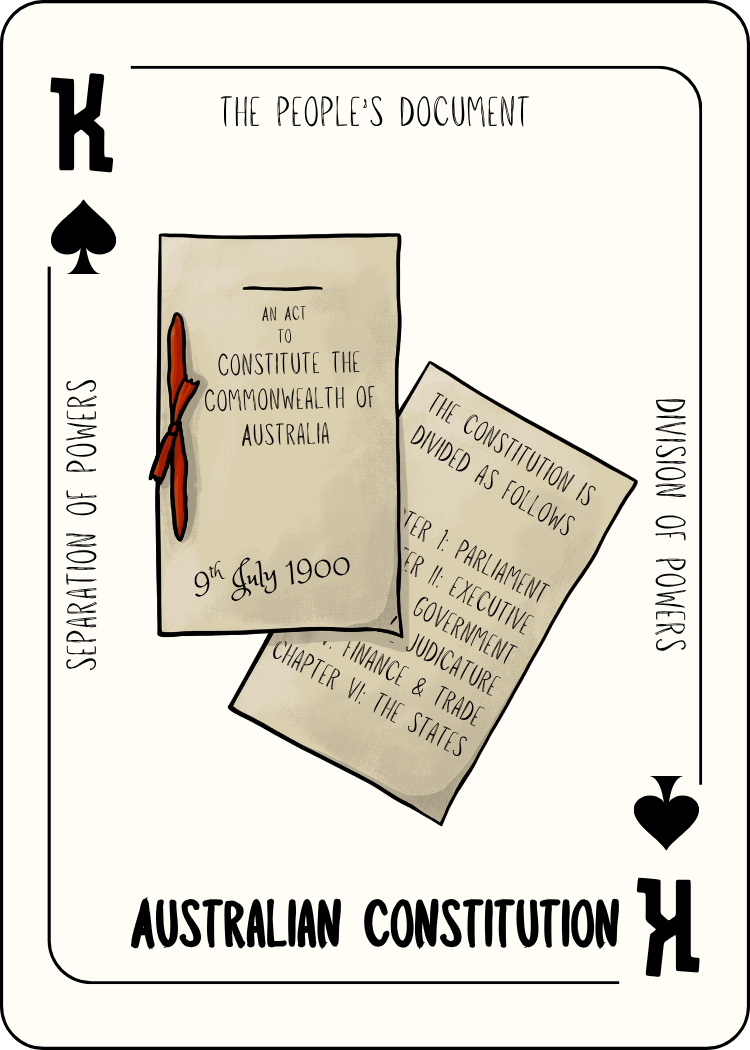
An overview of the key features of the Australian Constitution, including its role as the highest source of law, its democratic structure, and its deliberate division and separation of powers. It explains federalism, the responsibilities of the Parliament, Executive and Judiciary, the High Court’s constitutional role, and the Constitution’s reliance on the rule of law and responsible government rather than a full Bill of Rights.
-
An overview of how governance structures in New South Wales have evolved from the early colonial period to the present, highlighting key changes such as the shift from autocratic rule to responsible government, the development of democratic institutions, and the introduction of checks and balances. It also identifies elements of continuity, including the ongoing influence of Westminster traditions, the role of the Governor, and the structure of Parliament within the NSW system of government.
Explore Related Topics
-
Federation of Australia
Explore resources on Federation in 1901, outlining how Australia became a nation, divided powers, and established the constitutional structures and institutions that govern today.
-
Democracy
Explore resources on democracy, highlighting how accountability and representative institutions ensure power is exercised fairly and transparently through open processes, civic engagement and responsible governance.
-
Human Rights
Explore resources on human rights and freedoms, outlining the key protections, legal frameworks, that support rights, and explore how rights and responsibilities are balanced against government power in Australia.