
Australia: Making a Nation
-
An overview of the major factors that shaped the development of democracy in Australia, including egalitarian legal ideals shown in cases like Kable v Sinclair, the introduction of checks and balances through institutions such as the Supreme Court and a free press, the influence of immigration and political activism including Chartism and the Eureka Stockade, and the constitutional debates that led the colonies to design their own representative systems of government.
-
A summary of the key arguments for and against Federation in Australia, including support for unified defence, emerging nationalist ideas, immigration control, and economic disagreements. It also outlines major developments from the 1880s to 1901, from the Federal Council and Tenterfield Oration to the Conventions, referendums, and final passage of the Constitution.
-
This explainer examines the War Precautions Act 1914, highlighting how the legislation granted broad executive powers, regulated public behaviour, and demonstrated the tension between national security and individual freedoms.
-
An overview of the key features of the Australian Constitution, including its role as the highest source of law, its democratic structure, and its deliberate division and separation of powers. It explains federalism, the responsibilities of the Parliament, Executive and Judiciary, the High Court’s constitutional role, and the Constitution’s reliance on the rule of law and responsible government rather than a full Bill of Rights.
-
This explainer examines the development of workers’ rights in Australia, focusing on trade unions’ advocacy for fair pay and safe conditions, and analysing how the Immigration Restriction Act 1901 affected labour markets and access to workplace protections.
-
An overview of the Commonwealth Franchise Act 1902 and its significance in expanding political rights for women in Australia. It explains how the Act granted most Australian women the right to vote and stand for federal Parliament, placing Australia among the earliest countries to adopt women’s suffrage. The explainer also outlines the Act’s limitations, and examines its broader impact on democratic participation and later reforms.
COMING SOON!
-
An overview of how governance structures in New South Wales have evolved from the early colonial period to the present, highlighting key changes such as the shift from autocratic rule to responsible government, the development of democratic institutions, and the introduction of checks and balances. It also identifies elements of continuity, including the ongoing influence of Westminster traditions, the role of the Governor, and the structure of Parliament within the NSW system of government.
Factors that contributed to the development of democracy in Australia
Democracy is more than just voting. It is a system in which citizens are the ultimate source of political authority and actively participate in decisions about how they are governed. In a democracy, governments are formed by elected representatives whose power is limited by checks and balances. These safeguards ensure that any use of authority is lawful, accountable and ultimately directed toward the public interest.
Australia led the world in democratic reforms. It evolved with popular support through law reform, expanding rights, and the creation of new institutions, rather than through war, revolution or widespread violence. By the 1850s, when colonies such as NSW, Victoria, South Australia, and Tasmania enacted their own constitutions, the essential features of a democratic system, such as representative and responsible government, open elections, and checks and balances on power, were already in place.
Key Factors that Contributed to the Development of Democracy in Australia
Australia’s democratic system did not develop overnight. Instead, it evolved over time through the efforts of informed, active, and engaged citizens. They built upon significant ideas, events, and institutions from history, starting with the Magna Carta in England in 1215. Together, these historical developments helped shape the democratic values, institutions, and practices that underpin Australia's system of government today.
The major factors were:
Egalitarian Ideals - the belief that legal rights and protections should apply equally to everyone, regardless of their class or social status. This principle is illustrated by the civil case brought by convicts Henry and Susannah Kable against Captain Duncan Sinclair. Despite being convicts, the Kables were able to have their case heard before an independent court and successfully challenged Sinclair.
Checks and Balances on Power - influenced by British and Judeo-Christian legal traditions. The Bigge reports, the New South Wales Act 1823 (UK), and Royal Letters Patent (written legal orders issued by the UK Monarch) established the Supreme Court of New South Wales, an appointed Legislative Council, and an Executive Council to advise the Governor. Together with the emergence of a free press, these institutions introduced important checks on government power, limiting arbitrary decision-making and helping ensure that executive authority was exercised according to the law.
Immigration and Political Activism - many migrants brought with them Chartist ideas. They called for greater political representation, improved working rights, and expanded voting rights. By 1850, population growth and economic change meant that convicts were no longer the majority, and the colonies were better placed to govern themselves. These developments contributed to the passage of the Australian Constitutions Act 1850 (UK), which allowed the colonies to draft their own Westminster-style constitutions . The New South Wales Constitution (1855) introduced responsible government, a bicameral parliament with an elected legislative assembly, and broader public participation. Events such as the Eureka Stockade further strengthened calls for political representation and voting rights, making it an important milestone in Australia's democratic development.
Constitutional Development - As the Australian colonies gained authority to draft their own constitutions, public meetings were held to debate the structure of government. A central question was whether an the Legislative Council should mirror British traditions of hereditary nobility. Ultimately, New South Wales rejected the creation of a noble class. Instead, Legislative Councils remained largely appointed by the Governor. These constitutional frameworks continued to evolve and later informed the national Constitution at Federation. The New South Wales Legislative Council did not become fully elected until 1978.
Each of these factors is examined in more detail in the following pages.

1. Egalitarian Ideals
One significant factor in the development of democracy in Australia was the emergence of the egalitarian ideal – the belief that legal rights and opportunities should apply equally to all people, regardless of class, wealth, gender, religion, or social background. These ideas contributed to the growth of democratic values in the colony and later became an important part of Australian national identity.
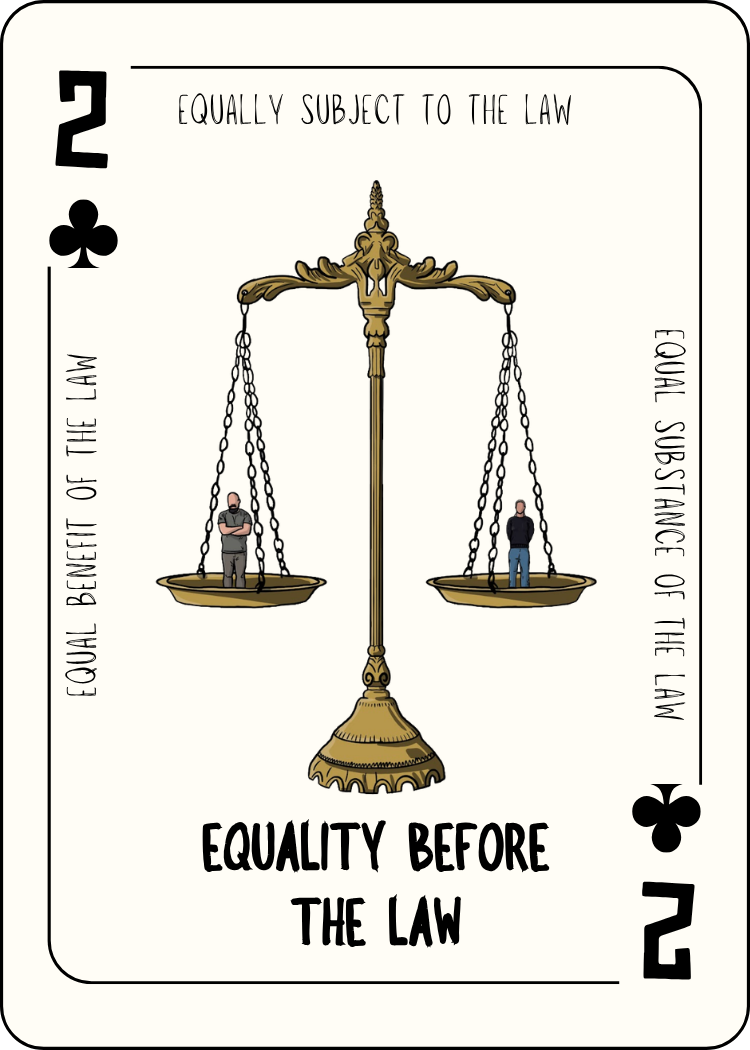
Closely connected to egalitarianism is the principle of equality before the law, which is a key principle of the rule of law and the foundation of the Magna Carta. Equality before the law means that all individuals are subject to the same laws, receive the same legal protections, and are entitled to fair treatment by an independent judge in court. No person should be above the law because of their social status or power.
Background – colonial context
When the First Fleet arrived in New South Wales in 1788, English law was formally introduced into the colony. As Sir William Blackstone wrote, “the law is the birthright of every subject, for wherever they go they carry their laws with them”. This included legal traditions that had developed over centuries in Britain, including principles associated with the Magna Carta (1215), which established the idea that even governments and rulers were subject to the law. Legal texts such as Blackstone’s Commentaries on the Laws of England were brought to the colony and guided the application of English legal principles in early New South Wales.
However, the unique conditions of the penal colony created some legal challenges. Most of the population consisted of transported convicts, and under English law, many convicts were affected by the doctrine of felony attaint. This doctrine stated that individuals sentenced to death (even if later pardoned or transported) were considered “dead in law.” As a result, they could not own property, sue in court, give evidence, or exercise many legal rights.
If this rule had been strictly enforced in early New South Wales, the colony would have struggled to survive. In its first years, the settlement faced severe food shortages, isolation, and a lack of skilled labour, making it essential that it become as self-sufficient as possible.
Convicts made up the majority of the population and workforce, so denying them legal rights would have undermined the colony’s ability to function. Without some recognition before the law, convicts could not effectively engage in trade, enter agreements, own or use property, or contribute fully to economic life. As a result, colonial authorities adopted a more pragmatic and flexible approach, allowing convicts to participate in legal and economic activities despite their status as being dead in law.
Kable v Sinclair (1788)
Early egalitarian ideals were demonstrated in Kable v Sinclair (1788), the first civil case heard in New South Wales.
Timeline
1783–1784: Henry Kable and Susannah Holmes were convicted of theft in Britain and sentenced to death. Their sentences were commuted to transportation.
1786: While imprisoned in Britain, Henry and Susannah met and had a child. Supporters in Britain donated a parcel of goods to help them begin a new life in the colony. The parcel was entrusted to First Fleet captain Duncan Sinclair.
1788: After arriving in Sydney Cove, Henry and Susannah were married and requested the return of their parcel, but it could not be located.
1 July 1788: With assistance from the Reverend Richard Johnson, the Kables sued Captain Sinclair for the loss of their property.
1 July 1788: The Court of Civil Jurisdiction heard witness testimony and ruled in favour of the Kables, ordering Sinclair to pay £15 in damages.
Despite this, the court issued a writ* in their names, and their convict status was deliberately omitted from official court records to allow the case to proceed.
The trial demonstrated that colonial authorities were willing to adapt English law to suit the realities of life in New South Wales. Although the colony was only a few months old, a formal legal process was followed.
Judge Advocate David Collins and two civilian officers heard evidence, considered witness evidence, and delivered a judgement according to legal procedure.
The case was remarkable because Henry and Susannah Kable were poor, illiterate convicts challenging the authority of a powerful ship captain - and they won. In a society where class distinctions heavily influenced legal rights in Britain, the case suggested that the new colony could operate on more equal legal principles.
Read our resources on Indigenous People in the early colony here.

2. Checks and Balances on Power
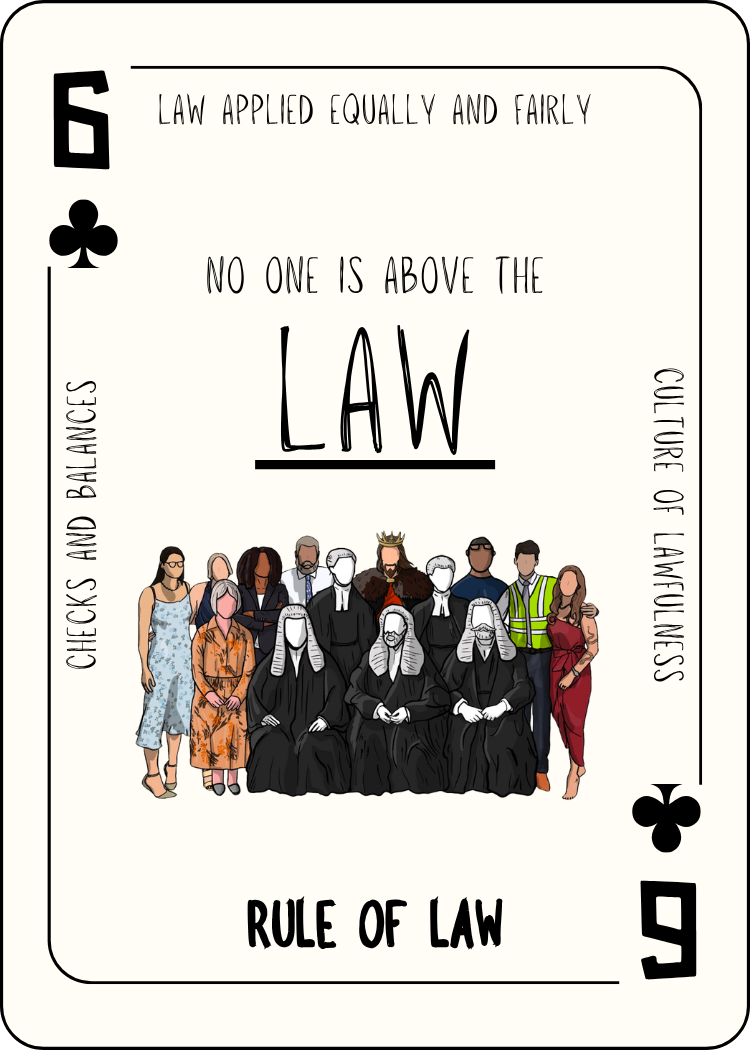
A second major factor in the development of democracy was the introduction of checks and balances on government power. When New South Wales was established in 1788, the Governor exercised almost complete authority. His decisions operated as law, and there were few mechanisms to limit or review his actions.
Over time, institutions and legal safeguards were introduced to restrict concentrated power, increase accountability, and ensure decisions were made according to law. These developments formed an essential foundation for democratic government.
British Ideas About Limiting Power
The concept of limiting government power came from Britain’s long, Judeo-Christian, legal traditions.
The Magna Carta (1215) established that the monarch was subject to the law and that punishment required lawful judgement.
The Bill of Rights 1689 (UK) further restricted royal authority and protected principles such as open elections, parliamentary oversight of taxation, and rights relating to a fair trial.
These ideas shaped how Britain governed its colonies, including New South Wales.
Magna Carta
Clause (39) No free man shall be seized or imprisoned, or stripped of his rights or possessions, or outlawed or exiled, or deprived of his standing in any way, nor will we proceed with force against him, or send others to do so, except by the lawful judgment of his equals or by the law of the land.
Clause 39 from the Magna Carta,1215
The Bigge Reports
By the early 1800s, the British Government was concerned about the concentration of power in the hands of the Governor, particularly during Governor Macquarie’s administration. To investigate, Britain appointed John Thomas Bigge, who produced a series of reports between 1822 and 1823.
Bigge recommended the creation of new institutions that would:
limit the Governor’s authority
ensure decisions were made according to law
introduce greater accountability in the administration of the colony
These recommendations reflected Britain’s legal heritage and its emphasis on oversight and accountability.
REPORT OF THE Commissioner of Inquiry on the Judicial Establishments of NSW.
The civil and criminal judicatures… had previously been united under the presidency of one person holding the office of judge advocate.
The injury that was sustained by individuals from the want of any tribunal in which causes of a larger amount than 50l. could be tried, was very great;
A report of the Commissioner of Inquiry, on the Judicial Establishments of New South Wales, and Van Diemen’s Land, Bigge Report, 1823. https://gutenberg.net.au/ebooks13/1300181h.html
The New South Wales Act 1823
The New South Wales Act 1823 (UK) implemented many of Bigge’s recommendations and introduced two key institutional checks on power:
A Legislative Council, which the Governor was required to consult when making laws (although the Governor could ignore its advice); and
An independent Supreme Court of New South Wales.
A significant feature of the Act was the requirement that the Chief Justice review all proposed laws to ensure they were not inconsistent with English Law. This meant the Governor could no longer make laws without legal scrutiny.
New South Wales Act 1823
And be it further enacted that no law or ordinance shall by the said governor or acting governor be laid before the said council for their advice or approbation or be passed into a law unless a copy thereof shall have been first laid before the chief justice of the supreme court of New South Wales and unless such chief justice shall have transmitted to the said governor or acting governor a certificate under the hand of such chief justice that such proposed law is not repugnant to the laws of England.
Excerpt from New South Wales Act 1823 (UK).
Two years later, King George IV appointed, by letters patent, Ralph Darling as Governor of NSW and established an Executive Council which provided advice and assistance to Darling in administrating the Colony.
The Legislative vs Executive Council
The Legislative Council existed to advise on and review proposed laws, and its members were formally appointed by the British Government (and later by the Governor after 1856). The Executive Council, by contrast, advised the Governor on executive and administrative decisions, and its membership consisted of the Governor and his closest advisers, serving as the colony’s inner governing circle rather than its law‑making body.
The Supreme Court & the Rule of Law
The establishment of the New South Wales Supreme Court was a major step toward limiting executive power. The Court ensured that:
the Governor acted within the law
individuals had access to legal remedies
judicial independence was maintained
Sir Francis Forbes was the first Chief Justice of the Supreme Court. He noted that the Court was regarded by the community as a significant protection against absolute power.
The Free Press
Another important check and balance on authority was the emergence of an independent press.
Before 1824, the Sydney Gazette mainly published government notices and rarely criticised officials. This changed with the establishment of The Australian newspaper by William Charles Wentworth and Robert Wardell. In their first editorial, they argued that:
THE AUSTRALIAN
SYDNEY, OCTOBER 14, 1824
A free press is the most legitimate, and at the same time, the most powerful weapon that can be employed to annihilate such influence, frustrate the designs of tyranny, and restrain the arm of oppression.
Excerpt from The Australian Newspaper, 14 October 1824, p 2. https://trove.nla.gov.au/newspaper/page/4248411
An independent press allowed the public to:
learn about government actions
debate political issues
criticise decisions
expose misuse of power
William Blackstone, Commentaries
Vol IV, 1769
The liberty of the press is indeed essential to the nature of a free state: but this consists in laying no previous restraints upon publications, and not in freedom from censure for criminal matter when published. Every freeman has an undoubted right to lay what sentiments he pleases before the public: to forbid this, is to destroy the freedom of the press.
Excerpt from William Blackstone’s Commentaries on the Laws of England,1 769 .https://www.gutenberg.org/files/30802/30802-h/30802-h.htm
The Press Licensing Dispute
These principles were soon tested in a significant confrontation between Governor Darling and Chief Justice Forbes, which showed how the courts and the press could limit executive power.
In 1826, two soldiers, Joseph Sudds and Patrick Thompson, deliberately committed theft so they would be discharged from the army and become convicts. Governor Darling saw this as a challenge to his authority and increased their punishment to public flogging and seven years in a chain gang. Sudds, who was already seriously ill, died shortly afterwards.
The incident prompted strong criticism from independent newspapers, which accused Darling of excessive punishment. In response, Darling attempted to introduce new laws requiring newspapers to obtain an annual licence from the Governor, giving him the power to restrict or cancel publications that criticised his administration.
Under the New South Wales Act 1823, Chief Justice Forbes had to review all proposed laws. He refused to certify Darling’s licensing bill, arguing it imposed unlawful restraints on the press.
As a result, the press licensing scheme did not proceed. Forbes’ refusal demonstrated the growing independence of the judiciary and showed how the courts acted as a check on executive power in the developing colony.
Contribution to Democracy
The introduction of checks and balances, through the Supreme Court, Legislative Council, Executive Council and a free press, played a significant role in Australia’s democratic development. These institutions:
limited the concentration of power in the hands of the Governor
ensured decisions were subject to legal oversight
increased accountability and transparency
established early forms of representative and responsible government.
Together, they created the institutional framework that continues to support democracy in Australia today.
3. Immigration and Political Activism
A third factor that contributed to the development of democracy in Australia was the rise of political activism driven by large-scale immigration during the mid-1800s, along with the decline of convict transportation. The arrival of these migrants, many of whom had experience in movements such as British Chartism and the European revolutions, brought new expectations about representation, rights, and participation in government. As free settlers became the majority of the population, demands for a political voice, fair treatment, and a say in their own government grew stronger across the colonies.
Population Change and New Political Expectations
The Australian Gold Rushes brought rapid population growth, rising from around 430,000 people in 1851 to more that 1.7 million by 1871. By 1854, the Ballarat goldfields alone held around 25,000 miners from Britain, Ireland, Europe, America, and China.
Many of these migrants were working-class and politically experienced. Some had been involved in the British Chartist movement or the European revolutions of the 1840s, shaping their belief that ordinary people should have political rights, representation, and fair treatment under the law.
The Chartist Movement
Chartism was a British working-class movement that aimed to gain equality, political rights, and influence for the working class. In 1838 in England, they issued the People’s Charter, imitating the Magna Carta, demanding:
Universal manhood suffrage. Voting rights for every man over 21.
Secret ballot. To protect voters from external pressure from employers/landlords.
No property qualification. Allowing any man to stand for parliament.
Payment of members of parliament (MPs).
Equal-sized constituencies. Electorates to have same number of voters.
Annual parliaments.
Despite this, most miners in the colonies had no voting rights, could not stand for parliament, and had limited civil rights, even though they were required pay taxes and obey laws they had no role in creating. This mismatch between expectations and reality fuelled political activism.
The Eureka Stockade (1854)
The Eureka Stockade emerged from this environment of rapid change and political frustration.
As the population grew, the Victorian Government introduced a costly monthly mining licence. Miners were required to pay the fee whether or not they found gold, and most still had no political representation. Police “licence hunts” became increasingly frequent, heightening resentment.
In November 1854, the Ballarat Reform League issued a Charter of Rights calling for:
The Ballarat Reform League,
Charter of Rights (1854):
The right of every citizen to have a voice in making the laws
No taxation without representation
Power to be in the hands of responsible representatives of the people, for honest government
Property qualifications to be abolished for members of the Legislative Council
Full and fair representation
Universal manhood suffrage
Members to be paid to enable less wealthy people to become members of the Legislative Assembly
Short duration of parliament between elections
Total abolition of the diggers’ and storekeepers’ licence tax
Excerpt from the Ballarat Reform League Charter of Rights, 1854. https://www.eurekaaustralia.org.au/ballarat-reform-league-charter.html
When these demands were rejected, tensions escalated. Miners burned their licences, raised the Southern Cross flag, and built a defensive stockade at Eureka. On 3 December 1854, government forces attacked. The conflict was brief but deadly, and although miners were arrested and charged withtreason, all were acquitted, reflecting public sympathy for their cause.
The Eureka events became closely associated with debates about political representation and helped accelerate democratic reforms.
Peter Lalor, a prominent member of the Eureka Rebellion, gave an infamous speech on Bakery Hill in 1854:
Peter Lalor's Bakery Hill Speech, 1854
“We swear by the Southern Cross to stand truly by each other, and fight to defend our rights and liberties”
Excerpt from speech by Eureka Leader Peter Lalor, Bakery Hill, 1854.
https://www.nma.gov.au/defining-moments/resources/eureka-stockade
Democratic Reforms
The ideas promoted by the Eureka miners shaped significant legislative reforms in the years following the incident. These included:
the abolition of the gold licence;
broader voting rights, including a secret ballot;
fairer representation in government;
freedom of assembly;
the removal of property qualifications for MPs and voters;
greater public participation in government; and
improved workers’ rights.
These changes strengthened the rule of law and contributed to a more representative and accountable political system.
Self‑Government and the End of Transportation
Even before Eureka, the British Government had begun considering self‑government for several colonies. In 1788, convicts made up the majority of the population, and political power was tightly restricted. But by the mid‑1800s:
transportation was ending due to public opposition;
convicts had completed their sentences;
free settlers were arriving in large numbers; and
the Gold Rush had made the colonies wealthier and less dependent on Britain.
Australia had the highest GDP per capita in the world at the time, and this rising prosperity helped expand political participation. As wealth increased, more people became economically secure and politically engaged. Free settlers increasingly demanded a say in how they were governed, and Britain responded by granting greater autonomy.
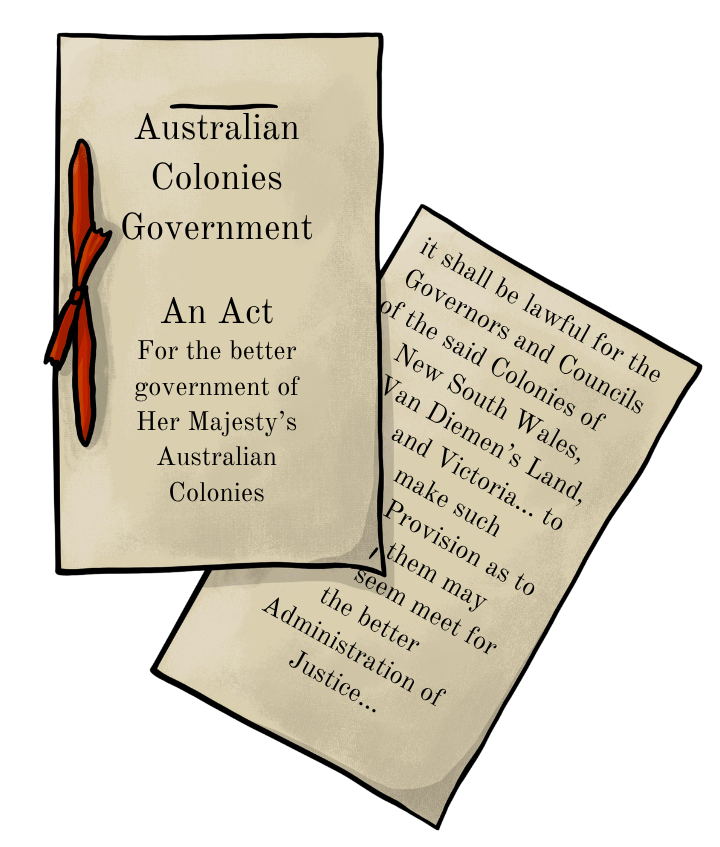
The Australian Constitutions Act 1850 (UK) allowed New South Wales, Victoria, South Australia and Tasmania to draft their own constitutions. These constitutions incorporated Westminster principles, including:
self‑government for internal matters;
responsible government;
bicameral parliaments; and
elected legislative assemblies.
These reforms were a major step toward the democratic governance seen in Australia today.
With their own constitutions, the colonies were able to make further democratic reforms, often inspired by Chartist influences. By 1900, most of the colonies had peacefully adopted laws to provide for adult suffrage for lower house elections, secret ballots, no property qualifications for members of lower house, payment of members and a stop to plural voting.
4. Constitutional Development
A fourth factor in the development of Australian democracy was the process through which the colonies drafted and passed their own constitutions. Unlike many nations, this shift occurred without war or revolution. Instead, the colonies gained the power to design their own systems of government, and public debate played a central role in shaping these new political frameworks.
Public Debate and the Question of Who Should Rule
As the colonies prepared to write their constitutions, public meetings were held so communities could discuss how their governments should be structured. One of the most significant debates concerned the Upper House (the Legislative Council).
In Britain, the Upper House (the House of Lords) was traditionally made up of hereditary aristocrats. Australia, however, had no established nobility. Some influential figures, including William Wentworth, argued that wealthy free settlers, known as ‘the Exclusives’, should form a new colonial aristocracy to act as the equivalent of British Lords.
Many migrants and emancipists (convicts who had served their sentence or been pardoned) strongly opposed this idea. In a society increasingly shaped by egalitarian values, they rejected the creation of a privileged class. Daniel Deniehy, a journalist and early NSW politician, famously mocked Wentworth’s proposal as a “Bunyip Aristocracy”. He argued that the colonies should be built on opportunity, merit and equal political rights rather than inherited status.
Public meetings recorded in newspapers, such as the Sydney Morning Herald, show widespread support for constitutions that reflected the wishes of the people. Speakers emphasised that representatives should not pass constitutional measures without first hearing the views of their constituents.
John Gilchrist (a prominent businessman), opened one such public meeting:
The Sydney Morning Herald, Tuesday, August 16, 1853
A PUBLIC meeting was held yesterday afternoon in the Victoria Theatre...
The CHAIRMAN [John Gilchrist] came forward, and, on the subsidence of very loud applause, opened the business of the day with the following observations...but the time has now arrived when every man who has any stake in the colony is called upon to express his opinion. (Cheers.) This colony is now assuming a very important position, and, as one of the proofs of it, the Home Government have sent out instructions to grant us a constitution to be framed by ourselves, and in conformity with these instructions a bill has been brought before the Legislative Council.... still it must be borne in mind that they are but the representatives of the people, and that it is their duty to pause before passing such a measure, until the opinions and wishes of their constituents are expressed and known on the subjects”
Excerpts from Sydney Morning Herald, Tuesday 16 August 1853, p 4-5. https://trove.nla.gov.au/newspaper/page/1505812
At this meeting, Daniel Deniehy gave his famous speech:
The Sydney Morning Herald, Tuesday, August 16, 1853
Bring them not here with delusive hopes—let them not find a new-fangled aristocracy haunting these free shores. (Cheers.) But it is yours to offer them a land, where man is rewarded for his labour, and where the law no more recognises the supremacy of a class, than it recognises the predominance of a religion. (Great cheering.) But there is an aristocracy worthy of our ambition. Wherever man's skill is eminent, wherever glorious manhood asserts its elevation, there is an aristocracy that confers honour on the land that possesses it. That is God's aristocracy.
Related Resources
-
This resource prompts students to explore the social, political, and economic forces that shaped Australia’s democratic system. It supports critical reflection on key milestones and influences that expanded participation and representation.
-
A summary of the key arguments for and against Federation in Australia, including support for unified defence, emerging nationalist ideas, immigration control, and economic disagreements. It also outlines major developments from the 1880s to 1901, from the Federal Council and Tenterfield Oration to the Conventions, referendums, and final passage of the Constitution.
Explore Related Topics
-
Federation of Australia
Explore resources on Federation in 1901, outlining how Australia became a nation, divided powers, and established the constitutional structures and institutions that govern today.
-
Establishment of the NSW Supreme Court
The establishment of the NSW Supreme Court and the subsequent battle between Chief Justice Forbes and Governor Darling over press freedom have shaped key democratic principles, including rule of law, separation of powers, and checks and balances.
-
First Civil Case in NSW: The Lost Parcel
On the First Fleet, a lost parcel sparked Australia’s first civil lawsuit. In Cable v Sinclair (1788), convicts Henry and Susannah Kable successfully sued a powerful ship’s captain.