
Australia: Making a Nation
-
An overview of the major factors that shaped the development of democracy in Australia, including egalitarian legal ideals shown in cases like Kable v Sinclair, the introduction of checks and balances through institutions such as the Supreme Court and a free press, the influence of immigration and political activism including Chartism and the Eureka Stockade, and the constitutional debates that led the colonies to design their own representative systems of government.
-
A summary of the key arguments for and against Federation in Australia, including support for unified defence, emerging nationalist ideas, immigration control, and economic disagreements. It also outlines major developments from the 1880s to 1901, from the Federal Council and Tenterfield Oration to the Conventions, referendums, and final passage of the Constitution.
-
This explainer examines the War Precautions Act 1914, highlighting how the legislation granted broad executive powers, regulated public behaviour, and demonstrated the tension between national security and individual freedoms.
-
An overview of the key features of the Australian Constitution, including its role as the highest source of law, its democratic structure, and its deliberate division and separation of powers. It explains federalism, the responsibilities of the Parliament, Executive and Judiciary, the High Court’s constitutional role, and the Constitution’s reliance on the rule of law and responsible government rather than a full Bill of Rights.
-
This explainer examines the development of workers’ rights in Australia, focusing on trade unions’ advocacy for fair pay and safe conditions, and analysing how the Immigration Restriction Act 1901 affected labour markets and access to workplace protections.
-
An overview of the Commonwealth Franchise Act 1902 and its significance in expanding political rights for women in Australia. It explains how the Act granted most Australian women the right to vote and stand for federal Parliament, placing Australia among the earliest countries to adopt women’s suffrage. The explainer also outlines the Act’s limitations, and examines its broader impact on democratic participation and later reforms.
COMING SOON!
-
An overview of how governance structures in New South Wales have evolved from the early colonial period to the present, highlighting key changes such as the shift from autocratic rule to responsible government, the development of democratic institutions, and the introduction of checks and balances. It also identifies elements of continuity, including the ongoing influence of Westminster traditions, the role of the Governor, and the structure of Parliament within the NSW system of government.
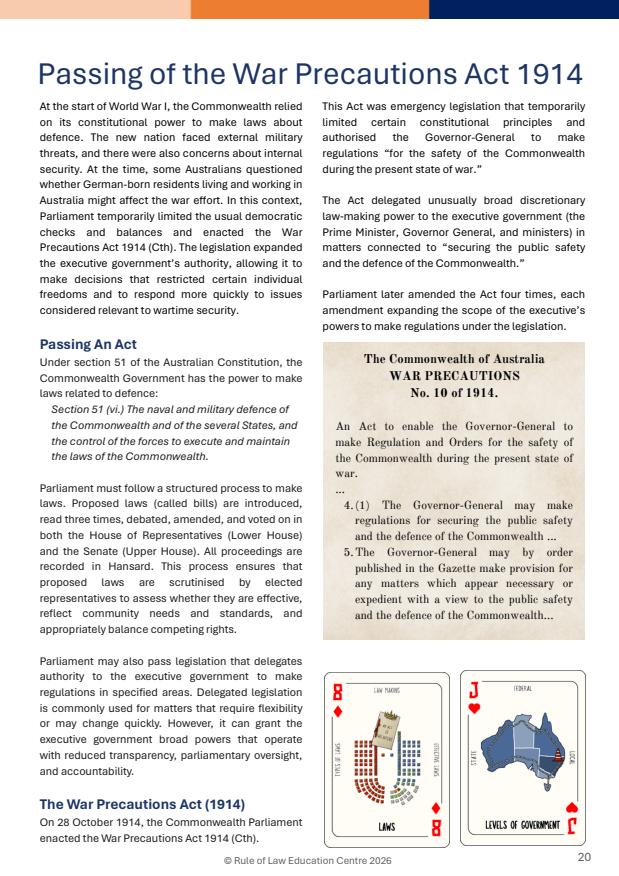
Passing of the War Precautions Act 1914
At the start of World War I, the Commonwealth relied on its constitutional power to make laws about defence. The new nation faced external military threats, and there were also concerns about internal security. At the time, some Australians questioned whether German-born residents living and working in Australia might affect the war effort. In this context, Parliament temporarily limited the usual democratic checks and balances and enacted the War Precautions Act 1914 (Cth). The legislation expanded the executive government’s authority, allowing it to make decisions that restricted certain individual freedoms and to respond more quickly to issues considered relevant to wartime security.
Passing An Act
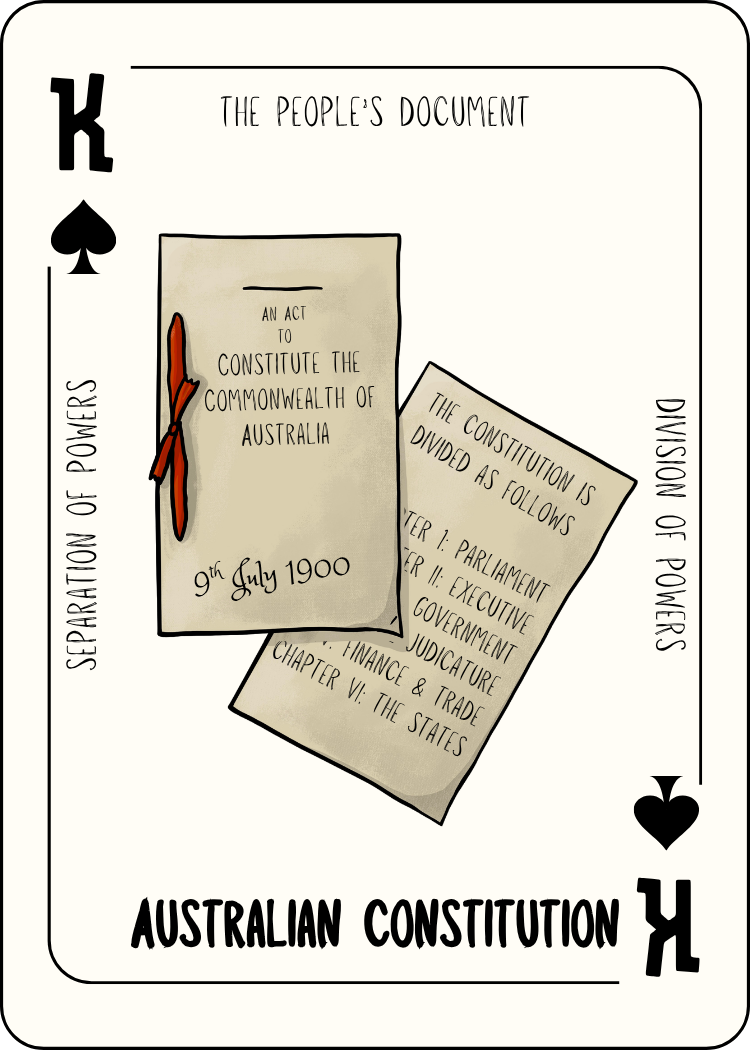
Under section 51 of the Australian Constitution, the Commonwealth Government has the power to make laws related to defence:
Section 51 (vi.) The naval and military defence of the Commonwealth and of the several States, and the control of the forces to execute and maintain the laws of the Commonwealth.
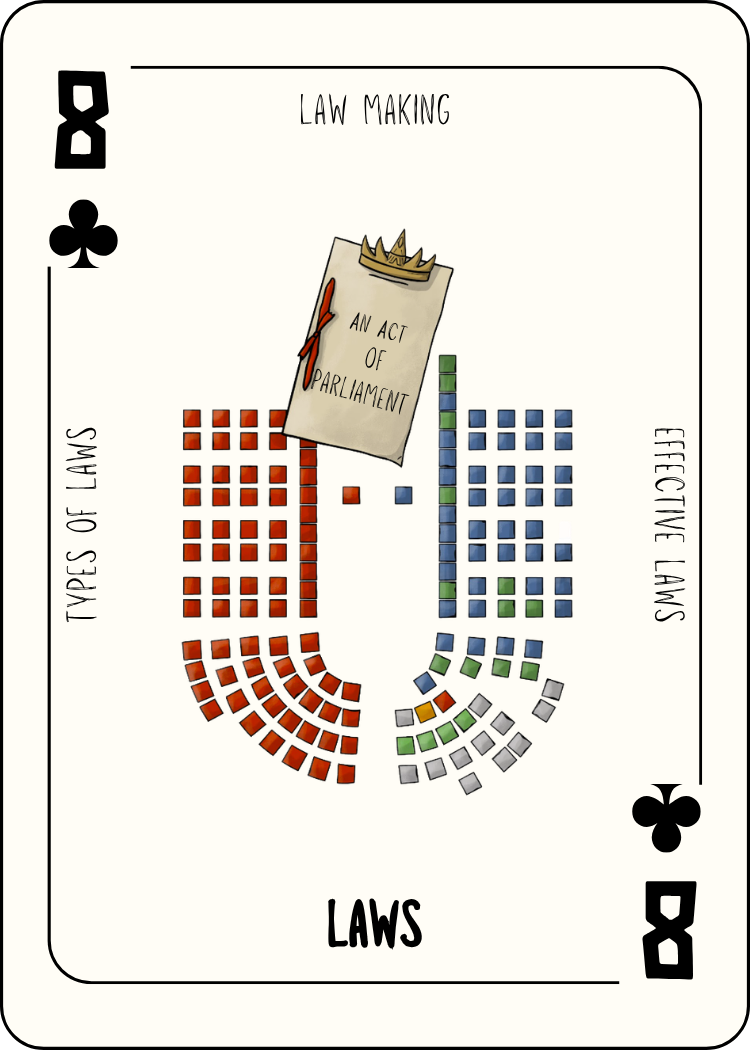
Parliament must follow a structured process to make laws. Proposed laws (called bills) are introduced, read three times, debated, amended, and voted on in both the House of Representatives (Lower House) and the Senate (Upper House). All proceedings are recorded in Hansard. This process ensures that proposed laws are scrutinised by elected representatives to assess whether they are effective, reflect community needs and standards, and appropriately balance competing rights.
Parliament may also pass legislation that delegates authority to the executive government to make regulations in specified areas. Delegated legislation is commonly used for matters that require flexibility or may change quickly. However, it can grant the executive government broad powers that operate with reduced transparency, parliamentary oversight, and accountability.
The War Precautions Act (1914)
On 28 October 1914, the Commonwealth Parliament enacted the War Precautions Act 1914 (Cth). This Act was emergency legislation that temporarily limited certain constitutional principles and authorised the Governor-General to make regulations “for the safety of the Commonwealth during the present state of war. ”
The Act delegated unusually broad discretionary law‑making power to the executive government (the Prime Minister, Governor General, and ministers) in matters connected to “securing the public safety and the defence of the Commonwealth. ”
Parliament later amended the Act four times, each amendment expanding the scope of the executive’s powers to make regulations under the legislation.
The Commonwealth of Australia WAR PRECAUTIONS No. 10 of 1914.
An Act to enable the Governor-General to make Regulation and Orders for the safety of the Commonwealth during the present state of war.
4.(1) The Governor-General may make regulations for securing the public safety and the defence of the Commonwealth...
5.The Governor-General may by order published in the Gazette make provision for any matters which appear necessary or expedient with a view to the public safety and the defence of the Commonwealth...
Excerpt from War Precautions Act 1914 (Cth). https://www.austlii.edu.au/cgi-bin/viewdb/au/legis/cth/num_act/wpa1914101914217/
Hansard records show that many members of Parliament recognised they were granting the Governor-General unusually broad wartime powers. All political parties supported the bill and accepted that the Government would assume full responsibility for how those powers were used during the war. The bill received assent from the Governor General on 29 October 1914.
THE COMMONWEALTH OF AUSTRALIA Parliamentary Debates
House of Representative Official Hansard No.44, 1914 Wednesday 28 October 1914 War Precautions Bill
Second Reading ...
Mr Hughes (W Syd- Attorney General)...The powers conferred by the measures are very considerable; but rest assured that they are required. ...
Mr Joseph Cook (Parra)...This is in some respects an extraordinary Bill, and one intended... to meet circumstances which are extraordinary... However much I object to some of the provisions of the Bill, I feel that I must support the measure, leaving the Government to take full responsibility for it.
This is not the time to do anything but to give full and cordial support to the Government in regard to all measures proposed for the maintenance of our supremacy in our own domain, and for assisting the the Empire in the great war in which it is engaged. I am only anxious that the Government shall not make a mistake in its procedure.
Sir William Irvine (Flinders)... We all recognise that at a time of war the Executive is entitled to be invested with authority which Parliament would not think of entrusting to it in ordinary times. But before the Bill passes, it is desirable that honorable members should understand fully the immense range of the Executive power which it confers on the Governor-General in Council.
Excerpt from The House of Representatives Hansard, 28 October 1914.https://parlinfo.aph.gov.au/parlInfo/download/hansard80/hansardr80/1914-10-28/toc_pdf/19141028_reps_6_75.pdf
THE COMMONWEALTH OF AUSTRALIA Parliamentary Debates
Senate Official Hansard No.44, 1914 Wednesday 28 October 1914 War Precautions Bill
Bill received from the House of Representatives and (on motion by Senator Pearch) read a first time.
That this Bill be now read a second time.
...
Senator Pearce (WA- Minister of Defence)... It is designed entirely to meet conditions inseparable from the war... to provide for effective measures being adopted for the safety of Australia, and for taking due steps to see that no assistance of any kind can be rendered to the enemies of the Empire...
...we shall be sending from the Commonwealth troops in transports, and that they are the easiest possible subject of attack... the only safety we can guarantee for them is absolute secrecy as regards their movements...
Senator Keating (TAS)... In a state of war, we have to meet emergent conditions, circumstances arise which call for action on the part of the Government action of a very speed and decisive character and it would be absurd if they had to wait for Parliament to pass the necessary legislation through both Houses to enable them to act...
Clause agreed to. Title agreed to. Bill reported without amendment, report adopted.. Bill read a third time.
Excerpt from The Senate Hansard, 28October 1914. https://parlinfo.aph.gov.au/parlInfo/download/hansard80/hansards80/1914-10-28/toc_pdf/19141028_senate_6_75.pdf
The validity of regulations made under the War Precautions Act
The War Precautions Act 1914 (Cth) gave the executive government broad authority to make regulations during wartime. Between 1914 and 1918, 406 regulations were issued under the Act, covering a wide range of matters, from “failing to close premises for the sale of intoxicating liquor when ordered to do so by a competent military authority” to “failure to register as an alien. ” The validity of two regulations was challenged in the High Court of Australia. In both cases, the Court upheld the regulations as a lawful exercise of the Commonwealth’s power under the Act.
HIGH COURT OF AUSTRALIA 1915
Llyod........Appellant; Wallach........Respondent.
Reg. 55 (1) of the War Precautions Regulations 1915 provides that "Where the Minister for Defence has reason to believe that any naturalised person is disaffected or disloyal, he may, by warrant under his hand, order him to be detained in military custody in such place as he thinks fit during the continuance of the present state of war. "
Held, that the regulation was a valid exercise of the power.
Excerpt from Lloyd v Wallach (1915) https://www.hcourt.gov.au/sites/default/files/eresources/1915/HCA/60.pdf
In Lloyd v Wallach (1915), Franz Wallach, a German‑born naturalised British subject married to an Australian, was detained under a ministerial warrant stating that he was “believed…to be disaffected or disloyal” and ordering that he be taken into military custody.
The Supreme Court of Victoria initially held the detention to be unlawful because the warrant did not identify any factual basis for concluding that Wallach posed a risk to public safety or defence. The High Court later overturned this decision, holding that the Minister’s subjective belief was the “sole condition” required for the exercise of the detention power and that the Minister was not obliged to provide reasons for that belief. Wallach remained in custody until April 1919.
HIGH COURT OF AUSTRALIA 1916
Farey........ Appellant; Burvett........ Respondent.
Held, by Griffith CJ. and Barton, Isaacs, Higgins and Powers JJ., that the legislative powers of the Commonwealth Parliament conferred by sec 51(vi.) and (xxxix) of the Constitution include a power during the present state of war to fix within limits of locality the highest price which during the continuance of the War may be charged for bread.
Excerpt from Farey v Burvett (1916). https://www.hcourt.gov.au/sites/default/files/eresources/1916/HCA/36.pdf
In Farey v Burvett (1916), the High Court upheld a regulation that fixed the maximum price of bread, rejecting a challenge brought by a baker, Mr Farey. The Court held that the Commonwealth’s defence power was broad enough during wartime to support price‑control measures, even where the connection to defence was indirect. The majority, led by Chief Justice Griffith and Justice Isaacs, held that the relevant test was whether the measure was capable of assisting the defence of the Commonwealth, even incidentally. Justices Gavan Duffy and Rich dissented, arguing that the defence power should be confined to matters directly related to military or naval operations.
This decision established a significant precedent for the wide scope of Commonwealth power under the War Precautions Act, and no wartime regulations were invalidated during World War I.
“However much the free man might boast his freedom, however republican his civic government might become, the presence of an enemy knocking at the gates almost invariably produced military dictator the personification of a strong and effective central government.... however much we may cherish the Rule of Law as one of our most precious possessions, we must recognize that permanent liberty is often best achieved only by temporary sacrifice of individual freedom. ” Robert Menzies in his Bowen Prize Essay (1917)
Related Resources
-
A teacher-facing PowerPoint that guides students through the War Precautions Act 1914 using legislation, Hansard, court cases and political cartoons as historical sources. It explains key constitutional concepts—federalism, division of powers, separation of powers—and shows how wartime emergency powers reshaped democratic checks and balances. Designed for NSW Stage 5 History, it supports historical inquiry, civics literacy and critical engagement with Australia’s response to WWI.
-
This resource engages students in analysing the context, purpose, and consequences of the War Precautions Act 1914. It supports discussion on how wartime pressures reshaped civil liberties, government powers, and public expectations.
-
An overview of how governance structures in New South Wales have evolved from the early colonial period to the present, highlighting key changes such as the shift from autocratic rule to responsible government, the development of democratic institutions, and the introduction of checks and balances. It also identifies elements of continuity, including the ongoing influence of Westminster traditions, the role of the Governor, and the structure of Parliament within the NSW system of government.
Explore Related Topics
-
Federation of Australia
Explore resources on Federation in 1901, outlining how Australia became a nation, divided powers, and established the constitutional structures and institutions that govern today.
-
Democracy
Explore resources on democracy, highlighting how accountability and representative institutions ensure power is exercised fairly and transparently through open processes, civic engagement and responsible governance.
-
Human Rights
Explore resources on human rights and freedoms, outlining the key protections, legal frameworks, that support rights, and explore how rights and responsibilities are balanced against government power in Australia.