
Civics: Democracy Year 5-6
-
A Year 5–6 civics and citizenship teaching program exploring Australian citizenship, rights and responsibilities, representative democracy, freedoms, and active participation in Australian society.
-
A Year 5–6 civics and citizenship teaching program investigating Australian symbols, emblems and national identity, including how they have changed since Federation.
-
A Year 5–6 civics and citizenship teaching program introducing democracy, Australian values, governance structures and government systems from around the world.
-
A Year 5–6 civics and citizenship teaching program exploring Magna Carta, the Rule of Law, equality before the law and the principles of justice.
-
A Year 5–6 civics and citizenship teaching program examining how bills become laws, the role of Parliament and Australia's bicameral system of government.
-
A Year 5–6 civics and citizenship teaching program exploring the roles and responsibilities of local, state and federal governments in Australia.
-
A Year 5–6 civics and citizenship teaching program investigating voting, civic participation, freedoms and the history of voting rights in Australia.
-
A Year 5–6 civics and citizenship teaching program exploring Federation, the Australian Constitution and the development of Australia's democratic system of government.
-
A Year 5–6 civics and citizenship teaching program consolidating learning about citizenship, democracy, government, laws and the Australian Constitution.
-
A Year 5–6 civics and citizenship teaching program investigating significant Australians and their contributions to the Commonwealth, democracy, society and Australia's development as a nation.

Teaching program – Week 7: Active citizens and voting rights
- To understand how people participate in Australia's democracy
- To be challenged on how they can personally be active and engaged citizens
- To explain Australia's voting system and why we have it
Modelled reading: “There’s a prawn in Parliament House” by Annabel Crabb
Differentiation / Adjustments: Whole class
Resources: “There’s a prawn in parliament house” by Annabel Crabb
Introduction:
Read “Democracy!” By Philip Bunting
Put Active and Engaged Citizens poster on board as visual prompt. As a whole class discuss the following:
What are some synonyms for ‘active’ and ‘engaged’?
What is meant by being an ‘active and engaged citizen’?
Is there a difference between how children and adults can be active and engaged citizens? Why / Why not?
Differentiation / Adjustments: Whole class; Whole class discussion
Resources: “Democracy!” by Philip Bunting
Activity 1: Tug-of-War Visible Thinking Routine
Watch video: Representative Democracy – Ep 4: Features of a Democracy: Voting.
Draw a long rope across the board. The two ends represent two opposing ideas. This routine looks at arguments or perspectives pulling in opposite directions.
Students write “tugs” (supporting points or evidence) on sticky notes and place them along the rope depending on which side they strengthen.
Discuss as students place post-it notes up on board – is the position correct? What if the note was moved further left or right?
Differentiation / Adjustments: Whole class
Resources: Ep 4: Features of a Democracy: Voting ; Sticky notes
Activity 2: Modern Day Scenarios
Discussion: Class debate - Voting in Australia: Australia is one of the few countries where voting is compulsory (required by law). Do you think forcing everyone to vote is a good thing for democracy, or should people have the freedom to choose not to vote?
Students divide page in half in their books & write points for both sides.
Students choose which side they support. Physically move to the side of the room they agree with.
Have an informal debate where teacher facilitates discussion and one student at a time speaks from alternating sides. Students agree and/or disagree with a reason.
* Prior to the informal debate teacher reminds students to listen, be respectful and be prepared to change their perspectives (they can cross to the other side of the classroom if they change their opinion).
Differentiation / Adjustments: Whole class debate
Resources: N/A
Activity 3: Think | Pair | Share
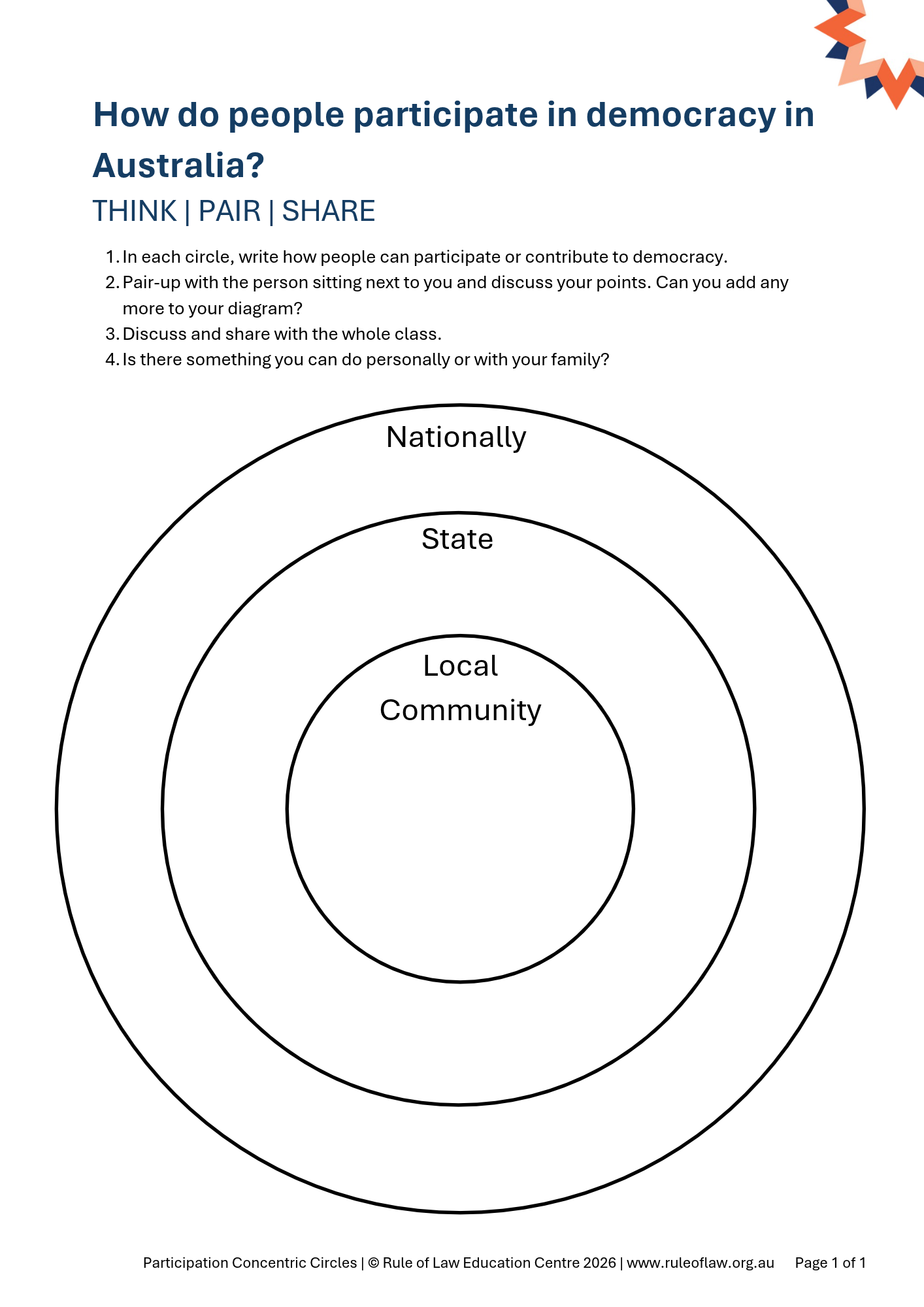
Using the concentric circles worksheet, brainstorm how people can participate in or contribute to your local community/suburb/neighbourhood, state, and nationally. Is there something that you can do/ and or your family do personally?
Differentiation / Adjustments: Independent; In Pairs; Whole Class
Resources: Concentric Circles Worksheet
Suggested Incursion
MP visit. This would be a good place in the unit for the local MP to visit – students have good background knowledge and understanding to then ask further questions.
Differentiation / Adjustments: Whole Class
Resources: Local MP visit
Activity 4:
Watch the video BTN: History of Voting. Research how and when voting rights were obtained for Aboriginal and Torres Strait Islander Peoples and women. What were the key events that led to voting rights for all Australian people?
Differentiation / Adjustments: Whole class discussion
Resources: BTN: History of Voting.
Activity 5:
Set up a timeline in books to show key events in Australia’s history that played a part in obtaining voting rights. Use library resources, non-fictional literature and online resources. Make sure the timeline is correctly labelled and events are accurately sequenced. Include pictures and dot points on timeline.
Differentiation / Adjustments: In pairs
Resources: N/A
Activity 6:
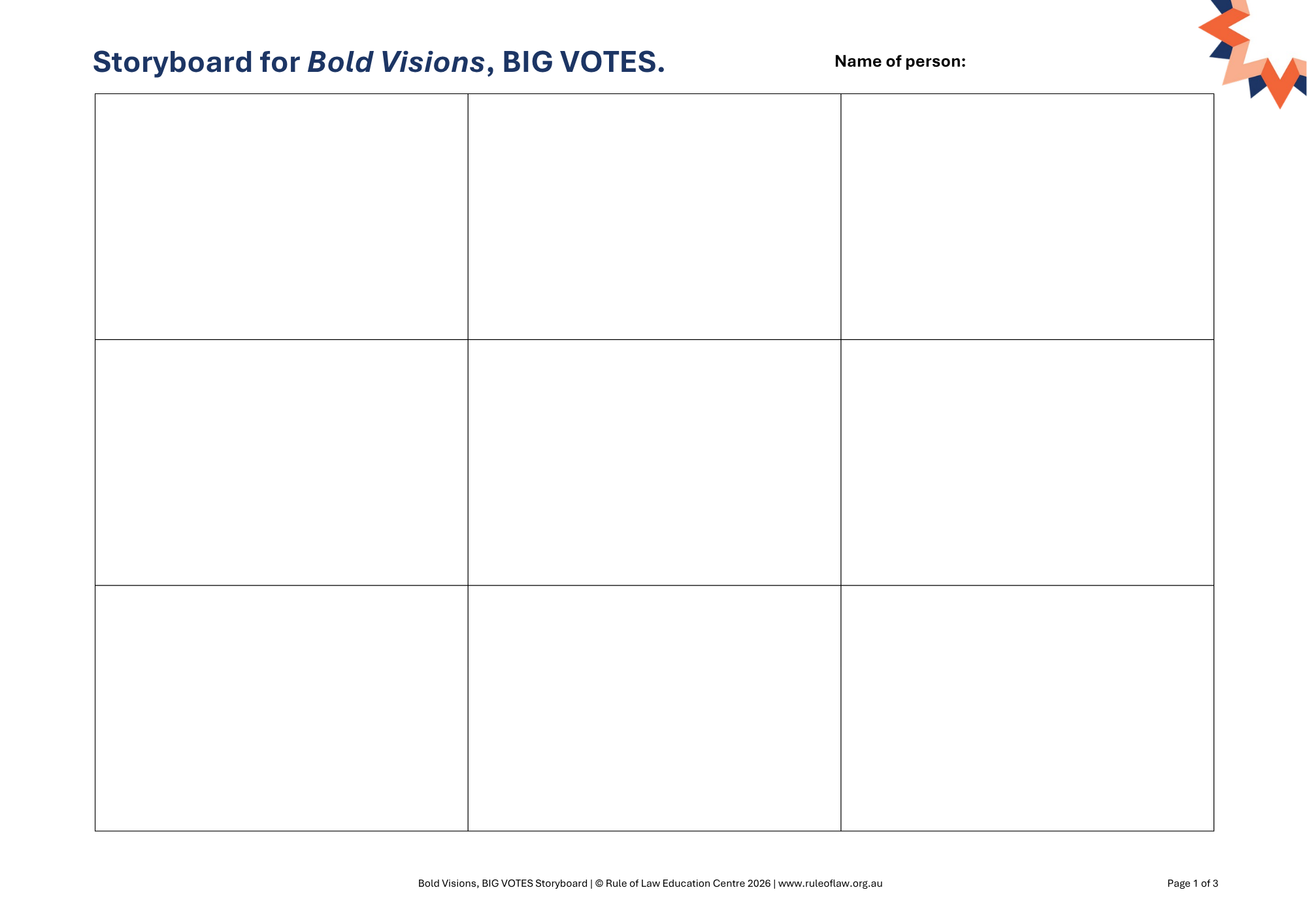
Using the series Little People, BIG DREAMS as inspiration, students create their own series of a key Australian Women and Aboriginal and Torres Strait Islander Peoples involved in obtaining voting rights: Bold Visions, BIG VOTES.
Students are allocated a person and:
a) Research their life, motivations, actions, and legacy
b) Draw storyboards of their person’s story in the same format as the Little People, BIG DREAMS books.
c) Can be published into individual books.
| Women | Aboriginal & Torres Strait Islander People |
|---|---|
| Mary Lee Catherine Helen Spence Mary Colton Vida Goldstein Louisa Lawson Rose Scott Maybanke Anderson Edith Cowan Emma Miller |
Joe McGinness Pearl Gibbs Sir Douglas Nicholls William Cooper Joyce Clague George Abdullah Dulcie Flower Dr Faith Bandler AM Oodgeroo Noonuccal (Kath Walker) |
Differentiation / Adjustments: In pairs
Resources: Little People, BIG DREAMS books as inspiration: Emmeline Pankhurst is a good example; Storyboard for Bold Visions, BIG VOTES- print at A3
Assessment:
Reflection on visit by Minister of Parliament. What did you learn? Write at least 3 interesting facts about the MP. What other questions would you like to ask them if you had another opportunity?
Differentiation / Adjustments: Independent reflection
Resources: Student book
Extension work: Freedoms
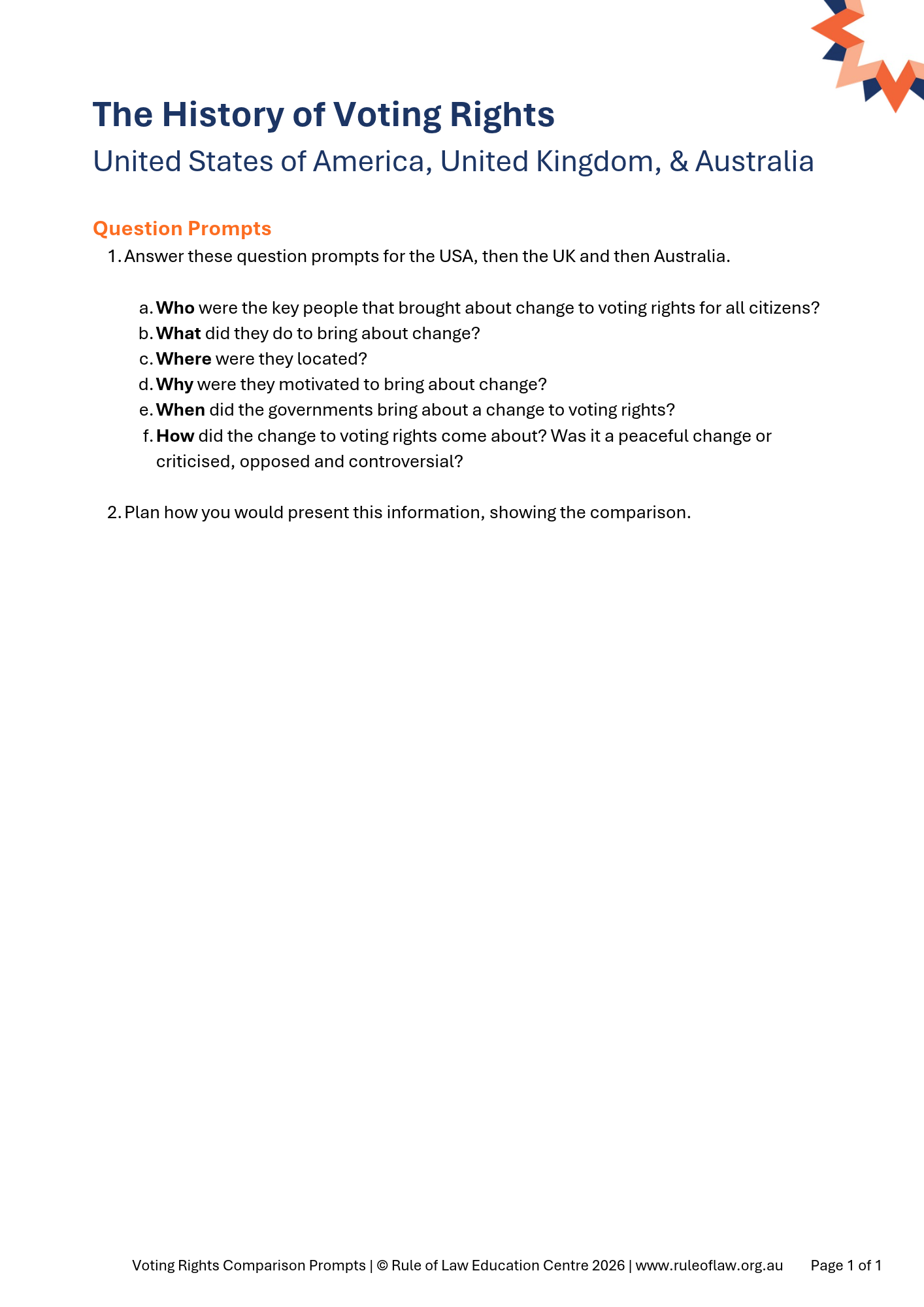
Compare the history of voting rights in the United Kingdom and the USA with Australia. Use the following prompts to find information:
Answer these question prompts for the USA, the UK and Australia.
WHO? Who were the key people that brought about change to voting rights for all citizens of the USA and the UK?
WHAT? What did they do to bring about change?
WHERE? Where were they located?
WHY? Why were they motivated to bring about change?
WHEN? When did the USA and UK bring about change to voting rights?
HOW? How did the change to voting rights come about? Was it peaceful change or criticised, opposed and controversial?
2. Choose how you would present this information to show comparison
Differentiation / Adjustments: Extension activity: CONTENT, PROCESS; Personalisation in PRODUCT – choice in how students want to present information
Resources: Question prompts
Key Words: preferential, compulsory, roles, responsibilities, participate, voting rights, referendum, campaign, voting age
People in Australia have democratic roles and responsibilities
- Describe the ways people can participate in democracy in Australia
- Research how voting rights for Aboriginal and Torres Strait Islander Peoples and women were obtained in Australia using timelines to sequence key events
Related Resources
-
-
A summary of the key arguments for and against Federation in Australia, including support for unified defence, emerging nationalist ideas, immigration control, and economic disagreements. It also outlines major developments from the 1880s to 1901, from the Federal Council and Tenterfield Oration to the Conventions, referendums, and final passage of the Constitution.
Explore Related Topics
-
Federation of Australia
Explore resources on Federation in 1901, outlining how Australia became a nation, divided powers, and established the constitutional structures and institutions that govern today.
-
Democracy
Explore resources on democracy, highlighting how accountability and representative institutions ensure power is exercised fairly and transparently through open processes, civic engagement and responsible governance.
-
Human Rights
Explore resources on human rights and freedoms, outlining the key protections, legal frameworks, that support rights, and explore how rights and responsibilities are balanced against government power in Australia.