
Civics: Democracy Year 5-6
-
A Year 5–6 civics and citizenship teaching program exploring Australian citizenship, rights and responsibilities, representative democracy, freedoms, and active participation in Australian society.
-
A Year 5–6 civics and citizenship teaching program investigating Australian symbols, emblems and national identity, including how they have changed since Federation.
-
A Year 5–6 civics and citizenship teaching program introducing democracy, Australian values, governance structures and government systems from around the world.
-
A Year 5–6 civics and citizenship teaching program exploring Magna Carta, the Rule of Law, equality before the law and the principles of justice.
-
A Year 5–6 civics and citizenship teaching program examining how bills become laws, the role of Parliament and Australia's bicameral system of government.
-
A Year 5–6 civics and citizenship teaching program exploring the roles and responsibilities of local, state and federal governments in Australia.
-
A Year 5–6 civics and citizenship teaching program investigating voting, civic participation, freedoms and the history of voting rights in Australia.
-
A Year 5–6 civics and citizenship teaching program exploring Federation, the Australian Constitution and the development of Australia's democratic system of government.
-
A Year 5–6 civics and citizenship teaching program consolidating learning about citizenship, democracy, government, laws and the Australian Constitution.
-
A Year 5–6 civics and citizenship teaching program investigating significant Australians and their contributions to the Commonwealth, democracy, society and Australia's development as a nation.
Teaching program – Week 9: Unit summary & assessment
- To demonstrate understanding of the topics studied in this unit
Modelled reading: “There’s a prawn in Parliament House” by Annabel Crabb
Differentiation / Adjustments: Whole class
Resources: “There’s a prawn in parliament house” by Annabel Crabb
Introduction:
What are the building blocks of Australia’s democracy?
Differentiation / Adjustments: Whole class discussion
Resources: N/A
Activity 1: Tug-of-War Visible Thinking Routine
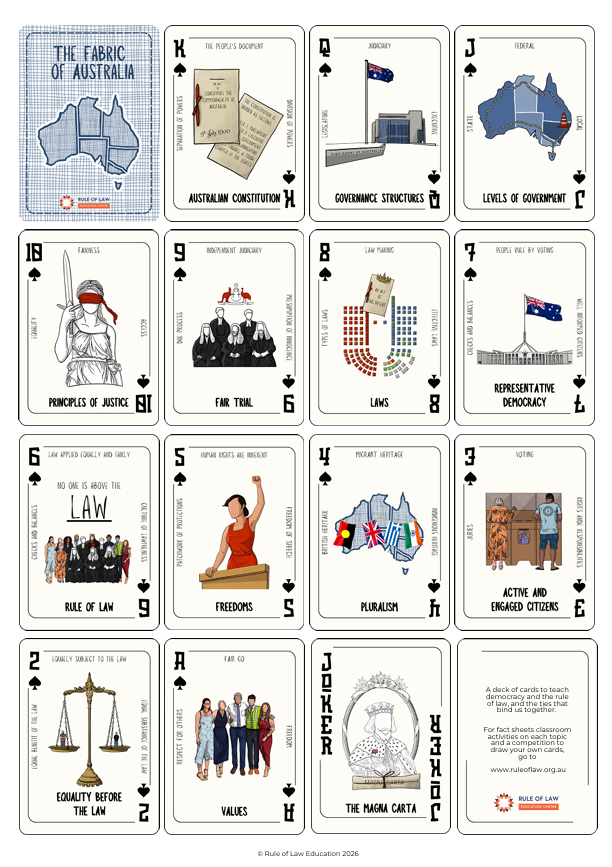
In pairs, students are given a box and the name of a ‘building block’. Names include:
Australian Constitution
Governance Structures
Levels of Government
Principles of Justice
Fair Trial
Laws
Representative Democracy
Rule of Law
Freedoms
Pluralism
Active and Engaged Citizens
Equality before the Law
Values
The Magna Carta
On each of the 4 sides (not on bottom or top side) write:
Side 1: The name of the ‘building block’
Side 2: Definition
Side 3: Example/s In Australian Democracy
Side 4: Paste picture of Poster
As a whole class stack the building blocks – thinking about having firm foundations.
What should be at the bottom/foundational building blocks of our democracy?
At the top?
Why /why not?
Makes a great visual 3D display.
Differentiation / Adjustments: Whole class discussion; in pairs
Resources: 14 boxes that large enough for the information, to stack and make a visual impact; Can also use nets to make 3D shapes – cubes and rectangular prisms; Fabric of Australia Posters – reduced in size to fit on 3D blocks/boxes (coming soon)
Discussion:
Why was it necessary to become a federated nation? How different would Australia look today of we didn’t become a federation?
Differentiation / Adjustments: Whole class discussion
Resources: N/A
Activity 2:
Using the Fabric of Australia posters – as a whole class order from most important to least important in Australia’s democracy. Line up on floor. Is it possible to do so? Are some more important than others?
Differentiation / Adjustments: Whole class
Resources: Fabric of Australia posters
Discussion/Activity 3:
Summarising unit topics through discussion questions:
Put the topic and corresponding questions onto separate pieces of butchers paper.
In groups of 3, students move from poster (butchers paper) to poster as a carousel answering the question/s and writing their ideas.
Students move all at the same time, so only one group is at each poster at one time.
At the end, as a whole class, discuss ideas written on each poster.
Topic/Question:
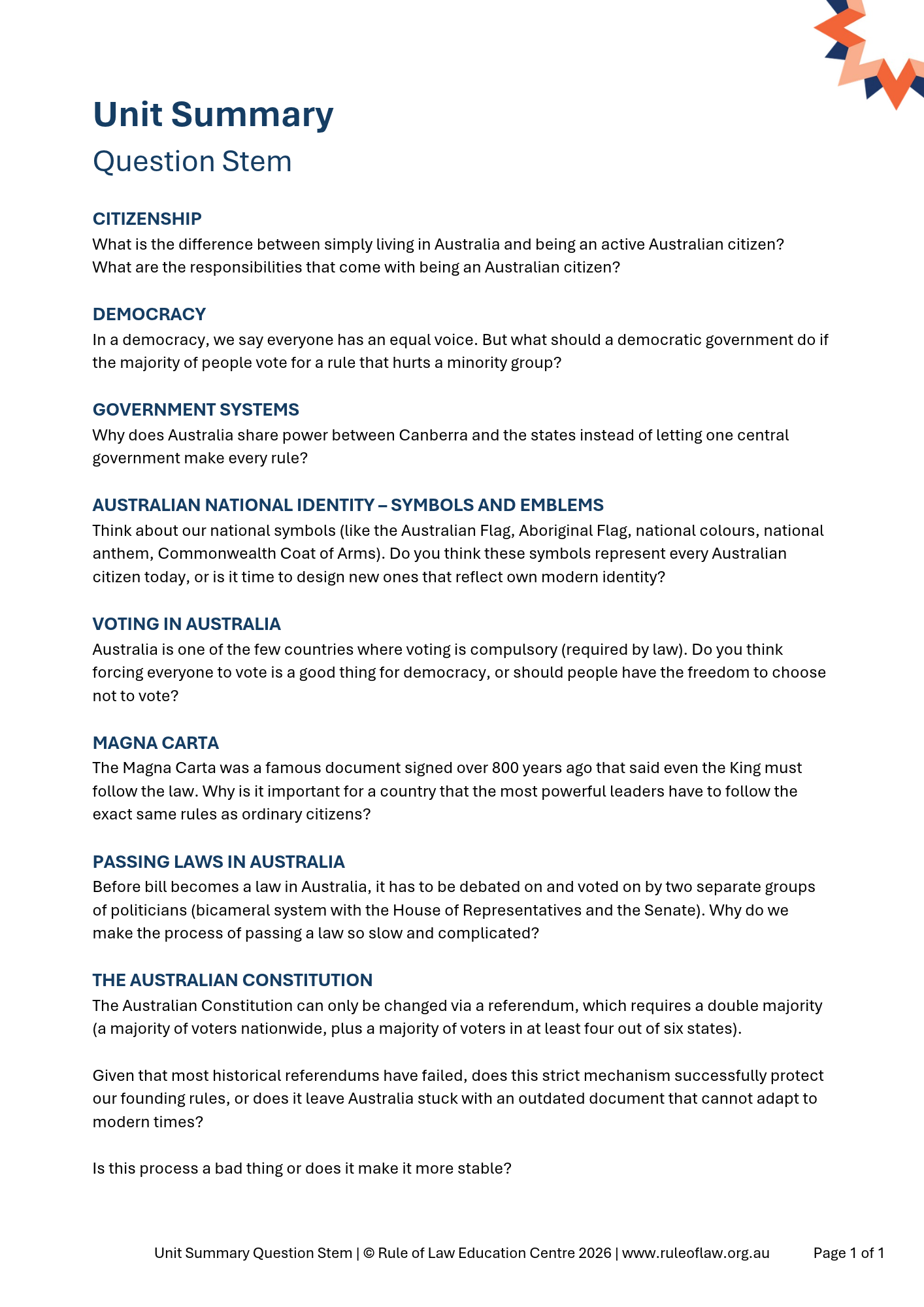
Citizenship: What is the difference between simply living in Australia and being an active Australian citizen? What are the responsibilities that come with being an Australian citizen?
Democracy: In a democracy, we say everyone has an equal voice. But what should a democratic government do if the majority of people vote for a rule that hurts a minority group?
Government Systems: Why does Australia share power between Canberra and the states instead of letting one central government make every rule?
Australian National Identity – Symbols and Emblems: Think about our national symbols (like the Australian Flag, Aboriginal Flag, national colours, national anthem, Commonwealth Coat of Arms). Do you think these symbols represent every Australian citizen today, or is it time to design new ones that reflect own modern identity?
Voting in Australia: Australia is one of the few countries where voting is compulsory (required by law). Do you think forcing everyone to vote is a good thing for democracy, or should people have the freedom to choose not to vote?
Magna Carta: The Magna Carta was a famous document signed over 800 years ago that said even the King must follow the law. Why is it important for a country that the most powerful leaders have to follow the exact same rules as ordinary citizens?
Passing Laws in Australia: Before bill becomes a law in Australia, it has to be debated on and voted on by two separate groups of politicians (bicameral system with the House of Representatives and the Senate). Why do we make the process of passing a law so slow and complicated?
The Australian Constitution: The Australian Constitution can only be changed via a referendum, which requires a double majority (a majority of voters nationwide, plus a majority of voters in at least four out of six states). Given that most historical referendums have failed, does this strict mechanism successfully protect our founding rules, or does it leave Australia stuck with an outdated document that cannot adapt to modern times? Is this process a bad thing or does it make it more stable?
Differentiation / Adjustments: Groups of 3; Whole class
Resources: Butchers Paper; Question Stems
Summative Assessment:
Differentiated activity to gauge understanding of content.
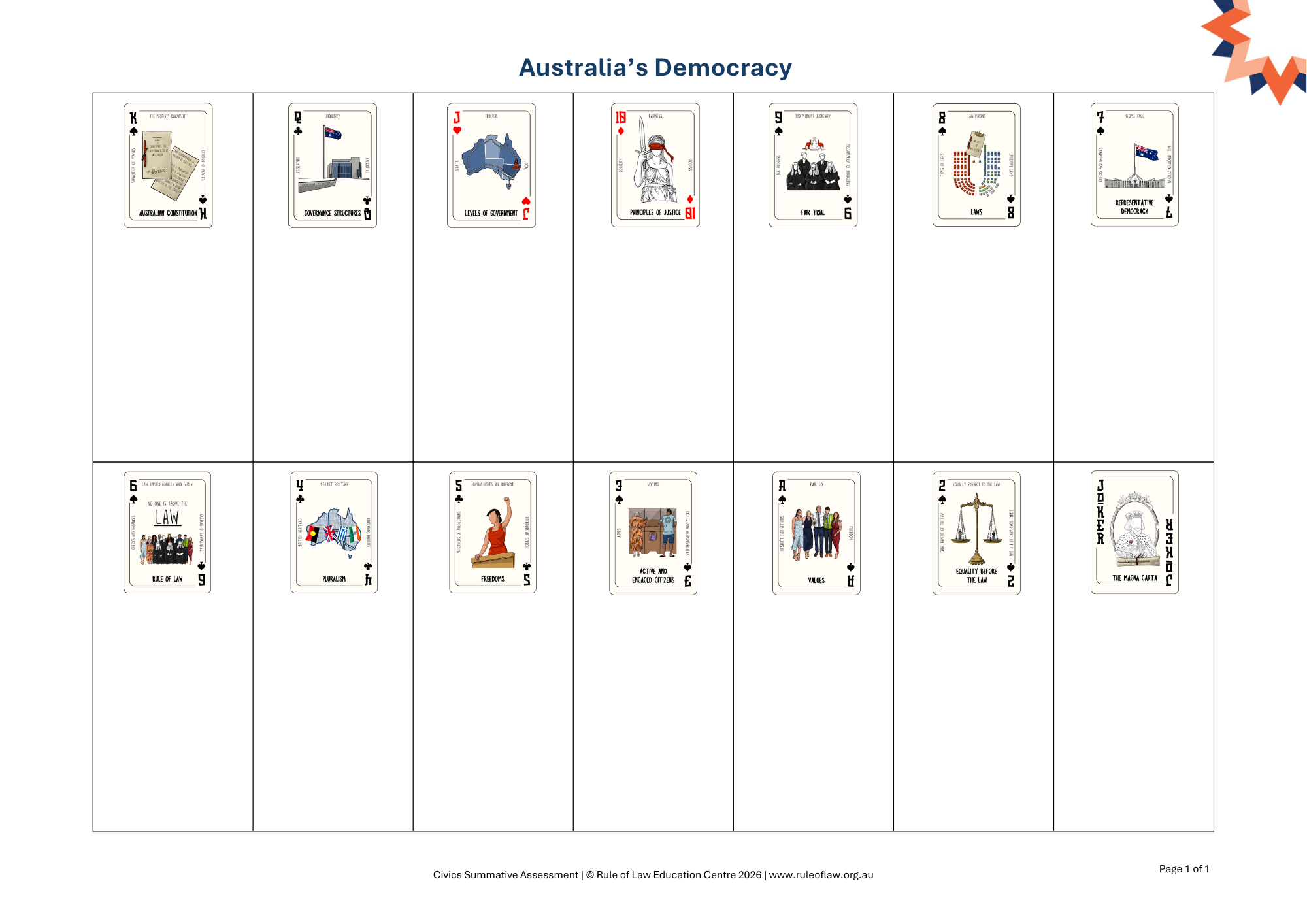
Write a summary of what each of the fabric of Australia posters is about underneath the picture.
Scaffold – Cut out posters and put a strip of glue across the top of each and pastes onto the correct definition.
Extension – extra examples need to be given for each poster and explanation of how it applies to Australia’s democracy.
Differentiation / Adjustments: Independent; Vary time given to complete task; Differentiated
Resources: Summative assessment worksheets – enlarge to A3 to allow for detail in responses
Related Resources
-
-
A summary of the key arguments for and against Federation in Australia, including support for unified defence, emerging nationalist ideas, immigration control, and economic disagreements. It also outlines major developments from the 1880s to 1901, from the Federal Council and Tenterfield Oration to the Conventions, referendums, and final passage of the Constitution.
Explore Related Topics
-
Federation of Australia
Explore resources on Federation in 1901, outlining how Australia became a nation, divided powers, and established the constitutional structures and institutions that govern today.
-
Democracy
Explore resources on democracy, highlighting how accountability and representative institutions ensure power is exercised fairly and transparently through open processes, civic engagement and responsible governance.
-
Human Rights
Explore resources on human rights and freedoms, outlining the key protections, legal frameworks, that support rights, and explore how rights and responsibilities are balanced against government power in Australia.