
The Magna Carta
-
Magna Carta established enduring principles that limit government power and require rulers to act according to law. Although created in 1215, its ideas continue to shape modern legal systems, influencing constitutional government, democratic accountability, and the expectation that power must be exercised lawfully and fairly.
-
Magna Carta contributed foundational ideas to human rights, including due process, lawful judgment, and protection from arbitrary imprisonment. While initially applying to a narrow elite, these principles expanded over time and now underpin modern human rights frameworks in domestic law and international agreements.
-
Magna Carta promoted the principle that no one is above the law, including the monarch. It helped inspire systems of checks and balances by limiting executive power, strengthening courts, and supporting institutional restraints that prevent the concentration and abuse of political authority.
-
The Kable case demonstrates how equality before the law developed in early Australia. The case confirmed that all individuals, regardless of background or status, were entitled to the same legal protections, reinforcing a key principle inherited from Magna Carta within Australian law.
-
One page Fact Sheet summarising key concepts about the Magna Carta. Can be used as part of Informed Civics Competition. The Magna Carta introduced the concept of equality before the law, independent judiciary, checks and balances on power and judgement before your peers.
-
Magna Carta promoted the principle that no one is above the law, including the monarch. It helped inspire systems of checks and balances by limiting executive power, strengthening courts, and supporting institutional restraints that prevent the concentration and abuse of political authority.
Magna Carta and Human Rights
Overview
The true power of the Magna Carta lies in its impact on human rights documents, and the creation of the rule of law and a respect for individual’s rights by those in power.
What has the Magna Carta got to do with human rights?
The Magna Carta, which is Latin for The Great Charter, was a list of demands and expectations forced on the evil King, John of England in 1215. King John was so evil, he heavily taxed his people, arbitrarily took their possessions and threw them into prison for the slightest reason.
By sealing the Magna Carta, King John was agreeing to follow the laws of the land. It gave the people a mechanism to limit the power of the King and assert their rights.
The Magna Carta established the rule of law and the idea that all citizens, including those in power, should be fairly and equally ruled by the law. It began the tradition of respecting the law, limiting government power, providing access to justice and the protection of human rights.
Its legacy continues to underpin key constitutional documents and human rights instruments around the world.
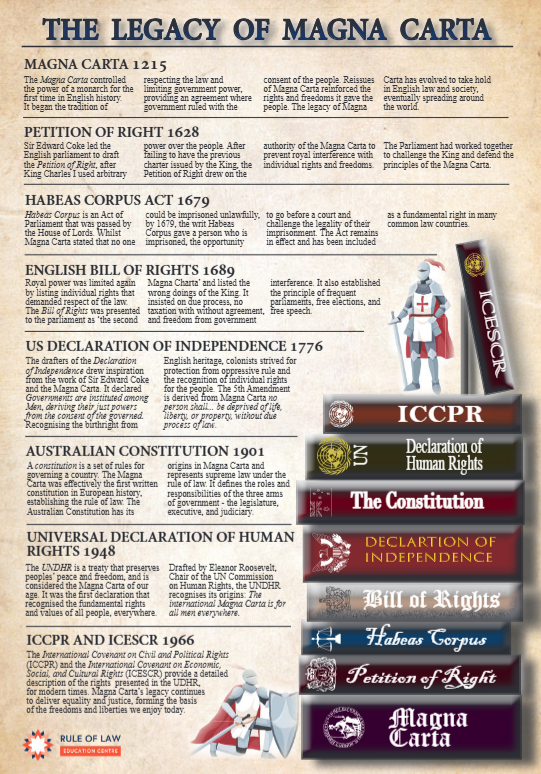
The Legacy of the Magna Carta in Human Rights Documents
The spirit of the Magna Carta played a critical role in the formation of modern human rights documents.
Many of these documents have built on the legacy of the Magna Carta and detail in writing the inalienable rights of individuals as pertinent at the time.
-
To fund his war in Spain, King Charles I forced his people to loan him money- and those who refused were thrown in jail. Sir Edward Coke and the English parliament were not happy!
To get King Charles I to re-commit to observe the rule of law, they drafted the Petition of Right, reminding King Charles I of their rights under the Magna Carta. The Petition was considered a ‘true exposition of the Great Charter’ as it confirmed the people’s rights such as:
no taxation without consent of Parliament
no imprisonment without a cause
It became an Act of Parliament in 1628 and is regarded as a Constitutional document of the UK.
-
Fearing that King Charles II’s successor might disregard their liberties, the English parliament passed the Habeas Corpus Act in 1679.
Whilst the Magna Carta stated that no one could be imprisoned unlawfully, by 1679, the writ Habeas Corpus gave a person who is imprisoned the opportunity to go before a court and challenge the legality of their imprisonment. Habeas Corpus means ‘bring out the body’ ie an order compelling the jailer/king/State to bring the prisoner to court to explain why they are held captive and if no legal reason is found, they must be released.
The Act remains in effect and has been included as a fundamental right in many common law countries.
-
After authoritarian King James II fled to France in 1688, Parliament required the next King, future King William III (and wife Mary), assent to the Bill of Rights before they could take the Crown.
The Bill of Rights was presented to the parliament as ‘the second Magna Charta’ to preserve the ancient rights and liberties of the nation. It listed the wrong doings of King James II and echoed the Magna Carta with its insistence on due process, no taxation without agreement, and freedom from government interference. It also established the principle of frequent parliaments, free elections, and free speech within parliament. The main principles are still in force today and is considered a Constitutional document of England. The Bill of Rights became a model for the US Bill of Rights and UN Declaration of Human Rights.
-
The drafters of the US Declaration of Independence, Constitution and Bill of Rights wanted to recognise the same rights as they had in England and strived for protection from oppressive rule through checks on government power. They drew inspiration from the English legacy of Sir Edward Coke’s Petition of Right and the Magna Carta. It declared Governments are instituted among Men, deriving their just powers from the consent of the governed. The 5th Amendment to the Constitution (part of the Bill of Rights) is derived from Magna Carta ‘no person shall… be deprived of life, liberty, or property, without due process of law.’
-
The legacy of the Magna Carta, instilled in English law, came as part of the ‘invisible cargo’ with the First Fleet on settlement in Sydney Cove in 1788. The Magna Carta formed the basis of the vision that all Australians would be treated consistently and fairly under the law.
With the First Charter of Justice came the start of the rule of law and Courts that provided, in a limited way, the birthrights and liberties that were inspired by the Magna Carta.
The Australian Constitution came into effect in 1901 and was based upon the rule of law, with the separation of powers to provide a check on government power and protect the rights of the people.
As stated by Hon Susan Crennan AC QC, former Justice of the High Court of Australia in her speech ‘Magna Carta, Common Law Values and the Constitution’:
“The Australian Constitution, a law of the Imperial Parliament, was not drafted in the context of any rupture, war or revolt against the supremacy of Westminster. It contains no Bill of Rights which prevents the legislature from passing laws that infringe such rights. It is readily distinguishable from the American Constitution, not least because it contains nothing equivalent to the guarantees of due process to be found in the Fifth and Fourteenth Amendments. The distinct features of the Australian Constitution blend three aspects of political and constitutional theory: responsible government derived from the British constitutional tradition; the separation of powers derived from the American Constitution; and our own local, colonial understandings of democratic theory and principles. It was obvious from the start that, although the Constitution contains no specific provisions for judicial review ensuring the constitutional validity of laws, the framers plainly intended that the High Court should, as Alfred Deakin put it, decide “the orbit and boundary of every power.”
-
The UNDHR is a treaty that preserves peoples’ peace and freedom and is considered the Magna Carta of our age. It was the first declaration that recognised the fundamental rights and values of all people, everywhere. Drafted by Eleanor Roosevelt, Chair of the UN Commission on Human Rights, the UNDHR recognises its origins: ‘The international Magna Carta is for all men everywhere.’
-
The International Covenant on Civil and Political Rights (ICCPR) and the International Covenant on Economic, Social, and Cultural Rights (ICESCR) provide a detailed description of the rights presented in the UDHR, for modern times. The legacy of the Magna Carta can be seen in many of the clauses.
For example Article 9 of the ICCPR aligns with clause 40 of the Magna Carta and due process:
Anyone arrested or detained on a criminal charge shall be brought promptly before a judge or other officer authorised by law to exercise judical power and shall be entitled to trial within a reasonable time or to release.
Article 2 of the ICESCR relates to the Magna Carta and the rule of law generally:
The States Parties to the present Covenant undertake to guarantee that the rights enunciated in the present Covenant will be exercised without discrimination of any kind as to race, colour, sex, language, religion, political or other opinion, national or social origin, property, birth or other status.
Magna Carta’s connection to human rights is the establishment of enduring principles that restrain power and demand justice according to law. Its influence can be traced through centuries of legal and political battles in England, shaping ideas of due process, equality before the law and accountable government. These principles continue to inform contemporary human rights protections in the international arena, reminding societies that liberty depends on lawful limits to authority.
Related Resources
-
One page Fact Sheet summarising key concepts about the Magna Carta. Can be used as part of Informed Civics Competition. The Magna Carta introduced the concept of equality before the law, independent judiciary, checks and balances on power and judgement before your peers.
-
This classroom activity looks at legacies and how they shape society. It includes short questions on a video about the Magna Carta in Australia and then extends students to consider where the rights from Magna Carta can be seen in modern Human Rights documents today.
Explore Related Topics
-
What is the Rule of Law?
Explore resources explaining the rule of law, showing how a collection of principles works to limit government power and protect rights through clear rules, accountability and fairness.
-
Checks and Balances on Power
Explore resources on checks and balances, explaining how oversight limits power and ensures decisions remain lawful and accountable through independent scrutiny and transparent review processes.
-
Democracy
Explore resources on democracy, highlighting how accountability and representative institutions ensure power is exercised fairly and transparently through open processes, civic engagement and responsible governance.